

Some no start problems are hiding in plain sight, and some are hiding at the bottom of the gas tank. A shop that took in a car that would not start dropped the fuel tank, and what came out of it explained everything in a matter of seconds.
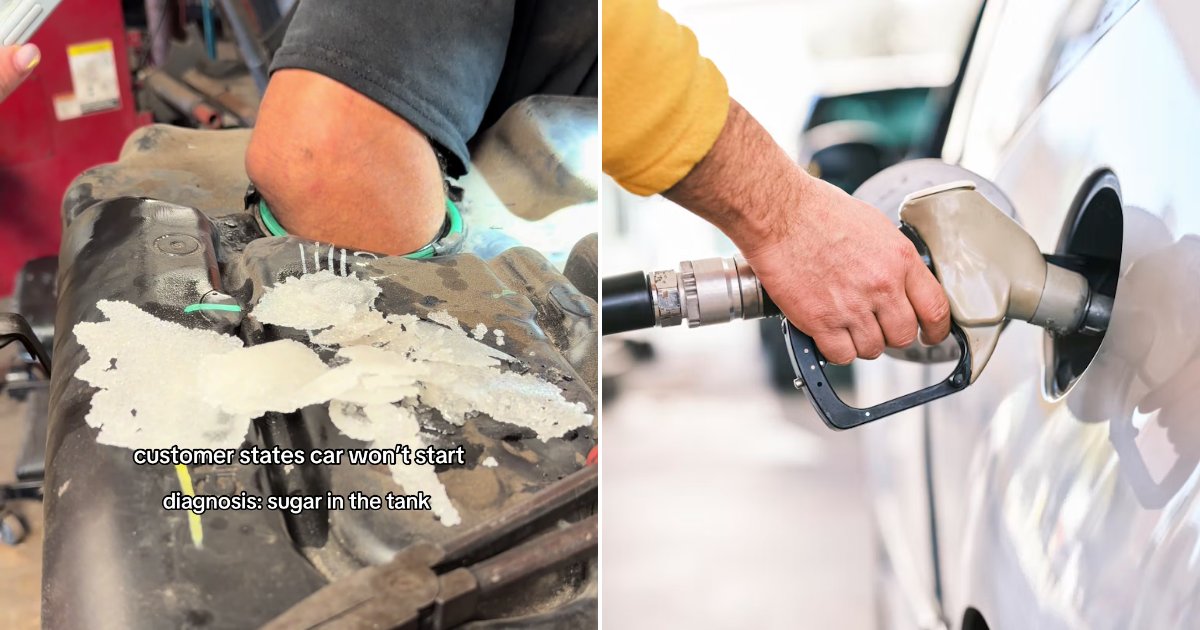
The work order read simply that the customer states the car will not start, with a diagnosis of sugar in the tank. It is a short job to describe and a strange one to see, because the evidence is right there in the mechanic’s hands.
The shop behind this story is run by @familyautosrq, and the scene plays out in an ordinary repair garage while the mechanic works.
@familyautosrq
What the mechanic found inside the tank
With the fuel tank already off the vehicle, the mechanic reaches deep into the opening and starts pulling out white, slushy, crystallized sheets. He piles them on top of the tank as he goes, and the pile keeps growing. At one point he points it out in plain words, saying to look at that, sugar in the gas tank.
Looking straight down into the opening, the remaining liquid is a murky greenish yellow, nothing like the clear fuel you would expect to see in a healthy tank. There is no dramatic narration, just shop noise, tools clinking and fluid sloshing around while the mechanic makes his point with his hands.
No explanation is offered for how the material got there, so the sensible takeaway is the mechanical one: a no start complaint can come from something far outside the usual suspects.
Why contamination in the tank can stop an engine
A fuel system is built around a simple idea. A pump pushes clean fuel through a filter and lines to the injectors, which spray a precise amount into the engine. Anything solid that does not belong in that path can clog the pickup screen, the filter or the tiny passages in the injectors, and once the engine cannot get enough fuel it will not start or will stall.
Foreign material is also hard on the fuel pump itself. Most modern pumps sit inside the tank and rely on the fuel flowing around them for cooling and lubrication, so a pump forced to pull thick, dirty liquid through a blocked screen can wear out far sooner than normal. That is one reason a shop will often remove and clean the tank instead of only swapping a filter.
There is an old belief that sugar dissolves in gasoline and wrecks the inside of an engine. Mechanics generally describe the more realistic problem as undissolved particles that clog filters, screens and pumps. Either way, the right answer is the same: do not keep trying to start the car and let a qualified professional inspect it.
Why dropping the tank is a big job
Taking a fuel tank out of a car is not a quick task, and that is part of why the shop in this story chose to do it only after the evidence pointed that way. On many vehicles the tank sits underneath the rear of the car, held up by straps, with a filler neck, vapor lines, fuel lines and an electrical connector for the pump all attached. A technician typically has to lower the fuel level first, disconnect each of those parts, support the tank and bring it down in one piece. Fuel is flammable and the work calls for good ventilation, the right tools and a clear area free of ignition sources, which is why it belongs in a shop and not in a driveway.
Once the tank is out, a good shop can look inside, flush it and decide whether it can be cleaned or has to be replaced. That decision often depends on how much material is stuck to the walls and whether the tank design makes it hard to reach every corner.
Other things that make a car refuse to start
Because a contaminated tank is rare, a good technician works through the more common causes first. The usual list looks like this:
- A weak or dead battery, or corroded battery terminals that cannot carry enough current.
- A failed starter or a bad starter relay.
- A fuel pump that is not running, which you can sometimes hear as a faint hum when the key is turned on.
- A clogged fuel filter or a restricted fuel line.
- A failed crankshaft or camshaft position sensor, which can leave the engine computer without a signal to time spark and fuel.
A shop typically confirms three basics, which are fuel, spark and air, before it removes anything heavy. Dropping a tank is labor intensive, so it usually happens only after simpler tests point that way, such as a fuel pressure reading that is low or absent.
What else usually gets replaced afterward
When a tank has held contamination, cleaning the tank is only part of the repair. A shop will often replace the fuel filter, inspect or replace the pump and its pickup screen, and flush the fuel lines so nothing left behind can travel to the engine. Depending on how far the material reached, the injectors may also need cleaning or testing. Owners should ask for an itemized estimate and have the technician explain which parts were affected and which were replaced as a precaution. Keeping the old parts to look at is a fair request at most shops.
What to do if you suspect bad fuel
If a car that ran fine suddenly will not start, and especially if the fuel gauge or the way it died suggests something odd, there are a few sensible steps to take before spending money.
- Stop cranking the engine repeatedly, since that can push more debris into the pump and filter and wear the starter.
- Do not add random additives hoping to fix it. Additives are designed for normal fuel, not for solids.
- Have the vehicle towed to a shop instead of driving it, if it does run roughly.
- Tell the technician exactly what happened and when the problem started, because those details shorten the diagnosis.
Fuel is flammable, and a tank is not something to remove in a driveway without the right tools, ventilation and training. This is a job for a qualified mechanic.
Early signs of a fuel problem
Many fuel system problems announce themselves before the car refuses to start. Watch for these clues and mention them to your mechanic if they show up.
- The engine hesitates, sputters or surges when you accelerate.
- The car stalls at idle or struggles to restart soon after a drive.
- Fuel economy drops without an obvious reason.
- The engine takes longer than usual to catch when you start it.
- The check engine light comes on with a fuel or misfire code.
How owners can lower the risk
Nothing makes a vehicle completely immune to tampering or accidents, but a few habits help. A locking gas cap is cheap and is a visible deterrent. Parking in a well lit spot or a garage when you can, and glancing at the fuel door and cap when you return, are easy routines. If the cap is ever loose, damaged or missing when it should not be, treat that as a reason to have the car checked before the next long drive.
If you ever suspect someone has put something in your tank on purpose, do not start the car. Call a tow service and report it, because a car that has not been run is much easier and cheaper to repair than one that has pulled contaminated fuel through the whole system.
Questions owners often ask
Will my insurance cover something like this? That depends on your policy and on how the damage happened, so contact your insurer before authorizing a large repair and ask what documentation they need.
Can a shop just filter the fuel and keep going? For light contamination, draining and replacing the fuel and the filter may be enough. When solids are as heavy as the ones pulled out here, the tank usually has to come out so it can be cleaned properly.
How can I tell if the repair was done right? Ask what was cleaned and what was replaced, and watch for the car to start easily, idle smoothly and hold steady fuel pressure afterward.
The bigger lesson is patience. When a car gives no sign of life, the cause can be as ordinary as a battery or as strange as what came out of this tank, and the only way to know is to test and look.
Credit for the original post goes to @familyautosrq on TikTok.
More from Steel Horse Rides
- Creator Rescued And Attempted To Start A 1971 Citroen DS21 That Had Been Sitting Completely Untouched Inside A Belgian Barn Since All The Way Back In 2005
- Fabricator Built His Own Homemade Metal Tool Specifically To Break Apart A Motorcycle Chain Link Instead Of Ever Buying A Specialty Breaker
- Flipper Paid Only Eight Hundred Dollars For A 2004 Honda Pilot At A Public Auction And Is Letting Total Strangers Online Decide If He Overpaid Or Scored A Steal