

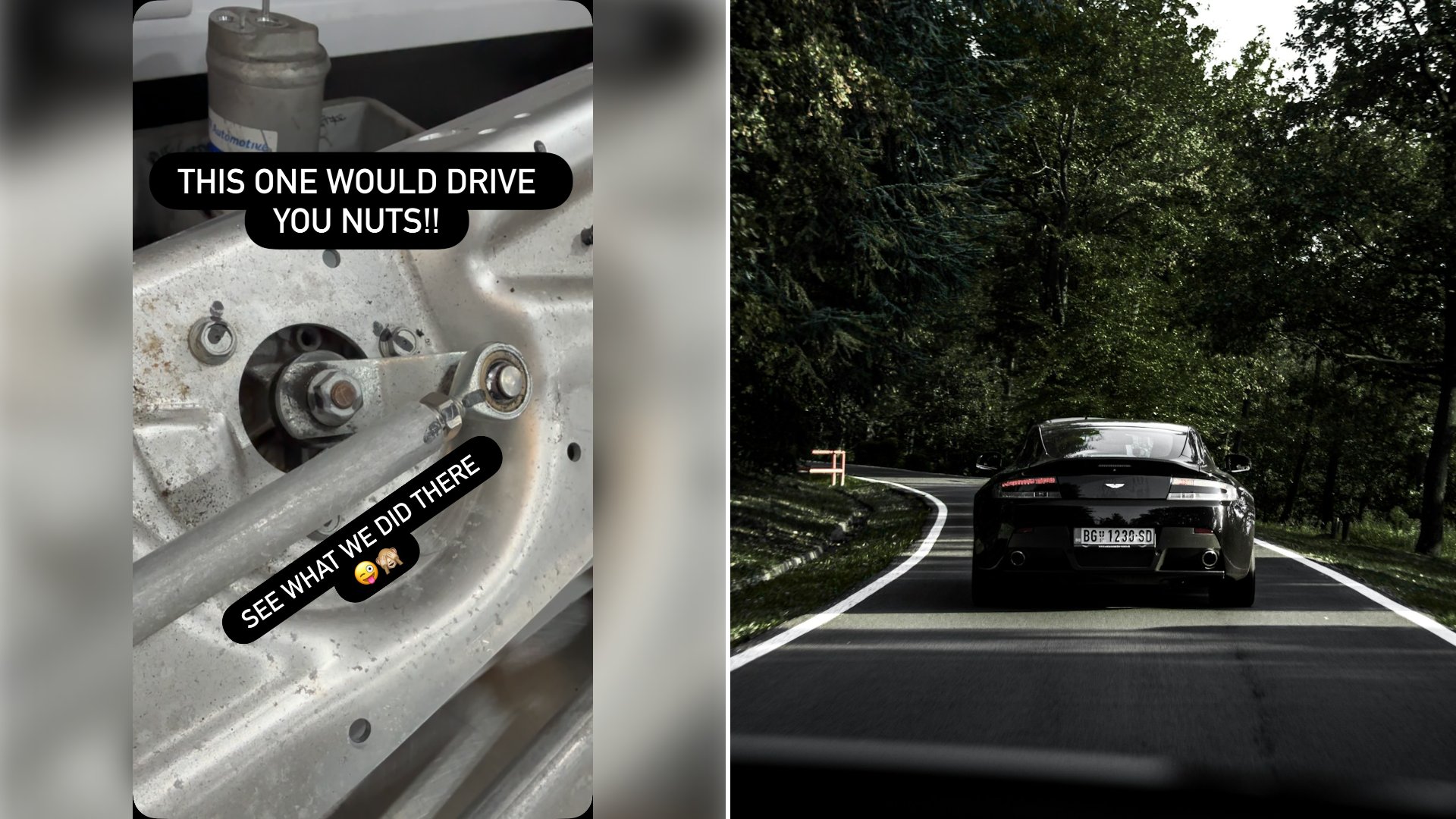
The caption on a reel from @davidapplebyengineering reads like a complaint from the workbench: “A crazy design by Aston Martin means there is only one way to fix this customers loose nut….” The hashtags tag the car as an Aston Martin Rapide, name the shop as an independent Aston Martin specialist and finish with “smallproblembigfix.” The clip itself has no on screen text and no burned in captions, so what follows is what the pictures show.
It opens inside the engine bay with the hood up. A handheld inspection camera on a flexible cable is fed down between the fuel rails and wiring, and its small screen shows a view of metalwork deep below the engine. The shots cut between the screen and the bay, then to the underside of the car, where a bare metal area with a hole and a cluster of lines and pipes is shown from below.
Then the job gets bigger. The car is shown raised on a lift with a technician working beneath it, and a separate shot shows a heap of removed drivetrain parts sitting on a workshop cart in the middle of the floor. Another view looks up into the empty space under the front of the car where those parts used to sit, with lines, brackets and a subframe exposed.
The last stretch of the video moves to the top. Under the open hood, at the base of the windscreen, a technician in a blue shirt leans over the cowl area and reaches into a metal linkage assembly. The final frames close in on a pivot with a nut on it, and a spanner turns the nut. The caption calls this the customer’s loose nut.
The reel does not say how long the job took, what the customer was charged, or what the nut held. It does not show the repair finished or the car being driven. The only claim it makes in words is the caption’s, that the layout of the car left one way in. The pictures show a lifted car and a cart of removed parts before the nut comes into view.
That gap between a small part and a large bill is worth understanding before a quote lands. The Federal Trade Commission’s auto repair guide tells owners to ask how a shop prices labor, either a flat rate based on published time estimates or the actual time the technician spends, and to get a written estimate that names the condition, the parts and the expected labor charge. It says the shop should agree to contact you for approval before going over a stated amount of time or money.
California’s Bureau of Automotive Repair guide makes the same point with specific rules for that state. A shop must give a written estimate before any work, the estimate must itemize parts and describe the repair method, and if the job will cost more than the estimate the shop has to describe the added work and cost and get permission before it goes ahead. The guide also says you can take a car to another shop for a second opinion after you have the written estimate.
For an owner of a car like this, the practical question to put to a specialist is not only what is wrong but what has to come off to reach it. Ask for the repair method in writing, ask whether the labor is quoted as a flat rate or by the hour, and ask what happens to the price if the access work turns out to be larger than planned. A loose nut can be a quick fix on one car and an engine out job on another, and the estimate should say which one it is before the wrench comes out.
More from Steel Horse Rides
- Narrator of a Repair Clip Says a Car That Shook Every Time the Owner Hit the Gas Had an Engine Mount Cracked Clean in Half, Then Explains Why the Impact Wrench Is Not the Last Step
- Honda Dealership Mechanic Says He Would Not Pay to Fix a Tire Pressure Sensor Light, a Minor Oil Leak or an Old Car Repair That Costs More Than the Car Is Worth
- Buyer Says He Bought a 90K Mile Bentley Continental GTC Sight Unseen at Auction, Then Finds a Check Engine Light, a Parking Brake Failure and a Fuel Door That Won’t Open