

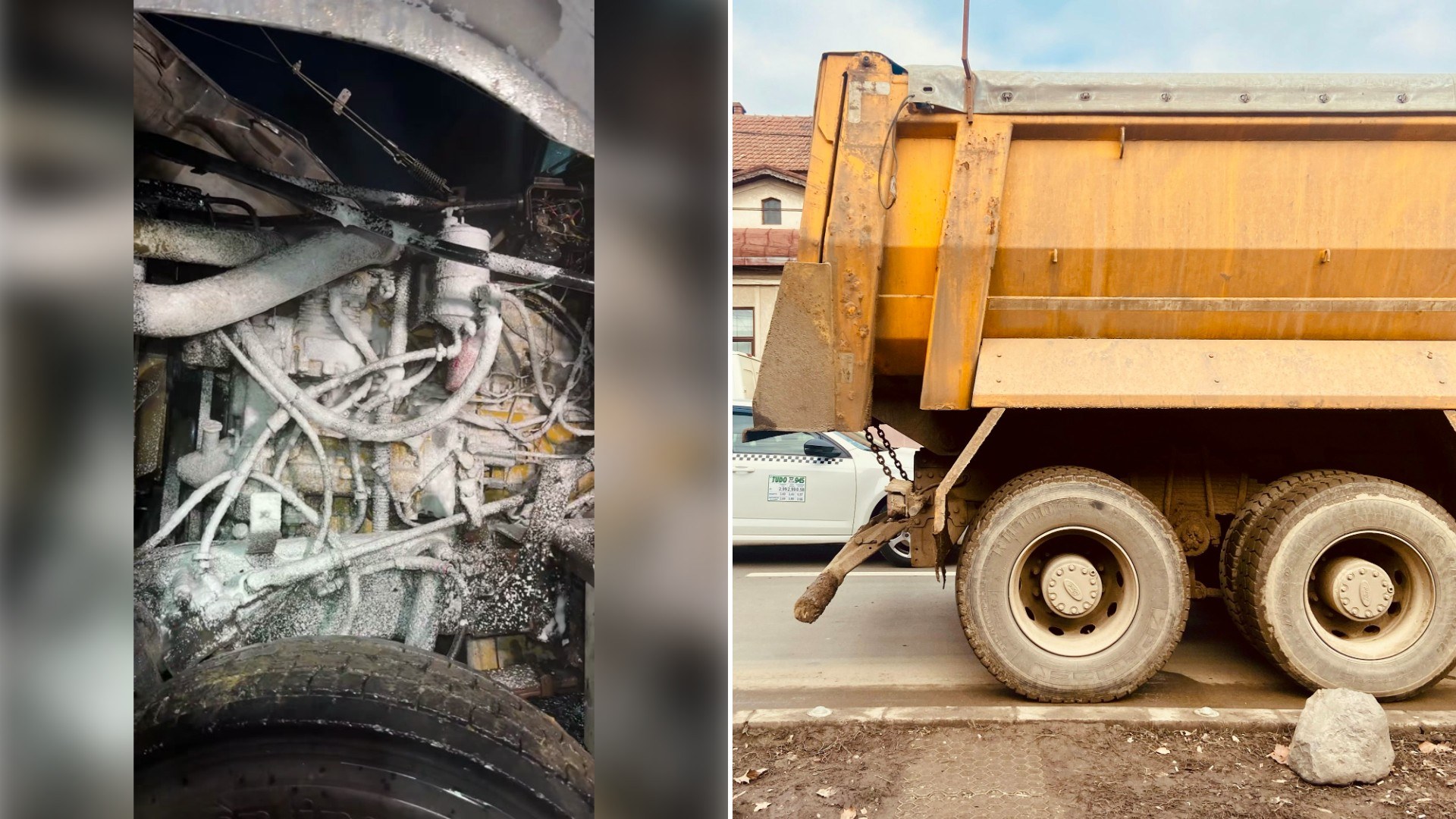
“I bought a very large dump truck project,” he says at the top of the video, “and today is the first step of getting this thing restored.” The first step does not involve a wrench. The truck was used off road at a rock quarry, and it shows. “This thing is just covered in this limestone dust and rocks,” he says. The cab door, the fuel tank and the steps below it all wear the same pale coat.
The video comes from @mark_decola, with the caption “The Ford dump truck gets the first step like every new project! This one is going to need to be done in stages though.” A label on screen says it in two words: “Clean Time!” And under the hood, he warns, “it is not any better.”
@mark_decola
“There was a yellow Cat 3406B engine under here,” he says. Between neglect and an oil leak, “you can’t even tell what color it was.” His first guess is an oil leak at the injection pump, and the whole side of the engine is coated. Someone before him made a custom flap to try to keep debris out, complete with a small access port for checking the oil. He decides it is coming off for now.
The cleaning is not cosmetic. “One of the first big issues on this thing is the Jake brakes don’t work,” he explains, and he cannot begin tracing the wiring until he can see the color of the wires or what he is chasing. So, as he puts it, “the first step with any project is we got to get this thing clean.” The tool is “the old fashioned pressure washer.” He admits, “this is where I really wish I had a Hotsy,” but the plan is to make up for it: “we’re going to use some aggressive degreasers today.”
The flap comes off first, then a second piece farther in. “But look at that,” he says. “We can actually see our engine and address our oil leaks.” Before any water hits it, he stops for pictures. “We have to get some good before shots because this is never going to look like this again. I can promise that.” He points out the electrical as an area to stay away from. A new air filter is on the list for later, so for now he covers the intake “to keep mud from blasting in here.”
Then the washing starts. “That completes phase one on this side of the motor,” he says after the first pass, and he is clear about how much that means. “We’re just trying to get the heavy stuff off.” Even so, parts are appearing that were buried, down to the brakes. “I couldn’t even see half of that before.”
For round two he tries “something a little more aggressive,” a battery powered foamer loaded with heavy duty degreaser. “We are going to foam the absolute heck out of this,” he says, with extra attention on the steering box, which is “really built up in there,” and the front of the engine. On the driver’s side he explains why he likes it. “It’s nice cause this foam will stick. You can lay it in all the nooks and crannies.” Then, “let’s let it marinate,” before the pressure washer takes it off.
The job finishes the way he says they all do. “As does every project, I swear, it ends in the rain, being absolutely soaked and covered, but ending up with a clean machine in the end.” His verdict is measured. “I’m not telling you this is a brand new Cat engine, but, holy cow, does that look way different.” The frame and the gearbox will need another round. The grease there, he says, was about an inch thick.
The wash also turned something up. “A little worried because I uncovered this,” he says. “That looks like a little bit of a roadside fix or something.” There is silicone on an injection line, and “I’m not sure how silicone would hold that.” On the other side the news is better. “You can see the paint underneath there.” Painting the engine would be a lot of work, he says, but “maybe if this thing proves to be a nice truck, we could do that.”
“I think that’s a wrap for tonight. I will call that a success.” The rest of the truck will take far longer, with piles of limestone dust left from the quarry “this thing’s been living in for a couple years.”
Anyone starting on a neglected vehicle can borrow the order he works in. Cleaning comes before diagnosis, because wiring cannot be traced and a leak cannot be found under a layer of grease. Once an engine is clean, fresh oil shows up quickly at its real source, and that saves replacing the wrong gasket.
Take the before photos he insists on, and take them before anything is removed. They are a record of how hoses, brackets and wiring were routed, which matters months later when memory has faded.
Protect what water can hurt. He steers the washer away from the electrical and covers the air intake before he starts. Alternators, connectors and open intakes are the places where a pressure washer does damage, so bag or cover them first.
Work in passes. His first pass only knocks off the heavy buildup. The foaming degreaser goes on after that, because foam clings to vertical surfaces and gets time to soak in before it is rinsed. Follow the label for how long to leave a product on, and rinse it before it dries.
Treat the clean engine as an inspection. The silicone on the injection line was invisible until the grime came off, and old trucks often hide a quick repair like that. Walk around with a light and write down every repair that looks temporary.
Plan for the mess as well. Oily runoff should not go down a storm drain, so check the local rules and wash where the water can be contained. Eye protection, gloves and waterproofs are worth having, since he ends the night soaked.
And hold off on cosmetic work. His own rule is that the engine gets paint only if the truck proves to be a good one. Money and hours go into making it run and stop first.