


Only two rows of crash-test data separate a Top Safety Pick+ badge from a midsize SUV that still leaves one occupant exposed in a 40 mph corner impact: driver-side and passenger-side small overlap front. IIHS built that test to strike just 25 percent of a vehicle’s front corner, outside the crumple zones most bumpers are actually engineered to catch, and the midsize SUV class shows some of the widest score spreads in the ratings database. A Hyundai Palisade scores Good on both sides. A Toyota Grand Highlander built on Toyota’s newest three-row architecture drops to Acceptable on the driver’s side alone, a gap measured in millimeters of intrusion into the footwell and door sill.
The small overlap front test matters more than IIHS’s older moderate overlap or full-width tests because it skips a vehicle’s primary crush structure. A quarter of the front bumper strikes the barrier right at the wheel and A-pillar, forcing the frame rail, dash, and door to absorb energy they weren’t originally built to handle. IIHS introduced the driver-side version in 2012 and added a separate passenger-side evaluation in 2017, after finding several automakers had reinforced only the corner the original test measured. Below are eight current midsize SUVs and how each performed on both sides.
1. Hyundai Palisade: Good/Good, Top Safety Pick+
The 2026 Palisade rates Good on both the driver-side and passenger-side small overlap front tests, part of the record that earned it IIHS’s top award. Hyundai’s three-row platform routes crash energy through the A-pillar and rocker panel identically on each side, rather than concentrating reinforcement only where the original driver-side test used to look, exactly the symmetry the 2017 passenger-side test was added to verify. The award applies specifically to Palisades built after November 2025.
2. Hyundai Santa Fe: Good/Good, Top Safety Pick+
The redesigned Santa Fe matches its larger sibling with Good ratings on both corners of the small overlap barrier, holding footwell and door sill intrusion inside IIHS’s tightest band. Two Hyundai Motor Group SUVs posting identical Good/Good results in the same test cycle points to a shared body architecture doing the structural work rather than one well-optimized trim. Santa Fe also carries the Top Safety Pick+ designation for 2026.
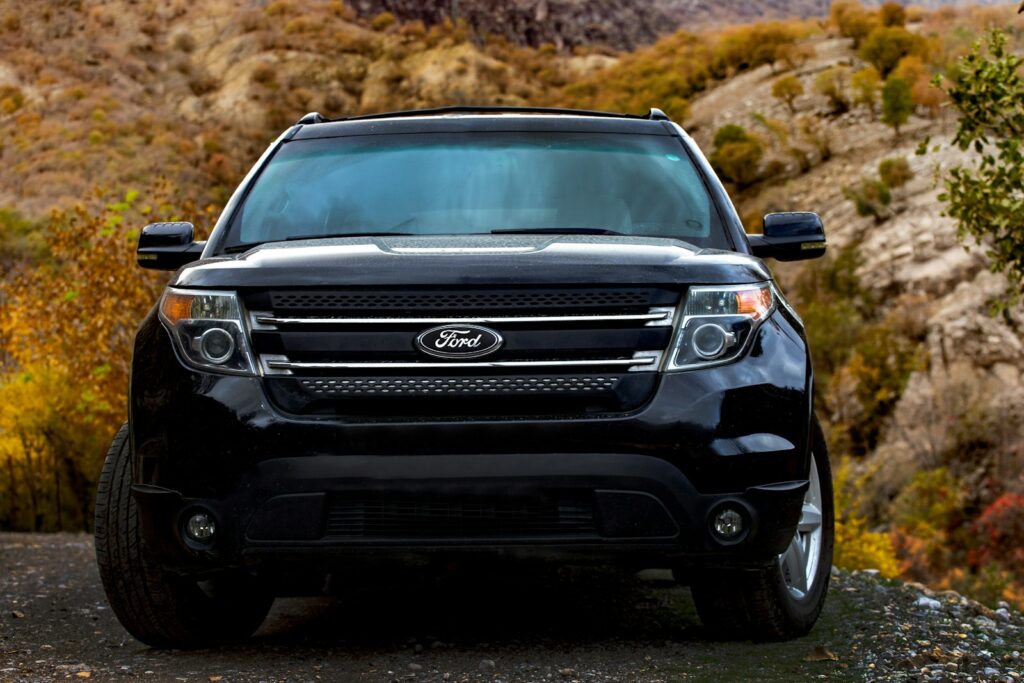
3. Ford Explorer: Good/Good, Top Safety Pick
Ford’s Explorer earns Good on both the driver and passenger small overlap tests and carries a Top Safety Pick badge for 2026, one rung below the Plus-level award. IIHS notes that structural changes to the Explorer’s front frame rails after May 2020 specifically improved occupant protection in this crash mode, proof the test has pushed real engineering revisions rather than marketing-friendly patches. It remains one of the few domestic nameplates in the class with matching scores on both sides.
4. Acura MDX: Good/Good, Top Safety Pick
The MDX rates Good on every individual injury measure IIHS tracks in the small overlap test, covering the head, neck, chest, hip, thigh, and lower leg, on both sides. That level of detail matters because a vehicle can post an overall Good rating while still showing elevated risk in one body region. The MDX shows none of that unevenness, part of why it holds a Top Safety Pick award for 2026.
5. Toyota Highlander: Good/Good
The 2026 Highlander rates Good on both sides of the small overlap front test, matching the scores of SUVs that carry IIHS’s top awards. Yet no Top Safety Pick or Plus designation is attached to this model year, a reminder that a clean small-overlap result alone doesn’t clinch an award; every crashworthiness and crash-avoidance category has to clear the same bar at once.
6. Volkswagen Tiguan: Good/Good on small overlap, Poor overall
The Tiguan is the clearest lesson in reading past a single test. It scores Good/Good on the small overlap front evaluation, matching the segment’s best performers corner for corner, but IIHS rates its moderate overlap front result Poor, which disqualifies it from any Top Safety Pick award. A vehicle can master the 25 percent offset crash and still fail the wider-overlap scenario that shows up more often on real roads.
7. Jeep Wrangler: Good driver-side, Acceptable passenger-side
The Wrangler carries the segment’s starkest split. IIHS rates the driver side Good but the passenger side only Acceptable, and because the combined small-overlap score defaults to whichever side scored lower, the Wrangler’s overall rating lands at Acceptable. Jeep added frame reinforcements to models built after October 2025 to close that gap, but the asymmetry on earlier 2026 production is precisely the pattern the passenger-side test was designed to expose.
8. Toyota Grand Highlander: Acceptable driver-side, Good passenger-side
Toyota’s three-row Grand Highlander flips the Wrangler’s problem. Passenger-side protection rates Good, but the driver’s side comes back Acceptable, pulling the combined score down to Acceptable and knocking the vehicle out of Top Safety Pick contention. IIHS’s methodology is blunt about the math: the combined rating always equals the lower of the two individual scores. Toyota’s newest three-row platform hasn’t fully matched the corner-impact structure its smaller Highlander sibling already gets right.
Line up all eight and the real split in this class isn’t between safe and unsafe SUVs, since every one posts at least one Good result. It’s between automakers that engineered both front corners to the same standard and those that optimized for whichever side the test used to check first. A single “Good” headline rating, read without checking which side it came from, still isn’t the whole story.