
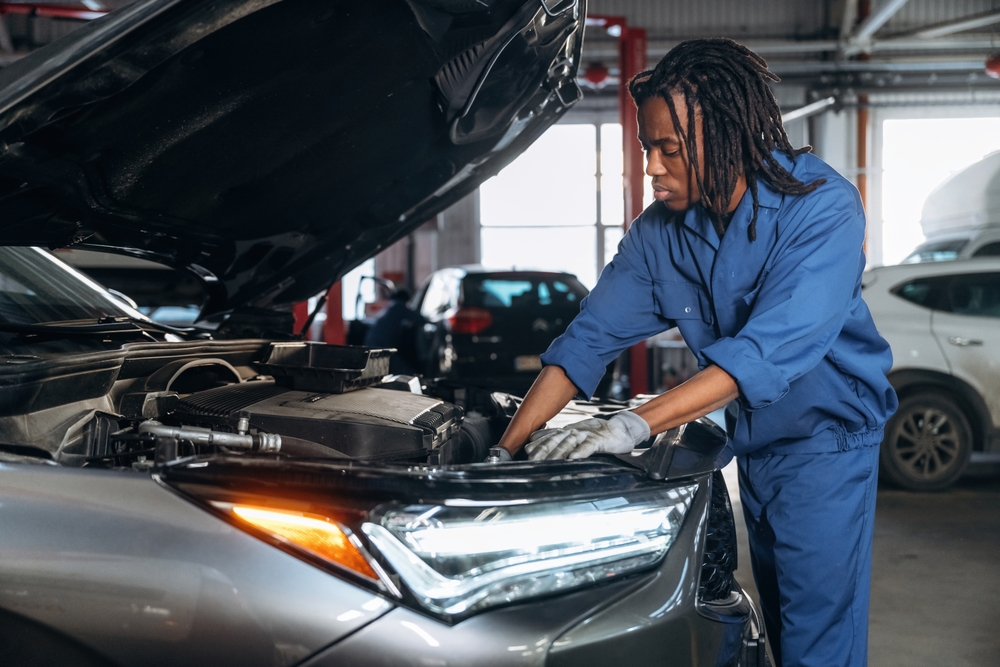

It started the way a lot of small, annoying car problems start: a weird noise, a warning light, a “please not this right now” moment in the driveway when you’re already late for everything. The woman—early 30s, works a regular job, not a car person—did what most people do when they don’t have a trusted shop on speed dial. She searched locally, found a mobile mechanic with decent-looking posts, and sent a message.
He replied fast, confident and casual, with that “I got you” energy that makes you feel like you’re not about to get taken for a ride. He asked a few questions, tossed out a price range, and then offered something that sounded convenient: he could collect the car, do the repairs off-site, and bring it back. She hesitated for a second—because handing your keys to a stranger is always a moment—but he talked like a professional and had the whole routine down.
The first red flag wasn’t even a red flag at the time. It was just how normal it all seemed: a guy in work clothes, phone in hand, chatting about parts delays like everyone else in 2026. She watched him do a quick walkaround, maybe take a couple of photos “for the job,” and then he slid into the driver’s seat like he belonged there.
The pickup that felt a little too smooth
He showed up when he said he would, which is part of why she relaxed. No sketchy “running late, send me a deposit” texts, no weird requests—just, “I’m outside.” He looked the part, talked the part, and didn’t seem nervous in the way scammers sometimes are when they’re improvising.
They did that awkward doorstep handoff where you’re half in customer-service mode and half in self-protection mode. She asked how long it would take; he said a day or two, depending on parts. He asked for the keys, and she handed them over while doing the mental math of, “Okay, I’ve got his number, his profile, his name… this is fine.”
Before he left, he took a few more pictures—close-ups of the bodywork, the wheels, the odometer. She assumed it was documentation, the way insurance and shops do it to avoid arguments later. He said something like, “Just so we’re both covered,” and that sounded responsible, not ominous.
Then he drove off. Not fast, not dramatic, just down the street like he’d done this a thousand times. She watched the car disappear and went back inside, already thinking about the inconvenience of being without it for a couple days.
The first day: normal delays, then silence
For the first several hours, the communication stayed normal. He texted that he’d “gotten it to the yard,” that he’d run diagnostics, that a part might need replacing. He dropped a couple of blurry photos that looked like engine bay shots, plus a screenshot of what could’ve been a parts listing, like he was proving he was working.
By the next morning, though, the tone shifted. She asked for an update, and he replied hours later with something vague about waiting on a delivery. She tried not to be annoying—nobody wants to be the customer who texts every twenty minutes—but she also didn’t love the way he stopped using specifics.
That night she asked when she could expect the car back. He didn’t answer. The next day she called; it rang and rang, then went to voicemail. She sent another message that was polite on the surface but sharper underneath: she needed the car for work, she needed a timeline, and if there was an issue she could come pick it up.
No reply. And that’s when the “maybe I messed up” feeling started to settle in, heavy and humiliating. People will tell you to trust your gut, but the more common experience is realizing your gut only started yelling after the door closed.
The scramble: trying to prove he’s real before it’s too late
She did what everyone does when a service provider vanishes: she went back through everything she thought she knew. The profile she found him on still existed, but it was suddenly scrubbed—fewer posts, no recent photos, contact details changed. His number, which had been responsive for days, now went straight to voicemail like it had been set to “ignore.”
She tried to piece together a location from the messages—where he said he was working, the “yard” he mentioned, anything. She drove to a couple of nearby industrial areas on a lunch break, more out of desperation than logic, hoping to spot her car. It’s a weird feeling, hunting for your own property like it’s an escaped pet.
Then she did the practical things people always wish they’d done sooner. She reported it to police as stolen, explained that she’d handed the keys over for repairs and the guy never returned. She called her insurance, and got that frustrating gray-zone response: they’d open a claim, but because she’d voluntarily given him the keys, it could get complicated.
Meanwhile, she kept checking listings. Not because she expected to find it, but because it was something she could actually do—scroll, refresh, search the make/model, search the year, search nearby towns. It’s a kind of nervous ritual, like picking at a scab you know you shouldn’t touch.
The listing: her own driveway in the background
When she finally found it, she didn’t even recognize it at first as “her car.” She recognized it as her driveway. The same cracked concrete, the same angle of the fence, the same little patch where the grass never grows right. The photos were clean and bright, like someone had purposely tried to make the car look loved and glossy.
The ad was bold in that way scammers are bold when they think they’re untouchable. “Runs great,” “no issues,” “selling due to upgrade,” the usual. It had details she hadn’t provided—things like trim package and mileage—because he’d had the vehicle and could just look at it.
She zoomed in, heart pounding, and saw things that made her stomach drop. The car was pictured from multiple angles, and the earliest shots were unmistakably taken the day he picked it up. You could tell because a distinctive item in the driveway—something small like a planter or a kids’ scooter—was still in the exact spot it had been that morning.
It wasn’t just theft; it was almost performative. Like he couldn’t resist using the best lighting and the easiest place to stage it, even if it meant photographing it in the one location that could tie it directly back to her. There was something chilling about that kind of casual arrogance.
Trying to trap a guy who already has the keys
She sent the listing to the police report contact and to her insurance, along with screenshots showing the background and the timestamp. She also reported the listing to the platform, though those reports often feel like shouting into a vent. The big question was whether law enforcement would move fast enough before the car changed hands.
She did what a lot of people would consider doing, then hesitated—setting up a meet with the seller through a friend’s account. It’s the kind of plan that sounds good when you’re angry and spiraling, but gets complicated when you remember you’re not an action hero and the other person might be unpredictable. She still wanted eyes on the car, wanted confirmation it existed, wanted a location.
So she looped in someone practical: a relative, maybe a coworker, someone who could talk her down and help keep the steps clean. They messaged the seller politely, asked basic questions, and got an almost immediate reply—friendly, eager, pushing for a quick sale. The mechanic was chatty again, suddenly very available, like his phone had never been turned off.
The more he talked, the more it became obvious he wasn’t worried. He didn’t ask suspicious questions, didn’t seem to fear being traced, and didn’t care that the photos screamed “stolen” to anyone paying attention. He just wanted it sold and gone, and he was acting like a guy who’d done this before and expected the confusion and paperwork to protect him.
By then she was living in that miserable in-between where nothing feels resolved. She had a report number, a claim in progress, screenshots, and a listing that might disappear any second. She also had to keep going to work, borrowing rides, calculating how long she could function without a car while other people decided whether her situation counted as urgent.
The last thing hanging in the air wasn’t the money, or even the car itself—it was the fact that he’d been standing in her driveway. He knew where she lived. He’d touched the keys, walked around her property, taken photos with her fence and front path in the background, and then used that same familiar setting as a showroom for selling her vehicle. Even if the car turned up, that sense of safety doesn’t just snap back into place, and she was left staring at her empty driveway like it had been used as a prop in someone else’s scam.
More from Steel Horse Rides: