

By the time the police officer walked back to his cruiser, Caleb was already replaying the last ten seconds in his head like a glitching GIF. Green light. Steady speed. A silver SUV appearing from nowhere, cutting across the lane like it owned the intersection. The crunch of metal wasn’t even the worst part—what stuck was the other driver stepping out and immediately talking like they’d been rehearsing it.
The woman in the SUV—mid-40s, big sunglasses even though it was overcast—didn’t check her bumper first. She pointed at Caleb’s car and started in with, “You came out of nowhere,” and “People like you always speed through here,” like she was narrating a crime documentary. Caleb said almost nothing, mostly because he could feel that weird post-adrenaline calm where your hands shake but your brain goes quiet.
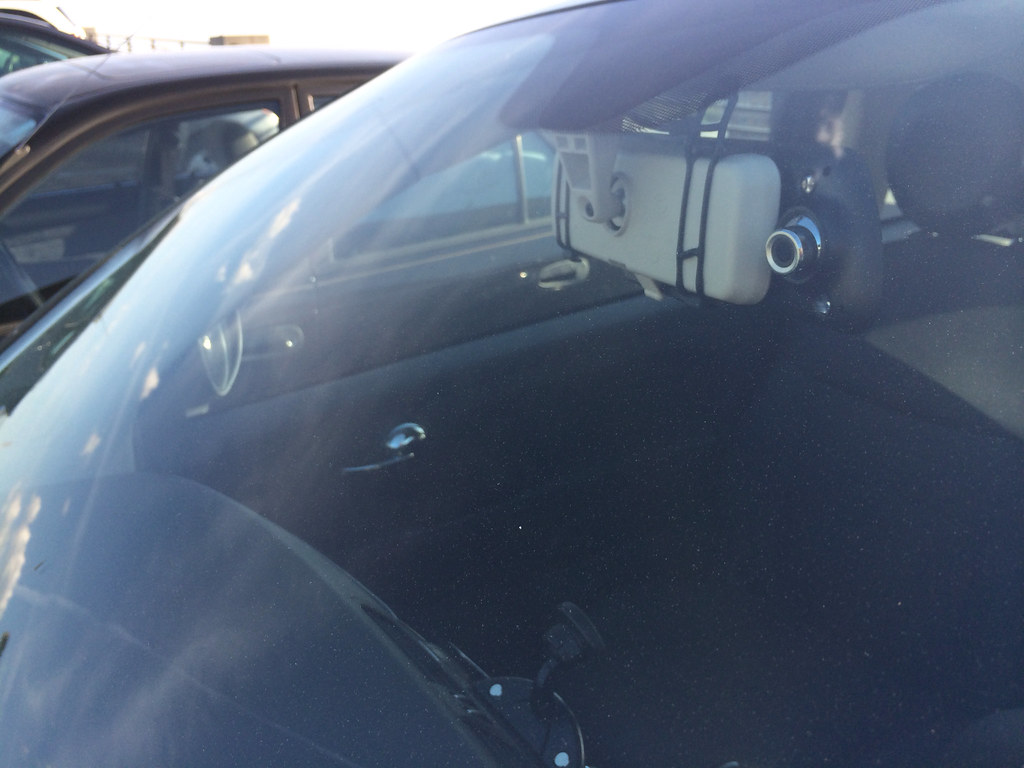
He did one thing, though: he reached up and tapped his dashcam to make sure it was still recording. He’d installed it after watching a friend get blamed for a fender bender that wasn’t their fault, and he’d always felt slightly paranoid about it. Standing on the curb with traffic hissing past, he finally had that unpleasant “Oh, so this is why” moment.
The accident that turned into a performance
The crash itself wasn’t high-speed, but it was expensive. Caleb’s front quarter panel was mangled, and the SUV had a deep scrape along the passenger side like it had been peeled open. Both cars were still drivable in that limping, humiliating way where the steering feels wrong and every warning light on the dash tries to get your attention.
While Caleb called his insurance and took photos, the woman—Linda, according to her license—kept working the scene like she needed an audience. She told the officer Caleb “blew through the light” and said she’d had her turn signal on “forever.” She also made sure to mention her neck “already hurting,” but not in a way that sounded like pain so much as a line she’d learned from somewhere.
The officer did the usual calm, neutral thing, asking for statements and drawing the little diagram on a clipboard. Caleb gave his version: he was going straight through on green, she turned left across his path. Linda’s story was basically the opposite, except it had more flourishes and a lot of hand gestures toward the intersection as if the asphalt itself would back her up.
Then came the moment Caleb almost felt bad about. The officer asked if anyone had video, and Caleb said, “Yeah, I’ve got a dashcam.” Linda’s whole face shifted for half a second—barely there, but noticeable—before she snapped back into indignation and said, “Those things don’t show everything.”
The video that made it “open and shut”… for about an hour
At home, Caleb pulled the footage onto his laptop and watched it like it was going to change depending on how many times he replayed it. The camera caught the green light clear as day. It caught Caleb’s speed—normal, boring, almost disappointingly responsible. And it caught Linda’s SUV starting the left turn late, sliding right into his lane like she either misjudged the gap or decided he’d stop for her.
Caleb sent the clip to his insurance adjuster, who responded fast in that way that feels like a small miracle. They told him liability was on the other driver based on the video, and to forward it if the other insurer asked. For a brief moment, Caleb got to breathe again.
Linda, meanwhile, called him directly—something she shouldn’t have done, and something his insurance later told him not to engage with. She left a voicemail that started polite and turned sharp: she “just wanted to resolve it like adults,” but she also wanted him to “admit what really happened.” She said the dashcam was “conveniently angled” and that it “didn’t show the full truth.”
Caleb didn’t call back. He did, however, save the voicemail and send it to his adjuster, because there was something about her tone that felt less like a disagreement and more like a warning.
How “not at fault” still became months of hassle
The insurance companies did what they do: a lot of waiting, a lot of “we’re still reviewing,” and a lot of slow-motion paperwork. Caleb’s car went into the shop, and he started living that rental-car life—driving something unfamiliar, paying attention to every ding, feeling like you’re borrowing time. He thought the dashcam would make the whole thing quick, but “quick” in claims-world has its own definition.
Linda’s insurer didn’t immediately roll over. They asked for the raw file, then asked again, then asked if there was additional footage from “before the incident.” Caleb sent a longer clip that showed him driving normally for several minutes, hitting the same green lights as everyone else, not swerving, not speeding, not doing anything exciting. It was the most boring evidence imaginable, which was exactly the point.
And still, Linda kept pushing her version. She claimed Caleb must’ve accelerated to “beat the light.” She suggested his dashcam didn’t show her signal. She implied the camera’s frame rate could be “misleading,” which was impressive considering she’d probably learned the phrase “frame rate” that week.
Caleb tried to ignore it until a letter showed up—not from an insurance company, but from a personal injury lawyer. Linda was claiming neck and back injuries, lost wages, and “ongoing pain,” and she was suing Caleb directly. The letter also included the sentence that made Caleb’s stomach drop: the dashcam footage “does not accurately represent the totality of events.”
The lawsuit strategy: attack the camera, attack the person
Once attorneys got involved, everything took on this cold, procedural vibe that made the crash feel like it was happening again, just in slow motion. Caleb handed everything to his insurer’s legal team, which is what you’re supposed to do. Still, it’s hard not to feel personally accused when someone’s lawyer starts building a narrative that you’re reckless, dishonest, or both.
Linda’s side kept circling one argument: the dashcam only showed Caleb’s forward view. They said it didn’t show what Linda saw, it didn’t show whether her arrow was yellow, it didn’t show Caleb’s foot on the gas, it didn’t show “the moments leading up” in a way that captured his “intent.” They were trying to make the absence of a second camera look like a gap big enough to drive a settlement through.
They also tried to make Caleb himself look suspect. In depositions, they asked the kind of questions that aren’t about facts so much as vibe: why did he install a camera in the first place, had he ever been in other accidents, did he have anger issues on the road, did he “often feel other drivers are incompetent.” Caleb answered plainly, but it was exhausting in that way where you realize you’re not just defending an action—you’re defending your character.
And then Linda did something that made the whole thing feel less like a misunderstanding and more like a tactic. She submitted a written statement describing Caleb as “aggressive” and “impatient,” and she claimed she heard his engine “rev” right before impact. The dashcam audio—grainy but clear enough—captured nothing like that, just road noise and the thump of the collision.
What the footage showed… and what it couldn’t fix
Caleb’s lawyer kept coming back to the same blunt truth: the video showed right-of-way, point of impact, and timing. It didn’t need to show “the full truth” in some philosophical sense; it showed the collision. Linda turned left across oncoming traffic when it wasn’t safe, and the camera caught it.
Still, Linda’s side dragged the process out, because dragging things out is its own kind of leverage. Even when liability looks obvious, the threat of time, stress, and legal noise can push people into settling just to make it stop. Caleb didn’t have to pay out of pocket—insurance covered defense—but he still had to live with the constant low-grade dread of another email, another form, another request to “clarify” something that felt already clear.
There were small humiliations too. His premiums got reviewed. The body shop argued with the claims department about supplemental damage. His repaired car came back with slightly mismatched paint that only he would notice, which somehow made him angrier than the bigger stuff. Linda, meanwhile, kept insisting she was the real victim, as if the act of saying it enough times could overwrite the footage.
By the time mediation was mentioned—because of course it was—Caleb wasn’t feeling triumphant about having proof. He was just tired. The dashcam had saved him from being labeled at fault, sure, but it hadn’t saved him from being pulled into someone else’s refusal to accept reality.
What stuck with Caleb wasn’t the crash itself so much as the audacity of the follow-up: the way Linda looked straight at a clear video and told everyone it was incomplete, like truth was something you could negotiate. The case hadn’t exploded into some dramatic courtroom showdown, but it didn’t need to—months later, the most unsettling part was still hanging there. Even with the receipts, he was learning, you can’t always stop someone from trying to rewrite the story; you can only prove, again and again, that they’re lying.