


It started as one of those tiny, maddening parking problems that sounds petty until you’re the one wedged inside your own car like it’s a magician’s box trick. A woman in a small townhouse complex had a designated space, the kind painted with fading lines and a number nobody respects unless they have to. Her neighbor—same row, different spot—kept sliding his SUV in so close to her driver’s side that she couldn’t open her door more than a few inches.
At first she tried to laugh it off, because what else do you do when your morning starts with sideways yoga in a seatbelt? She’d climb in from the passenger side, scoot across the console, and pretend it was a quirky routine instead of a daily reminder that someone else’s convenience mattered more than her basic ability to enter her own vehicle. The neighbor would be gone by the time she got home, or he’d be inside, so it was always this weird, unprovable annoyance—until it wasn’t.
After a couple weeks, the inconvenience started turning into damage. Her purse snagged on the shifter. Her knee banged the steering column. Once, she scraped her jacket on a half-open door and left a faint line down the paint because she couldn’t angle herself right. That was the moment she stopped treating it like a quirky neighbor quirk and started treating it like something someone was doing on purpose.
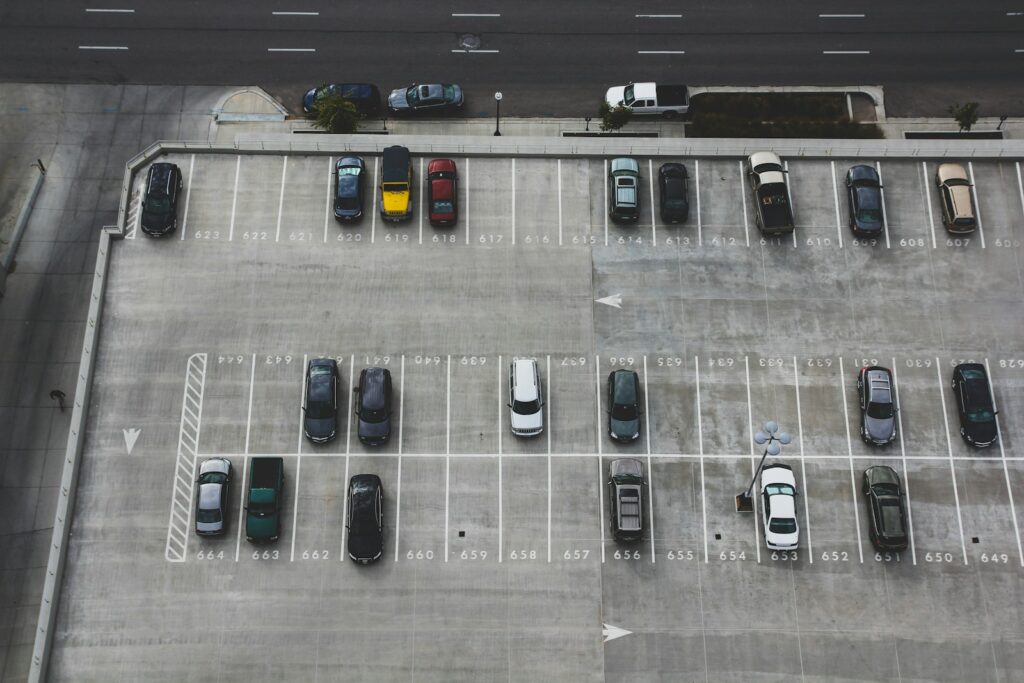
The First Time She Mentioned It, He Played Dumb
She caught him one evening unloading groceries, keys still in hand, his SUV parked so close to her driver’s side mirror that the two cars looked like they were in a slow-motion sideswipe. She kept her voice even and did the normal person script: hey, could you give me a little more room? I can’t open my door.
He stared at the gap like it was a puzzle. Then he shrugged and said something along the lines of, “There’s plenty of space,” the way people do when they want the conversation to die on the spot. She pointed out the obvious—she literally couldn’t get in—and he gave the classic non-apology: “I’ll try,” already walking away.
The next day he parked the same way, maybe even closer. It wasn’t the kind of tight parking that happens when someone’s rushed and misjudges an angle; it was a consistent, careful closeness, like he was using her car as a guide line. She started noticing he’d center himself in his space only when her car wasn’t there, but if she was home first, he’d tuck in tight to her side as if the far side of his spot didn’t exist.
The Passenger-Side Shuffle Gets Old Fast
She adapted, because people always adapt before they escalate. She started leaving extra time in the morning so she wouldn’t be late to work after climbing across the center console like she was stealing her own car. She stopped wearing skirts because the move wasn’t graceful, and she got tired of worrying about flashing the whole parking lot while trying to yank a laptop bag through from the wrong side.
But adapting didn’t make it less humiliating. There’s something about crawling across seats that makes you feel like you’re the one doing something wrong, even when you’re not. And every time she did it, she’d glance at his SUV and wonder if he was watching from a window somewhere, enjoying the tiny power trip of it.
She left a note once—polite, short, basically “Please don’t park so close, I can’t open my door.” The note was gone the next day, and his SUV was back in its usual position, snug against her driver’s side like it belonged there. No reply, no acknowledgment, just the same problem and the same silence.
She Starts Documenting, and That’s When He Actually Shows Up
After one especially tight parking job that left her door opening maybe three fingers wide, she finally did the thing everyone suggests and nobody wants to do: she pulled out her phone. She took a photo straight on, showing his tire practically kissing the line on her side and the empty, generous space on his other side like a punchline. Then she took another from above, trying to capture how the cars lined up and how little room there was.
She wasn’t doing it to be dramatic. She wanted proof in case she had to talk to the property manager or the HOA or whoever pretends to care about numbered parking spaces until they don’t. She also wanted a record in case she ended up with a dent and a neighbor who suddenly “had no idea” how it happened.
That’s when his front door flew open. Not a casual step-out, not a normal “hey, what’s up,” but a sharp, immediate reaction like he’d been waiting for an excuse to come out. He walked fast, eyes locked on her phone, and before he even got close enough to hear her explanation, he was already talking.
He Goes From “Plenty of Space” to “Stop Harassing Me”
He demanded to know why she was taking pictures of his car. Not in a curious way—more like an accusation, like she’d been caught doing something creepy instead of documenting a parking issue. She told him plainly: because you keep parking too close for me to open my door.
He didn’t address that. He jumped straight to calling it “harassment” and said she had no right to photograph his property. He said it loud enough that it didn’t feel like he was talking to her anymore; it felt like he was talking for an audience, even though the only audience was the windows of a quiet row of townhouses.
She tried to keep it practical. She told him she wasn’t posting anything, she wasn’t doing anything weird, she was just keeping a record because it had happened repeatedly. She even gestured at the space between the cars, which was so tiny it made his outrage seem even more absurd—like being furious someone took a photo of a fire while you’re holding the match.
He stepped closer, not quite in her face but close enough that she instinctively held her phone tighter. He said he’d “call the police” if she took another picture, like that was the nuclear option. Then he did the most telling thing: he didn’t move his SUV, didn’t offer to adjust, didn’t say “fine, I’ll park differently.” He just stood there, angry that she’d started collecting evidence of something he wanted to keep deniable.
The Awkward Fallout: Everyone Can Feel It Now
After that, the parking lot didn’t feel like a neutral shared space anymore. It felt like a stage where every arrival and departure came with an invisible scoreboard. She started recording short videos as she walked up, not dramatic, just a quick pan: her car, his car, the distance, the lines.
He noticed. Sometimes she’d catch him hovering near his window when she pulled in, like he was checking whether she was about to “do it again.” Other times he’d come home and purposely swing wide, leaving room—just enough to signal that he could’ve been doing that all along. Then, a day later, he’d be right back to pinning her door in again, like he couldn’t resist poking the bruise.
She did end up talking to the property manager, because she was tired of living inside a weird intimidation experiment. The manager gave the standard mushy response: they’d “look into it,” they’d “remind everyone to park within the lines,” they couldn’t “police every situation.” There was no immediate fix, no tow threat, no official warning that felt solid enough to stop a determined neighbor from being a problem.
Meanwhile, the neighbor’s anger didn’t fade—it sharpened. He’d mutter “take a picture of this too” under his breath when he walked past, like he was daring her. He’d slam his car door louder than necessary, a small childish punctuation mark after every encounter.
And the worst part was the weird emotional whiplash: she wasn’t scared exactly, but she was on edge. She’d go out to her car with her keys between her fingers, not because she thought he’d attack her, but because she didn’t like how easily he escalated over something he’d caused. The photos had done what they were supposed to do—create a record—but they’d also ripped away the last layer of polite pretending between neighbors.
By the end of it, nothing was neatly resolved. She had a folder full of timestamped evidence and a neighbor who now watched her like she was the villain in his story, not the person who just wanted to open her own door. The parking space was still the same size, the lines still faded, and every time she pulled in, she could feel the tension sitting there before she even turned off the engine—waiting to see how close he’d get, and how much proof she’d need before someone finally believed her.
More from Steel Horse Rides: