

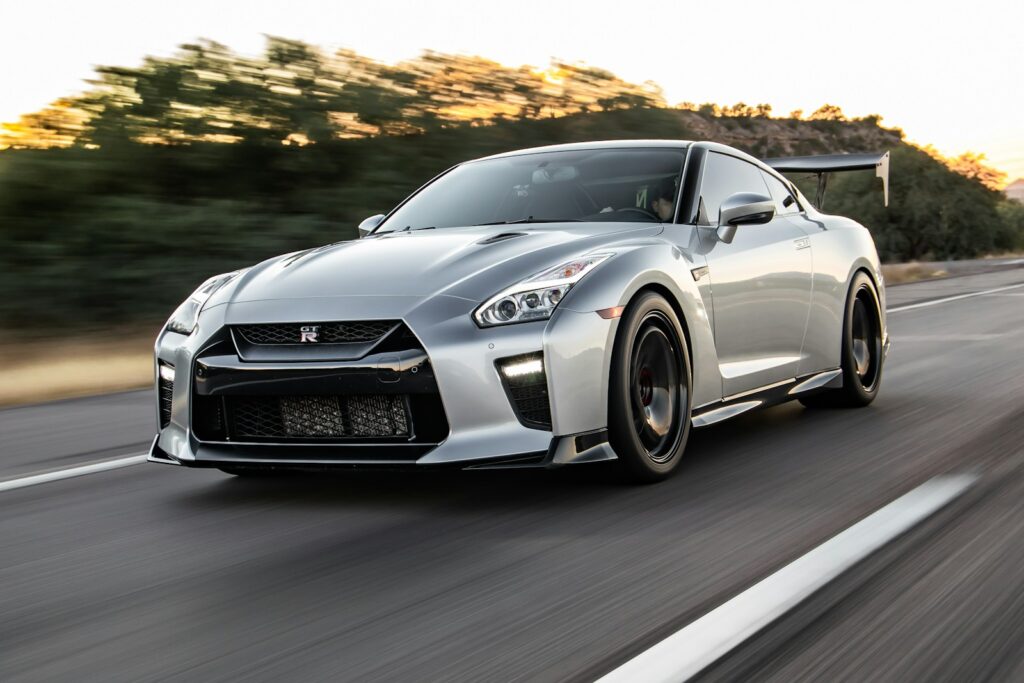
Forty-eight thousand. That’s the entire global production run of the R35 Nissan GT-R, spread across 18 years, and as of this year that number is final. Nissan confirmed in its own newsroom announcement that the last R35 — a Premium Edition T-Spec finished in Midnight Purple for a Japanese customer — has rolled off the assembly line, closing out a car that started as a 480-horsepower shock to the supercar establishment and left as a 600-horsepower cult icon nicknamed Godzilla. For a nameplate that basically never got a full ground-up redesign in nearly two decades, that’s a remarkable production number to end on, and it says everything about how long Nissan let one platform simply keep getting better.
An 18-Year Run With Almost No Full Redesign
Most performance cars get replaced every five to seven years. The R35 launched for the 2007 model year and Nissan kept building it, generation after generation of incremental upgrades, all the way to August 2025 — 18 years on one platform, confirmed in Nissan’s own release announcing the final build. That’s longer than the production runs of the Porsche 997 and 991 combined. Nissan never needed to start over because the twin-turbo VR38DETT V6 and the all-wheel-drive chassis underneath kept absorbing more power and more electronics without buckling, which is the entire reason “Godzilla” stuck as a nickname — the car kept getting bigger and meaner instead of getting replaced.
From 480 Horsepower to 600
The original 2007 GT-R left the factory rated at 480 horsepower (353kW), a number that felt outrageous for a Nissan at the time. By the time Nissan updated the car for the 2017 model year, that figure had climbed to roughly 565 horsepower (419kW), and the final NISMO variant — the track-focused halo trim built in tiny numbers — topped out around 600 horsepower (441kW), according to figures confirmed by CarExpert’s review of the model’s production history. That’s a 120-horsepower gain squeezed out of essentially the same basic engine architecture over nearly two decades, without Nissan ever needing to bolt on a bigger motor.
A Guinness World Record for the Fastest Drift Ever
The R35 didn’t just win drag races and lap records — it set an outright Guinness World Record. In 2016, a specially prepped GT-R hit 304.96 km/h (about 189.5 mph) while holding a sustained 30-degree drift angle at Fujairah International Airport in the UAE, the fastest drift ever officially recorded. No other production-based platform has come close to matching that number since, which tells you something about how much grip and power margin Nissan had built into a car that started life as a fairly ordinary-looking coupe.
Only 48,000 Cars, Ever
Across the entire 18-year run, Nissan built approximately 48,000 R35 GT-Rs worldwide — a genuinely small number for a nameplate this famous. For comparison, Chevrolet sells more Corvettes most years than Nissan built total GT-Rs across nearly two decades. Nissan Australia alone accounted for 993 of those cars, a rounding error against the model’s cultural footprint, per CarExpert’s production breakdown. That scarcity is part of why used R35 values have stayed stubbornly strong even as the car aged — there was simply never enough supply to go around.
What Comes Next
Nissan President and CEO Ivan Espinosa was direct about the finality of this moment in the company’s own statement: “After 18 remarkable years, the R35 GT-R has left an enduring mark on automotive history. Its legacy is a testament to the passion of our team and the loyalty of our customers around the globe.” But he also left the door open for a successor, saying, “I want to tell you this isn’t a goodbye to the GT-R forever, it’s our goal for the GT-R nameplate to one day make a return,” while cautioning that “the GT-R badge is not something that can be applied to just any vehicle; it is reserved for something truly special.” No timeline, no specs, no confirmation of what powertrain a next-generation car might use — just a promise that the name isn’t retired, only the car is.
What makes the R35’s exit different from most discontinued sports cars is that it isn’t going out because it got beaten. It’s going out at the top of its output, still capable of embarrassing cars twice its price, simply because Nissan ran out of room to keep evolving one platform under increasingly strict emissions and safety rules. Eighteen years, one basic architecture, and a 120-horsepower gain later, Godzilla leaves as the rare halo car that never really got old — it just ran out of time.