

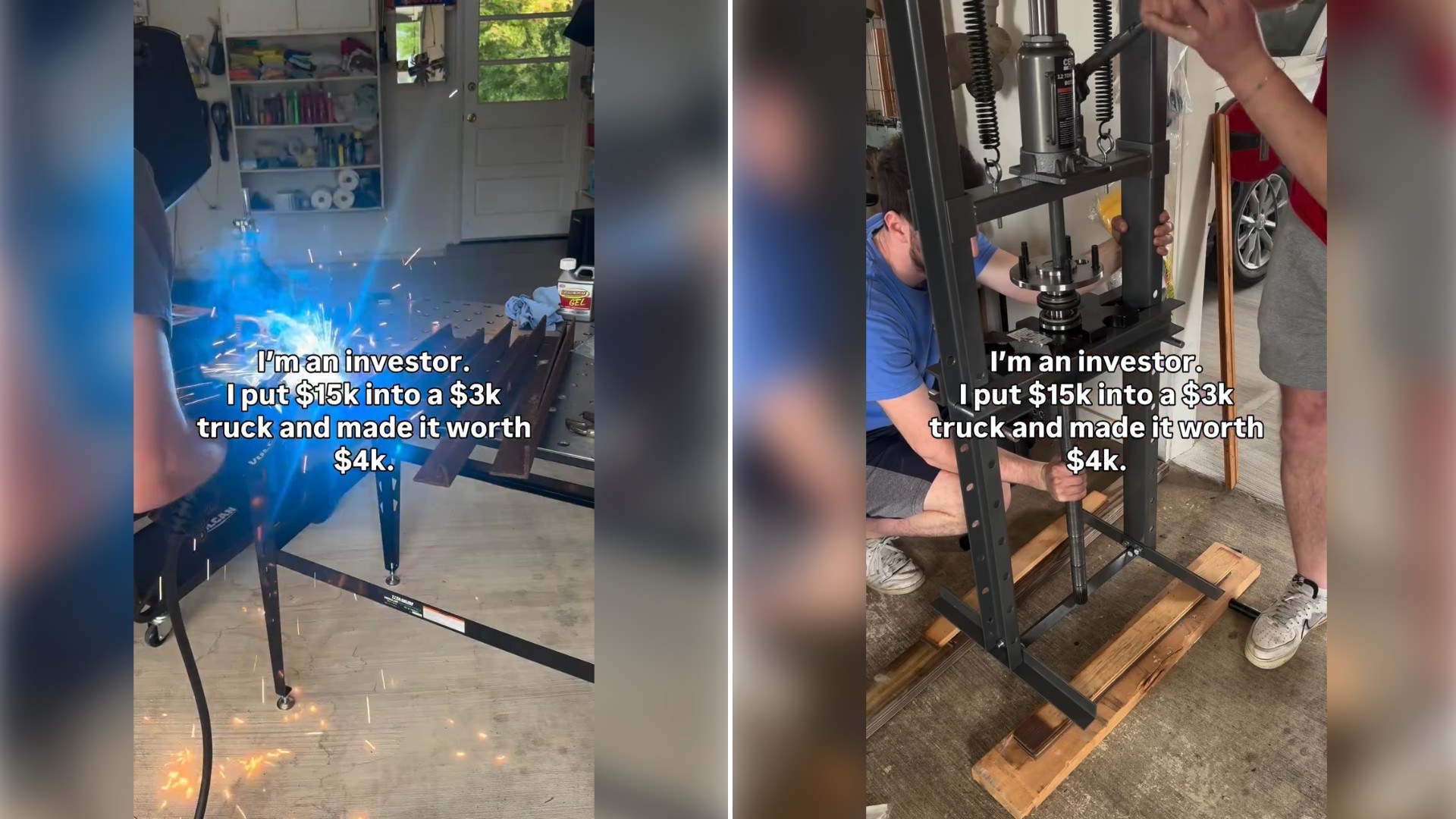
The math is right there on the screen, and it does not flatter anyone. “I’m an investor,” reads the text over a twelve-second reel from @rubensresto. “I put $15k into a $3k truck and made it worth $4k.”
Behind those words is an old red pickup in a home garage, hood up, front end in the air, surrounded by cardboard boxes of parts. The caption finishes the thought with a straight face: “It’s an appreciating asset because I appreciate it.”
The reel is a fast montage, and every cut shows where some of that money and time went. It opens on the truck from the front corner, sitting on stands with the hood propped, and boxes stacked and spilled across the concrete in front of it. Next, someone in a pink T-shirt is bent over the fender with both arms in the engine bay, an extension cord and a hammer on the floor behind him.
Then the pieces start appearing on their own. A red door with its chrome mirror still attached stands off the truck. A long drivetrain part lies on a black mat with its ends wrapped. Someone in a plaid shirt sits on the floor under the frame, working upward, with small parts and a bottle of fluid scattered around him.
The middle of the reel is the bright part. On a steel welding table, an arc lights up blue and throws sparks across the floor. After that the truck is back in frame with its front fenders and grille gone, the engine sitting in the open and more boxes at its feet.
Two more jobs follow. The person in the pink shirt works at the bare front of the truck, behind the radiator support. Then a shop press, standing on a pair of wooden boards, takes over the frame: one person crouches to steady the part while another works the jack handle with both hands. The last shot is someone in a light blue shirt and glasses standing at the stripped nose of the truck, with a loose fender lying in the foreground.
That is all twelve seconds. Nobody explains anything, and the truck is nowhere near finished. The joke does the talking, and the joke is a real number: $15,000 in, on a truck that cost $3,000, for a result he values at $4,000.
It is funny because it is a common outcome, and there are a few honest lessons in it for anyone standing at the start of the same road.
The first is that restoration money mostly goes into things a buyer will never see. The reel shows it. Boxes of new parts, a welder, a press, stands, consumables. The work those represent ends up under the truck and behind the panels. A buyer pays for a truck that runs and looks right, not for the hours and hardware it took to get there, so the gap between cost and value opens early and tends to stay open.
The second is to set the budget against the right question. If the goal is to come out ahead, the cheapest route is almost always to buy a truck someone else already finished and absorbed the loss on. If the goal is to build one, the purchase price is the small number, and the plan should start from what the whole job will cost.
Third, keep the receipts anyway. A folder of invoices and dated photos will not turn $4,000 into $18,000, but it does separate a documented build from an unknown one when the time comes to sell or insure it. For insurance in particular, an agreed-value policy backed by that paperwork is the way to protect what was actually spent, because a standard policy will look at market value.
Fourth, buy tools with the next project in mind. A press and a welder do not belong to one truck. Spread over years of use, they are the part of the $15,000 that keeps paying back.
The last lesson is the one the caption already gives. Several different people appear in these twelve seconds, crouched, kneeling and reaching into the same red truck. That is what the money bought, and it is the only kind of appreciation he is claiming.