

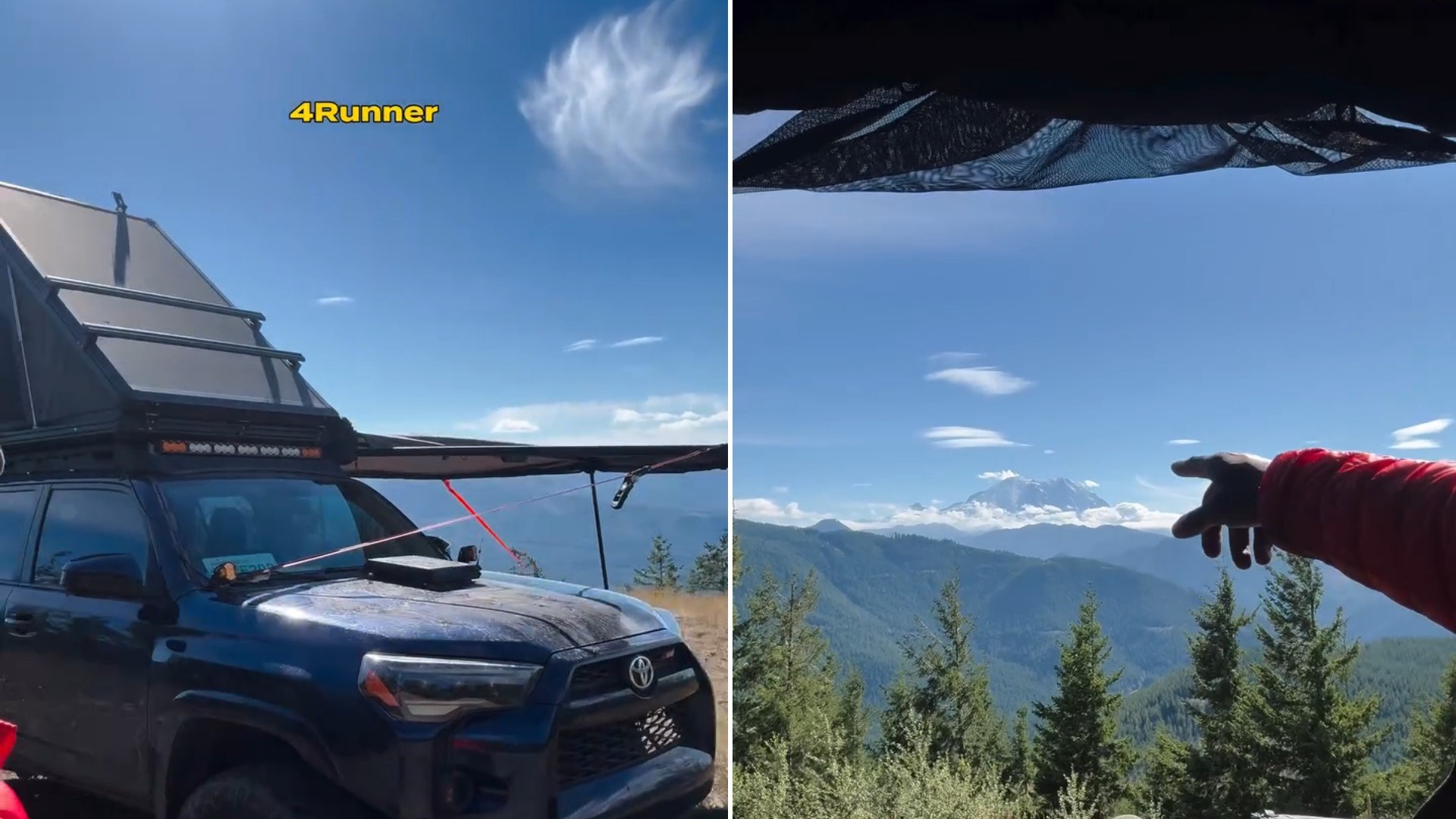
@snipezart, a photographer whose feed is full of landscapes from Washington and the Oregon coast, starts his reel by pointing at a dark blue SUV parked on a grassy ridge and offering to show viewers his home. “This is my SR5 2016 4Runner,” the captions on screen read. The post is captioned “Home on wheels” and tagged #washington and #pnwadventures, and for the next minute and a bit he walks around the truck pointing out the pieces that earn it that name.
The camp is in a clearing high on a mountainside, with fir trees behind the truck, ridgelines stacked into the distance and a bright blue sky overhead. A wedge-shaped rooftop tent is already propped open on the roof rack and an awning is swung out beside it. He is wearing a red quilted jacket and a green cap, holding the camera in one hand and pointing with the other.
The awning is the first stop. The captions describe it as a 180 awning “that wraps around the whole side of the truck,” and the footage backs that up. Tan fabric fans out from the roofline on a support pole and throws shade over the ground next to the doors, with red guy lines running from its edge down to stakes in the dirt.
A few steps away from the truck, he stops at a piece of gear standing on its own: a perforated metal box with two handles, set on tripod legs. He names the maker in the captions and has a short message for anyone who does not own one, which is to “definitely check them” out. A folding camp chair sits just beyond it, turned toward the view.
Then it is around to the back corner of the 4Runner. “Got my Molle panel here,” the captions read as he points to a slotted metal panel mounted over the rear side window, with gear fastened to it. A ladder runs up the rear hatch to the roof. His hand lands on it as the caption reads “Got my Westcott design,” and from there the camera tilts up to the rooftop tent. Coming back to the side panel, he adds one more detail: “This is where I keep the propane bottle here.”
After that he takes viewers up to the tent. The side is unzipped to show a mattress, which he names and presses a hand into, a plaid blanket and pillows stacked at the back. He talks about how comfortably he sleeps up there.
The last part of the reel is the reason the truck is parked where it is. “Now, let’s check out the view from inside the tent,” the captions read. The camera turns around and looks out through the open end of the tent, past his feet, over the tops of the firs to a long line of mountains on the horizon. He points to it. “That’s Mount Rainier,” the captions read. “Or I will say that’s Miss Tahoma. Yeah.” Tahoma is a name long used for the mountain by Native peoples of the region.
What stands out about the tour is how short the list is. He shows six things: an awning for shade, a metal camp unit on a tripod, a chair, a panel for storage on the outside of the truck, a ladder and a bed on the roof. Nothing in the reel is presented as a finished showpiece. It is a 2016 SUV with enough added to it that he can drive to a ridge, open the tent and stay.
For anyone thinking about a similar setup, the order he presents things in is a reasonable order to buy them in. Shelter from sun and rain comes first, and a wraparound awning of the kind he shows covers the side of the vehicle where the cooking and sitting happen. His is guyed out and staked, which matters on an exposed ridge like the one in the video, where wind can get under an awning in a hurry.
A rooftop tent solves the sleeping question in one move, and his tour shows the main appeal: the mattress, blanket and pillows are already in place when it opens. The trade-off is weight carried high on the vehicle. Before buying one, check the roof load rating in the owner’s manual and the rating of the rack it will sit on, both for driving and for when the tent is open with people in it. A tent on the roof also adds height, which is worth remembering at parking garages and on trails with low branches.
He gives the mattress its own moment in the tour, and that is a fair reflection of its importance. A bed that is comfortable enough to look forward to is what decides whether a setup like this gets used most weekends or a few times a year.
The propane detail is a good habit to copy. He keeps the bottle on the outside of the truck, at the panel on the rear corner, instead of inside with the bedding and bags. Storing fuel outside the cabin keeps any leak out of the space where people ride and sleep.
Exterior panels like the one he shows do a similar job for everything else that is dirty, wet or needed in a hurry. Gear that lives on the outside does not have to be dug out from under a bed, and it does not bring mud in with it.
And then there is the choice of campsite, which costs nothing. He parked so that the open end of the tent faces the mountain, and the best shot in the whole reel is the one taken lying down.