

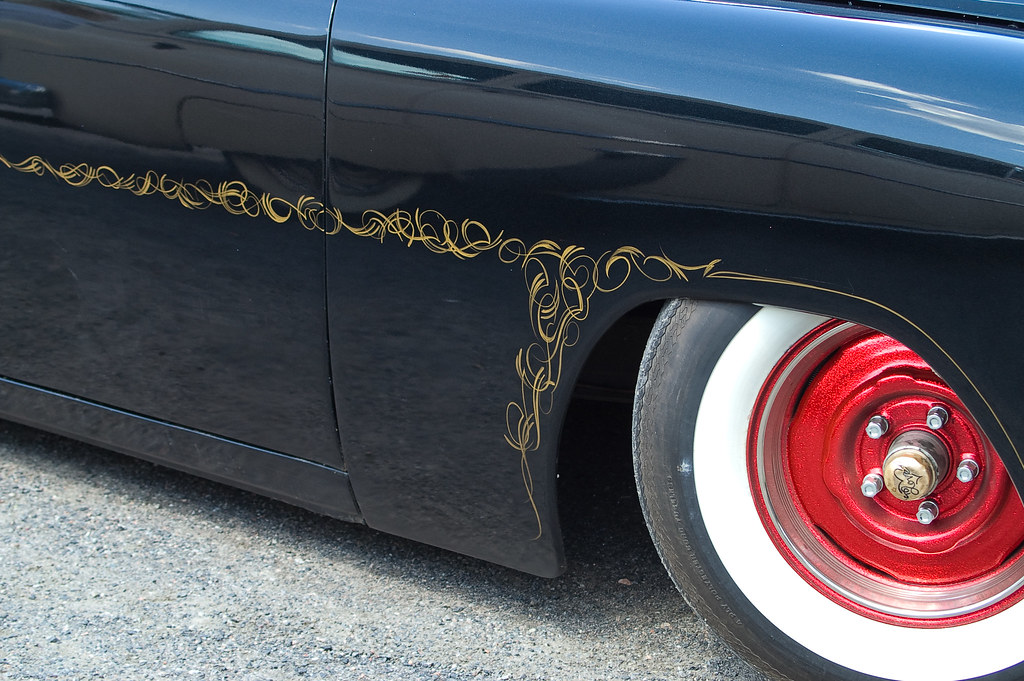
There is a particular stillness required for genuinely fine craftsmanship, and @picasso_pinstriping demonstrates exactly that discipline while laying down delicate gold leaf striping onto a vintage car, each pass of the brush requiring the kind of steady, practiced hand that simply cannot be rushed without immediately showing in the finished line. It is a quiet, almost meditative counterpoint to the loud, fast-paced content that typically dominates automotive social media.
Pinstriping itself represents one of the oldest decorative traditions in automotive customization, tracing its roots back to coach-building craftsmen who hand-painted fine decorative lines onto horse-drawn carriages long before the automobile even existed. That lineage carried directly into early automotive customization, where pinstriping became both a practical way to accentuate a vehicle’s lines and a genuine art form practiced by specialists whose skill could make or break a custom build’s overall visual impact.
There is also a genuine apprenticeship tradition behind serious pinstriping skill, since most accomplished practitioners did not learn the craft from a quick tutorial but through years of mentorship under an established artist, absorbing not just technique but an eye for proportion, flow, and how a design should interact with a car’s existing bodylines. That kind of slow, hands-on transmission of knowledge is itself becoming rarer as fewer young artists enter a trade that offers limited commercial demand compared to faster, cheaper alternatives.
Gold leaf application specifically elevates pinstriping into an even more demanding and specialized discipline, since working with genuine gold leaf requires an entirely different skill set than painting a standard striping line with pigmented enamel. Gold leaf consists of gold hammered into sheets only a few micrometers thick, delicate enough to tear or wrinkle from the slightest mishandling, which means the artist has to apply a specialized adhesive sizing with absolute precision before carefully laying the fragile leaf exactly where the design calls for it.
The technical sequence behind a genuine gold leaf stripe involves considerably more steps than viewers might assume from a quick clip, typically starting with a precisely drawn guideline, followed by careful application of an adhesive size that must reach exactly the right tackiness before the leaf can be applied, not too wet or the gold will wrinkle, not too dry or it will fail to adhere properly. Only after the leaf is burnished smooth and any excess carefully brushed away does the artist add the fine black or colored outline that traditionally frames gold leaf work and gives it crisp, professional definition.
This kind of specialized decorative work occupies an increasingly rare niche within the broader custom car world, since the number of artists with genuine, deeply practiced skill in traditional gold leaf and pinstriping techniques has shrunk considerably as the craft has become less commercially common than it was during its mid-twentieth-century heyday. Each video showcasing this kind of work effectively functions as a small act of preservation, keeping a dying art form visible to new audiences who might otherwise never encounter it outside a classic car show.
Mastering this craft also requires an understanding of brush control that goes well beyond basic painting technique, since traditional pinstriping brushes, long-haired tools called swords or daggers, are designed to hold a large reservoir of paint while releasing it in a single, continuous, perfectly tapered line as the artist’s hand moves steadily across the surface. Developing the muscle control needed to maintain that consistent pressure and angle across a long, often curved stripe typically takes years of dedicated practice before an artist can work with the kind of visible confidence on display here.
There is also something worth noting about the patience this craft demands in an era of increasingly fast, mechanized vehicle customization, where vinyl graphics and digital printing have made it possible to replicate almost any decorative pattern in a fraction of the time hand pinstriping requires. Choosing genuine hand-applied gold leaf over a far cheaper, faster vinyl alternative represents a deliberate choice to prioritize authenticity and craftsmanship over simple efficiency, a choice that carries real weight for collectors and enthusiasts who understand the difference.
The vintage car serving as the canvas here also matters considerably to how this work gets received within the enthusiast community, since gold leaf striping carries strong historical associations with classic custom culture, particularly the hot rod and kustom kulture movements that flourished decades ago. Applying this traditional technique to a genuinely vintage vehicle rather than a modern car creates a kind of visual and historical coherence that resonates especially strongly with collectors who prize period-correct detailing.
There is also a real financial dimension worth acknowledging, since genuine gold leaf material itself carries meaningful cost beyond the labor involved, and commissioning hand-applied gold leaf striping from a skilled specialist represents a premium investment that only makes sense for an owner who genuinely values authentic craftsmanship over a cheaper cosmetic shortcut. That willingness to pay for genuine skill is precisely what keeps artists like this one able to continue practicing and passing down a craft that could otherwise fade entirely from common practice.
By the time the final stripe is complete and the gold catches the light along the car’s bodyline, what started as a simple demonstration of technique has become a genuine testament to the enduring value of patient, specialized craftsmanship in an industry increasingly dominated by speed and mass production. It is a reminder that some of the most beautiful details on any car are the ones that took the longest, steadiest hands to create.