

He’d been talking about the coupe for so long that his friends had stopped asking what year it was and started asking what color he’d paint it. The shell sat in his garage on jack stands like a promise: doors off, glass out, wiring labeled in masking tape, every baggie of bolts Sharpied and stacked in milk crates. When he finally booked a weekend at a local sandblasting place, it felt like the moment the project officially graduated from “someday” to “it’s happening.”
The shop wasn’t fancy—concrete floors, a curtain of blasting grit that never really settled, the constant hiss of air—but they knew what they were doing. He’d seen the photos on their page: frames stripped clean, rusty truck beds turned honest again. The plan was simple: blast the body to bare metal, epoxy prime it fast, and start the real metalwork with a clean slate.
That’s not how it went. Somewhere between “nice and slow, keep it moving” and the first sweep across the driver’s quarter panel, the panel started to move in a way that didn’t make sense. Not the subtle ripple of heat warp, not the normal flex of a big piece of sheet metal—this thing waved. Like tin foil, like it was alive, like the car was trying to shrug out of its own skin.
The Coupe That Looked Too Good
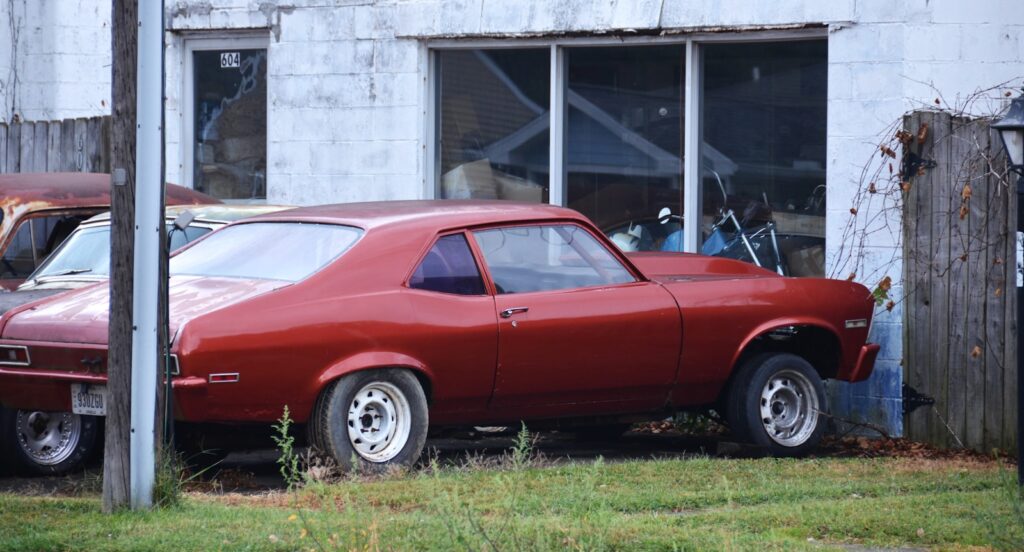
This wasn’t a barn find with daylight showing through the rockers. It was one of those deceptively tidy “older restoration” cars: decent paint, okay gaps if you didn’t stare too hard, a trunk floor that looked “solid enough,” and a quarter panel that, in photos, could pass for straight. The restorer had bought it because he wanted a driver he could improve, not a body shell that would turn into a year-long archaeology dig.
He’d done the usual pre-checks. Magnet test in a few spots, thumb pressed along the lower edges, a flashlight in the wheel well. There were a couple areas where the magnet felt weak, but nothing screamed “this is basically sculpture.” He told himself what everyone tells themselves when they want a project to be reasonable: it’s probably just a skim coat, maybe a repaired dent, maybe some old-school lead work.
He’d even bragged—half-joking, half-proud—that he’d found one that hadn’t been “Bondo’d to death.” That phrase came back later like a punchline nobody wanted. The quarter looked smooth, the contour was right, and the paint had held up for years, which can be its own kind of trap.
First Pass With the Blaster
They rolled the shell into the blasting bay and walked around it one more time, pointing out areas to be careful with: big flat panels, roof skin, anything that could oil-can. The shop guy gave the standard speech about pressure, distance, and moving the nozzle like you’re dusting, not drilling. The restorer nodded like a student who’d watched enough videos to feel prepared.
On the passenger side, things went the way he expected. Old paint feathered away, primer disappeared, and rust freckles showed up like an honest confession. You could see where the car had been hit at some point, where the metal was slightly stretched, where someone had used filler to smooth a crease—but it was within the range of normal.
Then he stepped to the driver’s quarter and started working the panel in long, careful arcs. At first it was fine: paint turning to chalk, then to a patchy grey. The moment the nozzle hit a certain zone near the wheel arch, the panel didn’t just reveal filler—it reacted to it. The skin visibly fluttered, like the blast air was pushing on something that had no backbone underneath.
The shop guy actually told him to stop and back off, because it looked like the metal was heating and flexing. The restorer pulled away and stared, waiting for it to settle. It didn’t settle; it kept that loose, unstable look, like a drumhead that had been cut too thin.
When “Bare Metal” Wasn’t Metal
They lowered the pressure and tried again, gentler, more distance, more motion. Instead of the satisfying clean sweep to steel, the surface started to crumble. Not flake like old lacquer—crumble like dried plaster. What they’d assumed was primer and paint turned out to be layers, and the blaster was excavating them in a way that felt wrong.
Once a corner opened up, the truth showed itself in cross-section. There was paint, then primer, then what looked like another paint job, then another, then a thick, uniform beige-grey layer that wasn’t steel at all. The “panel” they’d been blasting wasn’t a panel; it was a sculpted filler shell bonded to… something.
They stopped again and started tapping with a knuckle. The sound wasn’t metal—it was dull and dead. The shop guy took a pick tool and scraped a small line, and it peeled back like a rind. Underneath, instead of smooth factory sheet metal, there were pitted remnants and a seam that shouldn’t exist in that location.
That’s when the restorer said the thing that stuck: “It’s moving because it’s not metal.” He wasn’t even angry yet. He sounded more like someone who’d opened a wall expecting a stud and found termites holding hands.
18 Gauge of Bondo
The phrase “18 gauge” came up because, in the world he lived in, 18-gauge steel is the stuff you cut patches from. It’s a real thickness, a real measurement you can buy, weld, hammer, and shrink. What he was looking at now was a filler layer thick enough to joke about as sheet metal, except it wasn’t a joke when it had been masquerading as a quarter panel for years.
They measured it in a couple spots out of morbid curiosity. It varied—thinner toward the top, thicker around the arch where the contour had been built up—but it wasn’t a skim coat. It was a construction. In one area, the filler was thick enough that the sandblast wasn’t just removing paint; it was carving channels like a sandcastle.
The quarter “wave” suddenly made sense. The metal underneath was so compromised—thin, perforated, or partially missing—that the only thing giving the panel its shape was the hardened filler skin. The blast air wasn’t warping steel; it was flexing a brittle shell that had been doing structural cosplay.
He tried to find the edge of the original repair, because at least then he could tell himself it was localized. But as they chased it outward, the filler kept going. The deeper they went, the more it looked like someone had repaired a big hit by reshaping filler over a patched-together base, then smoothing it until it looked factory from ten feet away.
The Awkward Call and the Blame Game
He didn’t wait until he got home to start making calls. Standing there in the grit with his gloves still on, he rang the guy he bought the car from. The conversation started polite—“Hey, quick question about the driver quarter”—and turned tight when he described the panel moving and the filler depth.
The seller’s defense was immediate and slippery. He hadn’t done the bodywork, he’d owned it a few years, it looked fine when he had it, and besides, old cars have filler. The restorer kept trying to pin down what “a little filler” meant, because there’s a difference between smoothing a door ding and building a quarter out of mud.
It got worse when he sent photos. The seller shifted to technicalities: he never said it was “all original,” he never promised “no rust,” and the car was sold as-is. The restorer wasn’t even asking for a full refund yet—he was still processing the idea that his “solid driver” had a quarter panel that was basically a paper-mâché mask.
By the time he hung up, he wasn’t yelling. He was quiet in that way people get when they realize the argument they want to have won’t change the math. The shell needed a quarter panel, maybe inner structure, maybe more. The sandblasting bill was still the sandblasting bill, and now the car was stuck in that ugly in-between state—stripped enough to reveal the lie, not repaired enough to become anything else.
Back at home, he stood in the garage and looked at the coupe like it had personally betrayed him. He’d wanted a clean starting point, and what he got was proof that the car had been wearing makeup thick enough to stand on its own. The worst part wasn’t even the money; it was the feeling that every “good” panel could be hiding the same kind of fraud, waiting for the next pass of grit to make it wave like tin foil again.
More from Steel Horse Rides: