

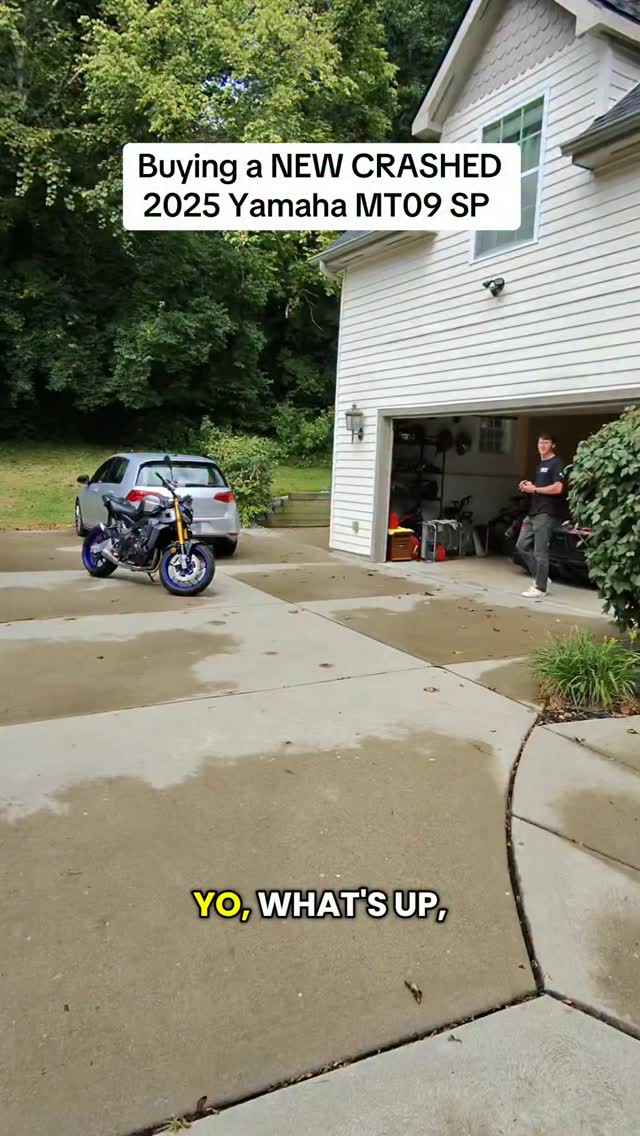
The title card on the latest reel from @ridersreserve says exactly what he is there to do: “Buying a NEW CRASHED 2025 Yamaha MT09 SP.” The caption says how he feels about it afterward: “Idk how I got it so cheap.”
The 72-second video is filmed from the buyer’s point of view and starts at the bottom of a driveway. The bike is parked out front with its silver tank, blue wheels and gold fork. The first thing he comments on, though, is the car sitting in the open garage behind it. “God damn, that R8, bro.”
The seller, in a black T-shirt, walks out of the garage, the two trade greetings, and the buyer starts circling the Yamaha. “Looks brand new,” he says. “Yeah, it’s 341,” the seller answers. In the wide shots nothing gives the crash away. The bodywork is all there, and the gold rear shock and black engine cases look clean.
Then comes the question every buyer of a crashed bike has to ask. “So when you drop it?” The seller’s account arrives in pieces across the on-screen captions. He was going down a hill, there was gravel, “and so I just low sided.” The buyer’s reply is one word: “Dang.”
The two of them go over the left side of the bike together. A hand points low on the machine, near the shift lever and the engine cover, over the caption “that I noticed.” Then two hands go to the left side of the tank cover, “I noticed this,” and a finger lands on the end of the left handlebar. “Yeah, but here.” The captions catch only fragments of that exchange, but what is on camera is a close, hands-on look at each mark before any money comes out.
The buyer still cannot leave the car alone. “This freaking R8, bro,” the captions read, and he walks up to the garage, lifts his phone and takes a picture of it. A second motorcycle is parked beside the car.
Back at the Yamaha, the seller carries out a cardboard box and sets it down next to the bike. The engine has not been run before the buyer arrived. “It’s completely cold,” one caption reads. The buyer’s thumb goes to the starter with the dash lit up in front of him. The verdict comes in two lines: “It’s loud as hell,” then, “Dude, it sounds so good.”
The last shots are of the buyer’s hands counting through a thick fan of bills with the bike parked in front of him. The video never states the price. The only comment on the number is the one in the caption.
For anyone thinking about the same kind of deal, the reel is a decent model of how the meeting should go, and a few things in it are worth copying.
Ask how it went down, and make the answer line up with the marks. A low side is when the tires slide out and the bike lies down on one side and skids. The damage from that is predictable: the bar end, the lever tip, the mirror, the footpeg, the shifter or brake pedal, the engine cover, the side of the tank and the tail. If the story is a left-side slide on gravel, the scuffs should be on the left and they should look like sliding, not like an impact. Then check the other side anyway.
After the cosmetic parts, look at the expensive ones. Turn the handlebar from lock to lock and look at the steering stops on the frame for dents or chipped paint. Sight along the fork tubes from the front and check the seals for oil. Look for cracks or fresh oil around the engine cover that touched down. On an SP, the gold fork and the rear shock are a big share of what the bike is worth, so nicks on those tubes matter more than a scraped lever.
Insist on a cold start. The seller here left the engine “completely cold,” which is what a buyer wants. A warm engine can hide hard starting and noises that only show up in the first minute. Put a hand on the engine case before pressing the button.
Price the parts before the drive over. Bar ends, levers, mirrors and pegs are bolt-on items, and knowing what they cost turns “it looks rough” into a real number to subtract. It also shows whether a low price is a bargain or just the repair bill handed to the next owner.
Do the paperwork before the cash. The title should be in the seller’s name, and the VIN stamped on the frame should match it. Ask whether an insurance claim was ever made on the crash. Write a bill of sale with the date, the price and both signatures, and count the money together where both people can see it.
There is a riding lesson in the seller’s story too. Gravel on a downhill is where a front tire gives up with the least warning. The safer habit is to get the slowing done before the loose patch, keep the bike upright across it and stay off the front brake until the tires are back on clean pavement.