

Some jobs are supposed to be easy. An oil change is the textbook example, the first thing every driver learns to respect. Then you try it on a car that has been parked in a barn since 1998, and the old filter turns the whole afternoon upside down.
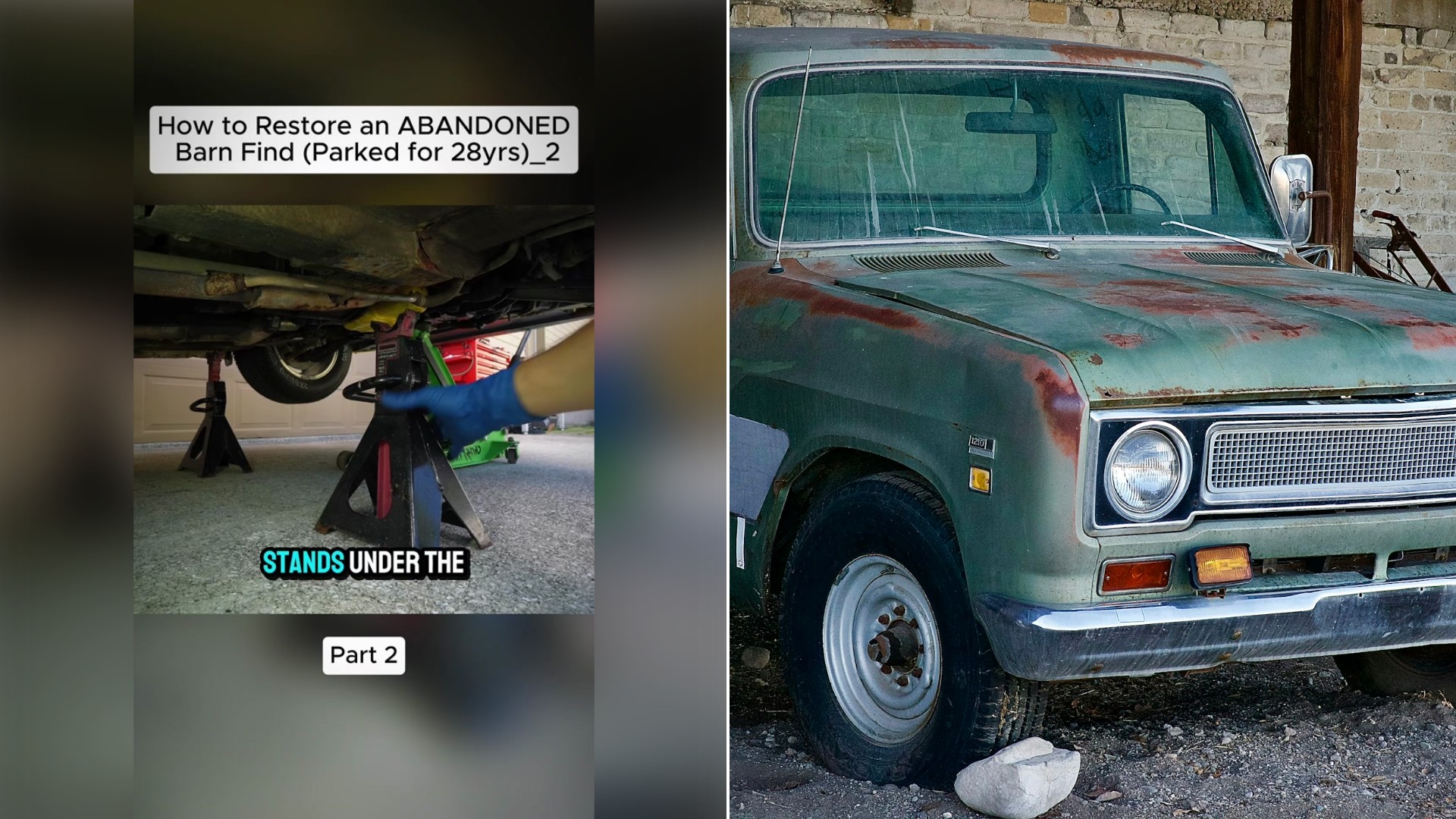
That is exactly what happened to @bushcraft.tv42 in the second part of a revival series on a long-sleeping car. The plan was simple: get the car safely on stands, drain the old oil, fit a fresh filter and find out whether the engine would turn over at all.
The Wrench Just Punched Right Through That Metal In The Filter
The prep went by the book. He lowered the frame onto jack stands, pulled the jack out and laid an oil mat down so the driveway would stay clean. Before going under, he gave the car a good shake to make sure it was solid, which is a habit worth stealing.
He used a clear catch pan so the oil could be seen as it came out, and a 14 millimeter socket broke the drain plug free. He took a sample to send out for analysis, since he wants to know the condition of the engine. He also swapped the crush washer on the drain bolt and snugged the plug to around 25 foot pounds.
@bushcraft.tv42
Then came the filter. He set the pliers on it and, in his words, “the wrench just punched right through that metal in the filter.” He says he was not even squeezing hard.
Under the paint, the filter was weak and rusty, and the metal simply collapsed. Grabbing lower did not help, because there is very little room down there. A second set of pliers slipped right off between the paint and the rust. “I’m starting to get a little nervous that a simple oil change is going to turn into something much bigger,” he admitted.
The Old Mechanic’s Trick That Finally Spun The Stuck Filter Loose
When pliers will not grip, he says, the best answer is a punch. He used a pry bar and hammered the filter in the loosening direction near the top, where the metal is thicker. That is the part of the can you can actually push against without crushing it.
It moved just a little, then a little more, and finally the whole thing spun free with a cheer. “That’s what happens when you work on a car that’s been sitting in a barn since 1998,” he said, relieved to have it off.
For the new filter he follows a few habits that matter on a car like this. He pre-fills it with oil so pressure builds faster, because the engine will be turned over with the starter until oil pressure shows up and the bearings need oil quickly. He lubricates the seal so it comes off easily next time, cleans the mating surface, threads it on and tightens by hand. He even writes the mileage on the filter so the next change is easy to track.
Tiny Steel Bits Showed Up In The Filter Pleats And In The Oil
Next he cut the old filter open with a filter cutter, then used tin snips to slit the mangled side so the element could come out. Between the pleats he saw what he called a normal amount of dirt for such an old filter. He also saw a lot of tiny metal pieces, plus one bigger piece.
He does not think the crushing caused them, since the bits sat deep in the pleats. A magnet run through the drained oil told the same story. Some of what it grabbed was rust flakes from the filter that fell in, but there were more of the small metal pieces too, and because they are magnetic, they are steel.
There were no big chunks. The oil itself, he said, looked pretty decent for its age. The sample he mailed out is meant to settle what the engine has been through.
What Goes In After 30 Years Asleep
The service manual calls for 3.4 liters of 10W30 or 10W40. He chose a high mileage 10W40, which has additives that condition and swell old hardened seals and help clean out sludge and deposits built up over the years. The engine filled to the top, and he found no fluid leaks while under the car.
Before cranking anything, he pulled the spark plugs. That makes the engine easier to spin and lets him oil the cylinders, which have been dry for decades. He blew dirt out of each spark plug well first, so nothing fell into the engine.
The first plug looked halfway decent and, to his relief, was not seized in place like the filter. A borescope camera, linked to his scan tool, showed the top of the piston and the cylinder walls. He saw the factory crosshatch honing marks and only some specks of rust.
Fogging The Cylinders With A Cavity Wax Wand
The spray nozzle on his fogging oil was too short for the deep wells, so he attached a cavity wax sprayer wand to reach the bottom of each cylinder. A burst of three to five seconds coated the walls completely, and the camera showed it live. A turkey baster of oil works too, he said, but fogging coats better.
Each spark plug well got a towel afterward to keep dirt out. One cylinder had the piston all the way up, so there was little to see, but he fogged it anyway to coat the rings. The last plug on that side sat behind a crossover tube, so he removed vacuum lines and fasteners to lift it out. Underneath, he found a flat O-ring that will need replacing. That cylinder showed a little rust pitting near the top, with the rest looking really good.
What To Take From This Barn Find
Even with a hard start, this build shows a sensible order of work for any car that has slept for years. These are the steps he followed that you can borrow.
- Support the car on stands and shake it before crawling underneath.
- Drain the oil into a clear pan so you can see what comes out.
- Cut the old filter open and run a magnet through the oil to check for metal.
- Pre-fill the new filter so oil reaches the bearings quickly.
- Pull the plugs, look inside with a borescope and fog the cylinders before cranking.