

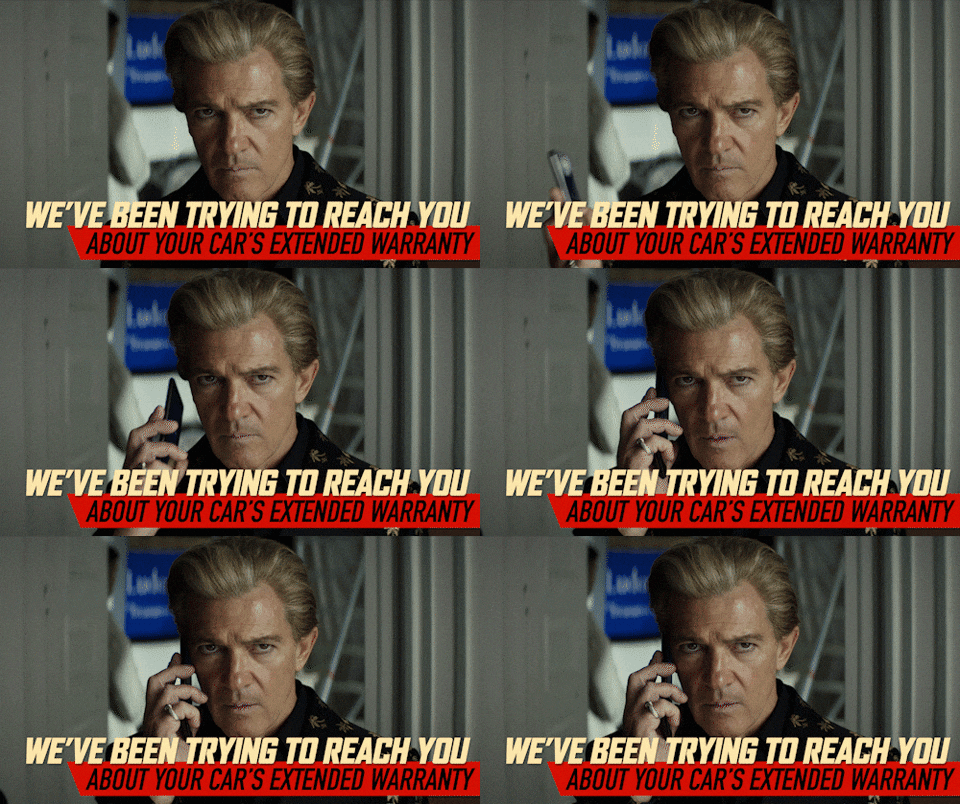
The Federal Trade Commission first sued to stop robocalls warning that your car’s warranty was “about to expire” back on May 14, 2009, when it filed suit against Voice Touch Inc., Network Foundations LLC, and Transcontinental Warranty Inc. for what then-Chairman Jon Leibowitz called one of the most aggressive telemarketing schemes the agency had ever encountered, according to the FTC’s own filing announcement. That case described hundreds of millions of prerecorded calls pushing service contracts priced at $2,000 to $3,000, dressed up as manufacturer warranty renewals. Seventeen years later, in a car-buying market that’s changed completely, the same basic call is still going out, and the FTC is still filing cases to shut it down.
The pitch hasn’t needed to change
The mechanics the FTC documented in 2009 are close to identical to what regulators were still describing more than a decade later: an automated call claims your factory warranty is expiring or has already lapsed, and urges you to press a button to speak with a representative about “extending” it before it’s too late. The 2009 complaint detailed callers who spoofed caller ID, ignored the National Do Not Call Registry, and called consumers repeatedly after they asked to stop, all violations of the Telemarketing Sales Rule, according to the same FTC press release. The product being sold was never an extension of the manufacturer’s actual warranty. It was a separately priced vehicle service contract from a third-party administrator, marketed in a way designed to make you believe you were talking to, or on behalf of, the company that built your car.
The enforcement record spans three different decades of phones
The FTC didn’t file once and move on. In July 2023, the agency announced a settlement permanently banning Kole Consulting Group and its principal from all outbound telemarketing and from ever marketing extended vehicle warranties again, after alleging their operation, doing business as American Vehicle Protection, made unsolicited calls to hundreds of thousands of consumers while falsely claiming ties to vehicle manufacturers, according to the FTC’s own settlement announcement. Fifteen months after that, in October 2024, the FTC distributed more than $449,000 in refunds to 18,255 consumers harmed by that same scheme, according to the agency’s refund announcement. A scam the FTC first sued to stop when smartphones barely existed was still generating tens of thousands of new victims in the same year gas prices and EV tax credits were dominating the actual car news.
Why a fifteen-year-old scam still gets people
Part of the answer is volume that dwarfs any single enforcement action. The Federal Communications Commission’s own consumer guide on the subject notes that auto warranty robocalls have repeatedly ranked among the most-complained-about unwanted call categories the agency tracks, and it lays out direct warning signs specific to this scam: legitimate warranty companies don’t cold-call you, and a real manufacturer already knows your VIN and coverage status without needing you to “confirm” anything over the phone. The other part is that the confusion the scam exploits is real. Most buyers genuinely don’t track their factory warranty’s mileage and date cutoffs precisely, which is exactly the gap a call claiming urgent expiration is built to land in.
How to tell the fake from the real thing fast
A genuine warranty or service-contract renewal notice comes from your dealership, your manufacturer’s financial arm, or the third-party administrator you actually signed a contract with, and it will reference your specific vehicle and account, not a generic “your car’s warranty” line read off a script. Real companies don’t need you to “press 1” on a robocall to verify coverage they already have on file. If a call or a mailer creates urgency around an imminent expiration and pushes you toward an immediate credit card payment over the phone, that pressure is doing work the FTC’s own case history says should make you hang up, not comply.
The pattern in a scam that won’t die
Individual operators keep getting sued, banned, and occasionally forced to refund what they took, and the underlying call keeps going out from whoever replaces them, because the economics never stopped working: robocalling is nearly free, the pitch requires no customization, and enough people answer to fund the next round. The FTC’s own timeline, stretching from a 2009 federal lawsuit to refund checks mailed in 2024, isn’t a story about one company. It’s a description of a business model that has outlasted three FTC chairs and shows no sign of running out of numbers to dial.