
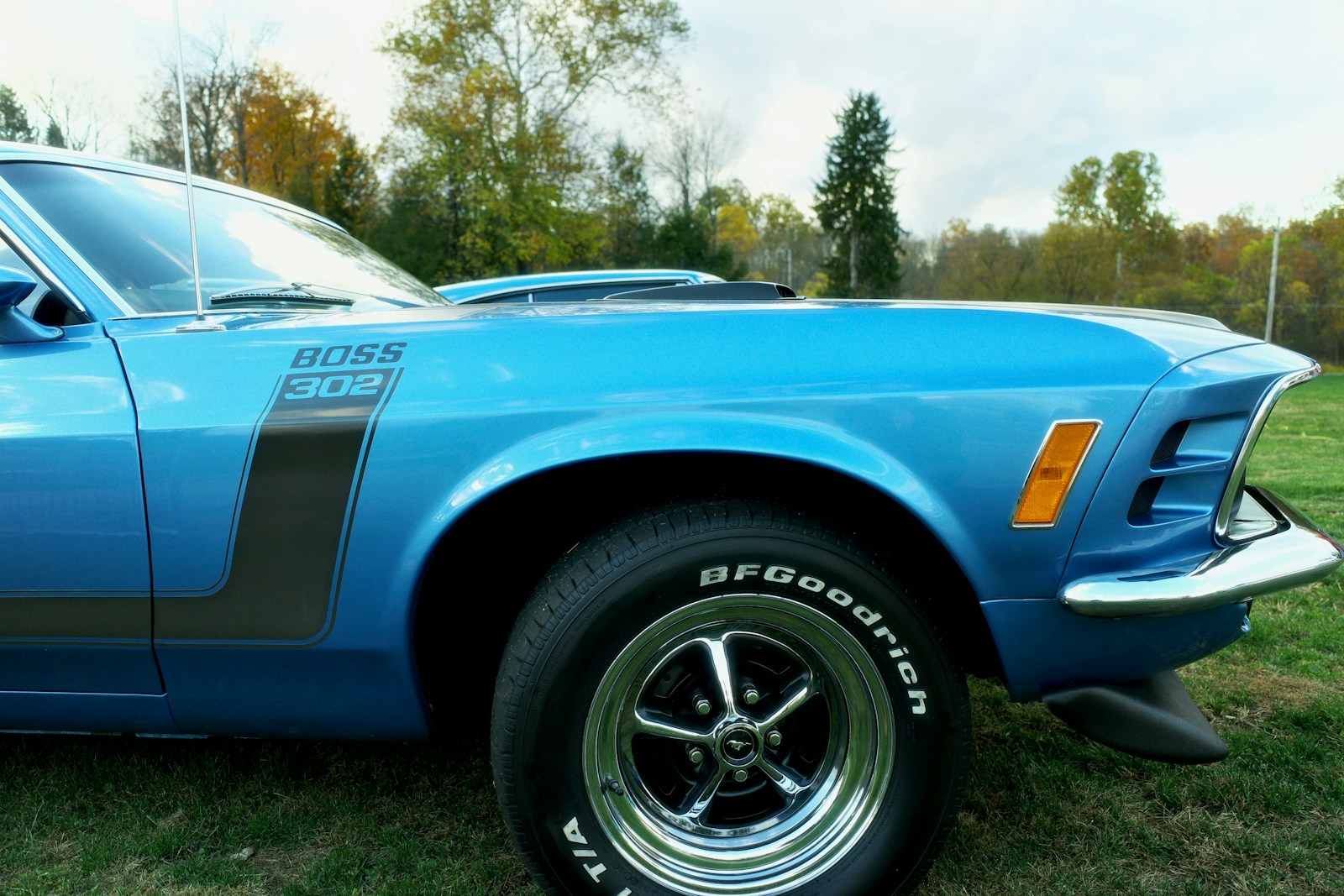

Ford built roughly 1,359 Boss 429 Mustangs across the 1969 and 1970 model years — the figure most consistently cited across documented production records and independent parts-industry historical accounts, which put the split at roughly 850-plus cars in 1969 and 499 in 1970 — and did it purely so Ford could legally race a completely different engine on NASCAR ovals where the Mustang itself barely competed. That number makes the Boss 429 one of the strangest homologation specials Detroit ever built: a street car created almost entirely as bureaucratic paperwork, wearing a body that had nothing to do with where the engine actually needed to win.
A rule that forced Ford’s hand
NASCAR’s homologation rules in the late 1960s required manufacturers to build and sell at least 500 street-legal examples of any engine before it could compete in stock car racing — a regulation designed to keep the sport tethered to cars regular people could actually buy. Ford needed a legal path to race its new semi-hemispherical-head 429 cubic-inch V8 against Chrysler’s dominant 426 Hemi, but the 429 was physically far too large to fit in the intermediate Torino and Fairlane bodies that actually ran NASCAR ovals. The Mustang wasn’t chosen because it made engineering sense — it was chosen because Ford needed 500-plus street cars built somewhere, and the Mustang’s engine bay, after extensive modification, was the least-bad option available.

How much surgery it actually took
Fitting a race engine into a car never designed for it wasn’t a bolt-in job. Ford contracted an outside engineering firm, Kar Kraft, to hand-build every single Boss 429, because the semi-hemi 429’s cylinder heads were too wide for the Mustang’s factory shock towers and front frame rails. Each car required relocated front suspension mounting points, a widened engine bay, a battery moved to the trunk to balance weight and clear space up front, and what became the largest factory hood scoop ever installed on a production Mustang just to clear the induction system. Every Boss 429 came exclusively with a four-speed manual transmission — there was no automatic option, because the engine’s design intent never accounted for anything else.
The racing payoff, and how quickly it faded
The engine did exactly what it was built to do, at least initially: the Boss 429 took 26 NASCAR victories in 1969 alone, validating the entire expensive homologation exercise in its first season. But Ford’s factory NASCAR involvement wound down not long after, and the semi-hemi 429 continued its competitive life mostly in other Ford and Mercury platforms — the Torino and Cyclone — through the early 1970s, essentially outliving the street car that had been built solely to make it legal in the first place. The Mustang version, ironically, was never the car that raced with this engine on ovals at all; it existed purely to satisfy a rule, then got out of the way.
Rarity born from a technicality, not a marketing plan
What makes the Boss 429 unusual in muscle car history is that its scarcity wasn’t a calculated business decision about brand exclusivity — it was the minimum number Ford legally had to build, full stop. Unlike the GSX or other genuinely low-volume specials that automakers chose to make rare, the Boss 429’s 1,359-unit run was essentially a regulatory floor Ford cleared by exactly enough margin, spread across two model years, to keep NASCAR satisfied while containing the cost of hand-building a car that lost money on every single unit sold at its list price. That’s a genuinely different kind of rarity than most collector cars carry, and it’s part of why documented, numbers-matching examples now sell for real money at auction — a Boss 429 brought $375,000 at a 2008 sale and more than $550,000 at a 2020 auction, according to sales tracked by parts retailer CJ Pony Parts, with a restored 1969 example separately reported to have reached $500,000 at a 2016 Barrett-Jackson sale in Palm Beach.
The loophole that became a legend
Sixty-plus model years later, almost nobody cross-shops the Boss 429 based on why it exists — they buy it because it’s a wildly overbuilt, hand-assembled anomaly wearing a body it was never meant to fit into. But the origin story matters, because it explains everything else: the impossible engine bay fitment, the four-speed-only drivetrain, the trunk-mounted battery, and the two-year production run that ended the moment the paperwork requirement had been satisfied. Few muscle cars have a more purely functional reason for existing, and even fewer turned that pure functionality into one of the most collectible Fords ever built.