
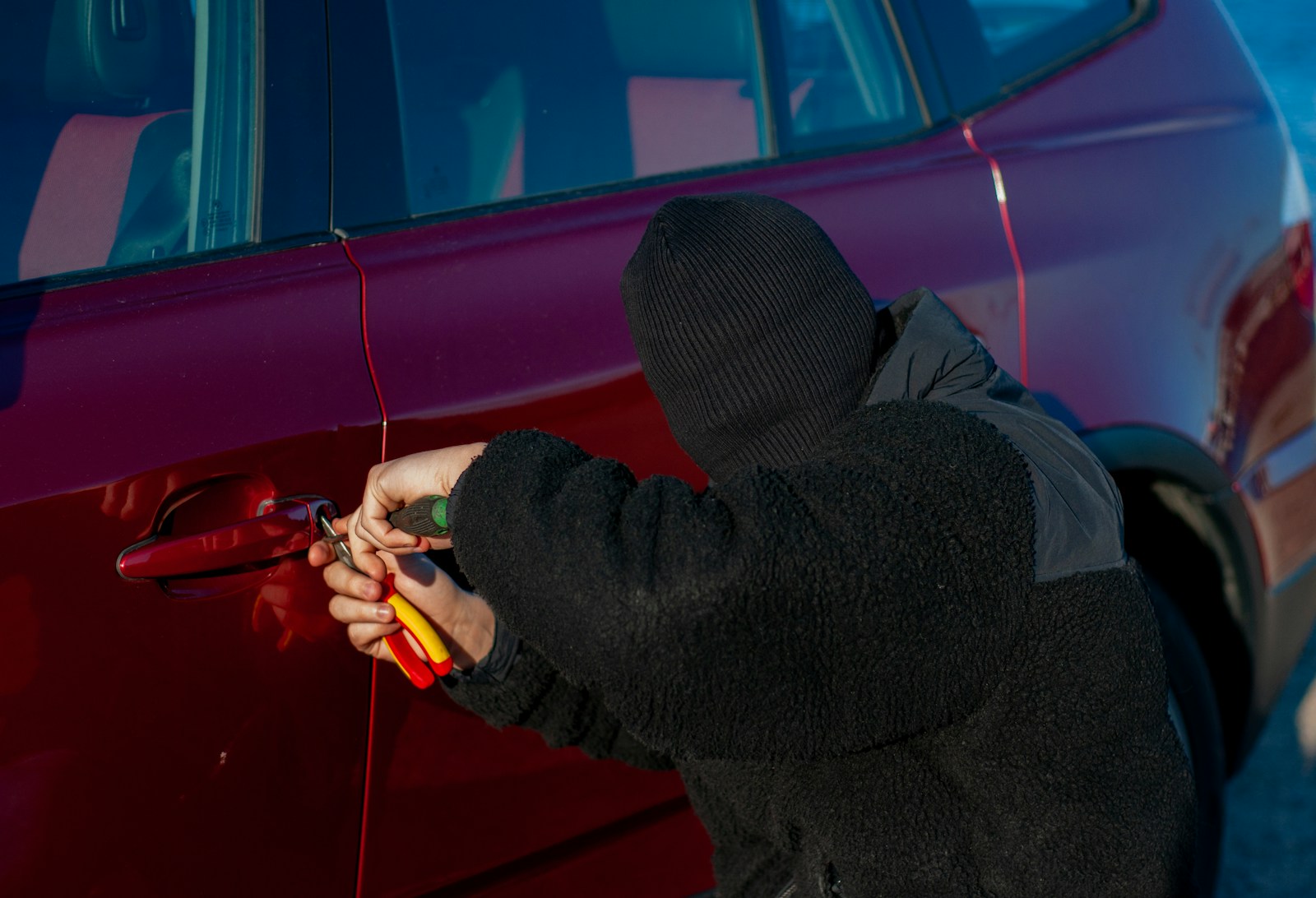

A car sitting in a locked driveway, key fob resting on a kitchen counter thirty feet away, can be unlocked and driven off in less time than it takes to brew a cup of coffee, and the owner never has to touch a lockpick or break a window to do it. That’s the reality of the relay attack, a theft method that exploits the constant low-power radio signal every keyless fob broadcasts. Security researchers in Germany tested more than 800 keyless vehicles and found roughly 85% vulnerable to it, according to reporting on the ADAC testing program. This isn’t a rare edge case. It’s become one of the default ways modern cars disappear.
How the Attack Actually Works
A relay attack needs two people and two cheap pieces of radio equipment, and neither thief ever has to touch the car until the very end. One stands near the house, close enough to pick up the faint signal the key fob is always emitting, waiting to authenticate with the vehicle. A handheld device captures and boosts that signal. The second thief stands next to the car holding a companion device that receives the relayed signal and presents it to the vehicle as if the real key were sitting right there in the driver’s hand. The car’s computer has no way to tell the difference between an authentic nearby key and a boosted signal relayed from inside someone’s living room, so it unlocks and, in many cases, allows the ignition to start.
The equipment itself is inexpensive and not hard to find. CBS News interviewed security specialist Steve Lobello, who demonstrated a related technique using a CAN bus tablet, reprogramming a vehicle’s key system in under a minute using hardware that’s sometimes stolen or bought secondhand from locksmith suppliers. “It’s basically the nervous center in the vehicle where everything has to process,” Lobello explained of the CAN bus system. “You can pretty much do things such as delete keys, program new keys.” He put the share of vulnerable vehicles at more than 90%.
The Scale of the Problem
This isn’t a fringe crime wave. National Insurance Crime Bureau President and CEO David Glawe, quoted in that same CBS News reporting, put the broader vehicle theft landscape in stark terms: “The criminal organizations and the suspects are always looking for security protocols and how to defeat them.” More than one million vehicles were stolen nationally in 2022, the highest total since 2008, working out to roughly two vehicles stolen somewhere in the country every single minute.
Keyless entry’s role in that number keeps growing internationally too. In the Netherlands, keyless systems were present on 59% of stolen passenger cars in 2025, based on Mercury Insurance analysis of NICB data cited in the Help Net Security report. NICB’s own technology page notes that newer anti-theft devices like the Flipper Zero, capable of intercepting and mimicking a key fob’s signal, are increasingly limited by rolling codes that change the signal with every use, a partial fix that pushes sophisticated thieves toward relay attacks instead, since relay attacks don’t need to crack a code at all. They just borrow the real one, briefly, from wherever the key happens to be sitting.
What Actually Stops It
The good news is that relay attacks have a genuinely simple countermeasure: distance and shielding. A signal-blocking pouch, often called a Faraday pouch, wraps the key fob in material that prevents its radio signal from being picked up at all, which means there’s nothing for a relay device to capture in the first place. Security guides recommend keeping keys away from exterior walls, windows, and doors even without a pouch, since a fob sitting on a front hallway table is often close enough to a driveway for a booster to reach it from the sidewalk.
Beyond the pouch, NICB recommends a layered approach rather than relying on any single fix: an OBD-II port lock to block the diagnostic port thieves use to program blank keys, a visible steering wheel lock as a deterrent, a hidden kill switch, and a GPS tracker in case a theft happens anyway. None of these cost much individually, and none require replacing the car’s factory security system. What they share is a simple premise: if the signal never leaves the house, there’s nothing for a thief standing in the driveway to relay.