

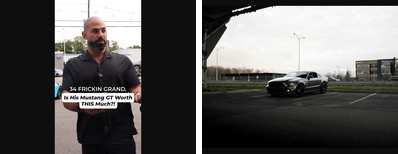
A trade-in negotiation over a modified Ford Mustang GT is drawing attention online after dealer @georgejsaliba filmed himself walking a client through the numbers right in the dealership parking lot. The clip frames the whole exchange around one blunt line of text flashed across the screen: “34 FRICKIN GRAND,” setting up the central question that drives the video, whether that figure actually reflects what the car in front of them is worth.
Rather than cutting straight to a number on a sheet of paper, the dealer walks the lot with the client, pointing out details on the car as he talks through how he arrived at his figure. The informal, outdoor setting is part of what makes the clip land with viewers, it looks less like a scripted sales pitch and more like the kind of back-and-forth that happens the moment a trade-in actually gets inspected, before anything is finalized on paper.
@georgejsaliba
Trade-in valuations on modified muscle cars are notoriously harder to pin down than on stock vehicles, and that’s a big part of why this kind of video resonates. A factory Mustang GT has a fairly predictable range based on mileage, trim and condition, but once a car has aftermarket parts, a dealer has to decide how much of that work actually adds value versus how much it simply narrows the pool of buyers who want it. Some upgrades, like a well-documented exhaust or suspension package from a respected brand, can nudge a number up slightly. Others, like aggressive tuning or cosmetic changes that don’t suit every buyer’s taste, can just as easily pull it down, even if the owner spent far more installing them than the dealer is willing to credit.
Dealers typically lean on a mix of auction data, regional demand and their own lot’s recent sales history when pricing a trade, rather than a single published guide. That’s one reason the same car can get noticeably different offers at two dealerships a few miles apart. Condition plays an outsized role too: paint and panel consistency, tire wear, interior wear patterns and whether modifications were installed cleanly or left visible marks under the hood can all shift an appraisal by thousands of dollars in either direction.
For owners heading into a trade-in conversation on a modified car, a little preparation tends to pay off. Bringing receipts and installation records for major modifications gives a dealer something concrete to work from instead of guessing. It also helps to get a rough independent estimate beforehand, whether from an online valuation tool adjusted for mods or a quick call to a specialty shop that knows the platform, so the number on the lot isn’t the only data point in the room.
It’s also worth remembering that a trade-in offer and a private-party sale price are rarely going to match. Dealers build in room to resell the car at a profit, cover reconditioning costs and account for the risk that a modified vehicle might sit on the lot longer than a stock one. That gap is normal, but it’s exactly why comparing a trade-in number against what similar cars are actually selling for in classifieds and marketplace listings remains one of the simplest ways to judge whether an offer is fair.
Videos like this one also serve a quieter purpose: they pull back the curtain on a process that usually happens behind closed doors. Watching a dealer explain his reasoning out loud, even informally, gives everyday car owners a clearer sense of what actually moves a number up or down, which is exactly the kind of insight that keeps comment sections busy with viewers running their own math on cars they’ve owned or traded in the past.
More from Steel Horse Rides
- Buyer Risked Five Hundred Dollars On A Mercedes GL450 Worth Close To Fifteen Thousand Dollars And Is Revealing Every Hidden Mechanical Flaw One By One
- Weekly Bank Repo Auction Just Sold An Entire Running Car For Only Three Hundred And Fifty Dollars And The Crowds Reaction Says Everything About How Shocked They Were
- Truck Flipper Was Mid Inspection On A Suspicious Facebook Marketplace Truck When It Suddenly Started Smoking And Leaking Fluid All Over The Parking Lot