

It started the way a lot of car trouble starts now: one weird noise that turns into a week of “Is it in my head?” and then a day where it definitely isn’t. The driver was a woman in a midsize crossover—nothing exotic, just the kind of family-ish vehicle that’s supposed to be boringly reliable—and her front end had been doing that low, rising growl that follows speed like a shadow.
She did what you’re supposed to do. Took it to a tire and service shop near her work, explained the noise, and left the keys with that uneasy feeling that comes from handing your whole commute over to strangers with impact guns. They called her later saying it was a front wheel bearing, pretty common, and they could knock it out same day. She agreed, paid the bill, and drove away thinking this was one of those adulting tasks you check off and forget.
For a couple days, it seemed fine. No growl, no vibration, no steering wheel wobble—just normal life and highway miles. Then, on an interstate run at about 70, the crossover started to feel “off” in a way that doesn’t have a good word until it becomes an emergency: a faint shimmy, then a tug, then a sound like something big and metallic was trying to chew its way out of the wheel well.
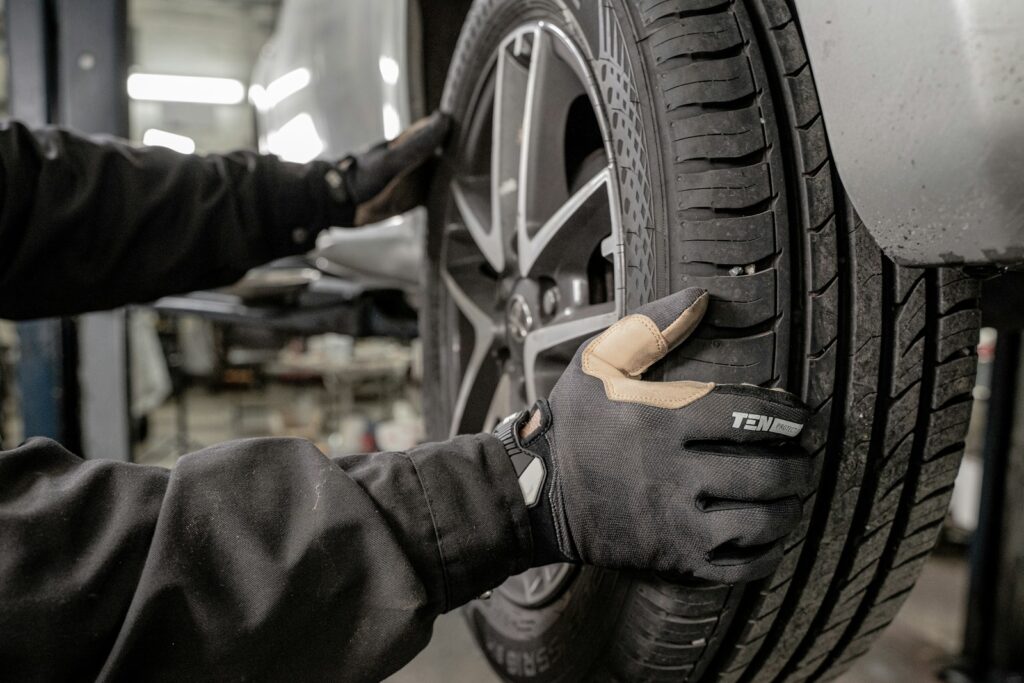
The Bearing Job That Was Supposed to Be Boring
The shop itself wasn’t some shady pop-up with spray-painted signs. It was the kind of place with a waiting area, a rack of wiper blades, and a service writer who could say “bearing” and “hub assembly” like they were ordering lunch. They’d quoted the job, recommended an alignment “since we’re in there,” and acted confident in that practiced way shops do when they want you to stop asking questions.
The customer wasn’t hovering, wasn’t trying to backseat-wrench. She dropped the car off, went back to work, and came back to a printed invoice that included the bearing replacement and the usual shop supplies line item nobody ever fights about. The tech—young, according to her, and moving fast—handed it off like it was routine.
There was a small detail she remembered later because it bothered her in hindsight: when she picked up the car, the steering wheel was slightly off-center on the drive out of the lot. Not wildly, just enough that you’d think, “Huh, that’s weird,” and then keep going because you’ve got dinner to make. She chalked it up to the alignment settling, or her brain being overly sensitive after spending money.
The First Hints Something Was Wrong
Over the next couple days, the crossover gave tiny, inconsistent warnings. A soft click on low-speed turns, like a pen tapping inside a cup holder. A faint vibration that came and went, not strong enough to pin down, and definitely not the dramatic, constant roar the bearing had been making before.
She did what a lot of people do: turned the music down, listened hard for a minute, then talked herself out of panicking. The car was just in the shop. It was “fixed.” Surely it couldn’t be something major again, not immediately, not after paying for a bearing.
By the time she actually started considering taking it back, life got in the way. The car still drove. The symptoms weren’t consistent. The shop was only open certain hours, and the idea of rearranging work for a maybe-problem felt ridiculous. That’s the trap with mechanical failures that aren’t loud yet: they weaponize your own desire to be reasonable.
70 MPH, Then the Wheel Starts Arguing With Physics
On the interstate, the “maybe” suddenly decided it was done being subtle. At cruising speed, the front end started to oscillate—first a light shake, then a rhythmic wobble like the tire was out of round. She eased off the throttle, hands tightening on the wheel, eyes scanning for an opening to move right.
Then came the sound people describe with their whole bodies: a harsh grinding and clattering that felt like it was under her feet. The steering got loose, like the front corner wasn’t connected in the way it’s supposed to be connected, and the car yawed toward the shoulder without her telling it to. She didn’t slam the brakes; she just tried to keep it straight long enough to get out of the lane and not get collected by a semi.
When she finally got it onto the shoulder, the crossover lurched and dropped on that corner with a final metallic bang. The wheel didn’t fly off into traffic like in a movie, but it wasn’t “on” in any healthy sense either. It was cocked at a wrong angle, stuffed into the fender liner, and you could see daylight where daylight shouldn’t be.
Traffic kept ripping by at full speed, the car rocking from the wind blast, and she sat there with her hazards on trying to slow her breathing down enough to make a phone call. It’s one thing when a car breaks; it’s another when it breaks like it wants to take the whole suspension with it. She kept thinking about what would’ve happened if she’d been changing lanes, or if it had let go on a curve.
The Tow, the Tear-Down, and the Missing Step
The tow truck driver took one look and got that expression that says, “Yeah, this is a mess,” before he even got the hook set. The wheel wouldn’t roll, so he had to drag it onto the flatbed in a way that sounded expensive. The driver asked if it had just had work done, because apparently he’s seen enough failures to recognize the vibe.
Back at a different shop—she didn’t want the original place touching it again without a neutral set of eyes—the diagnosis got ugly fast. The front hub assembly was destroyed, the spindle was sheared, and the whole corner looked like it had been hammered for miles. It wasn’t just a bearing that failed; it was a bearing that got the chance to eat itself while the wheel slowly loosened.
The mechanic doing the inspection found the kind of smoking gun that makes people go quiet: the front hub nut. It was backed off, not finger-loose, but loose enough that it had clearly never been final-torqued to spec, or it had been run down with an impact and left wherever it landed. Without that proper preload, the bearing didn’t just “wear out.” It got to wobble, heat up, and let the whole assembly work itself apart at highway speed.
There are a few moments in car stories where the technical detail actually matters, and this was one. That hub nut isn’t decorative. It’s what keeps the bearing clamped the way the engineers intended, and when it’s wrong, the rest of the parts don’t politely fail one at a time—they take turns destroying each other until something gives.
Back to the Shop: The Awkward Counter Conversation
Armed with the second shop’s photos and notes, she went back to the original tire place the next day, not to scream but to get someone to explain how a fresh bearing job turned into a shredded front corner. The first person she talked to was the service writer, who did that careful, defensive politeness that comes out when the story doesn’t match the invoice. They asked if she’d hit anything, if she’d been in an accident, if anyone else had worked on it.
She said no, and she kept her voice steady, but the frustration was right there on the surface. She’d paid them for a fix and ended up on the shoulder of an interstate. She didn’t want a lecture on road hazards; she wanted them to look at the failure and own whatever part of it was theirs.
When the manager got involved, the tone shifted into procedure. They wanted the vehicle brought back to their shop for inspection, which is the standard move because it gives them control of the narrative and the parts. She didn’t want to tow it to them and let the evidence disappear into a back bay, but she also knew the fastest path to any reimbursement usually involves playing along—at least a little.
At some point, someone went into the shop area and came back with the kind of tight face that suggests a tech had been asked a question he couldn’t answer cleanly. Nobody walked out and said, “Yeah, we forgot to torque it.” It was more like, “We’ll need to review,” and “We can’t determine anything until we see it,” and “Our techs follow procedure.” The careful language was doing a lot of work.
The Damage Number, the Liability Dance, and the Part Nobody Can Unhear
Meanwhile, the second shop’s estimate wasn’t small. It wasn’t just “replace the bearing again.” It was spindle/knuckle-related parts, hub, possibly the axle, and whatever collateral damage happened when the wheel ran loose. Plus towing, plus the cost of being stranded, plus the new fear that the car wasn’t trustworthy anymore.
The original shop’s offer—at least initially—wasn’t a clean “We’ll cover it.” It sounded more like a negotiation starting point: maybe they’d refund the bearing job, maybe they’d help with parts if they found “a defect,” maybe they’d only cover it if their own inspection proved fault. The customer wasn’t trying to get a free upgrade; she wanted the vehicle made whole and she wanted someone to admit this wasn’t normal wear-and-tear two days after service.
The detail that stuck with everyone who heard the story wasn’t even the shredded spindle. It was the thought of that hub nut being left short of final torque—one skipped step, one “I’ll come back to it,” one moment of distraction—and how quietly that decision can ride along until it cashes out at 70 mph. She didn’t have a dramatic crash to point at, just a hard, terrifying failure and a pile of metal that looked like it lost a fight.
And the tension that hung over the whole thing wasn’t resolved with a neat bow, because it rarely is. Even if the shop eventually paid, there was still the part where she had to sit in traffic afterward, watching cars whip past the spot where her wheel tried to leave the chat, wondering if “fixed” will ever feel like “safe” again—or if every faint vibration from now on is going to sound like that hub nut backing off in her head.
More from Steel Horse Rides: