

She’d been trying to be responsible about it, which is how these stories always start. The BMW 5-Series was due for tires, the rears were worn down enough to get that faint “don’t push it” vibration on certain highway ramps, and she didn’t want to be the person riding cords because she was busy.
So she booked an appointment at a chain tire shop on a Tuesday afternoon, the kind with bright lights, a waiting area that smells like coffee and rubber, and a service desk where everything is “no problem” until it’s very much a problem. She specifically asked for run-flats because the car came with them, the trunk setup didn’t have a spare, and she wasn’t looking to reinvent her whole roadside-plan.
Two new rear run-flats, mounted and balanced, in and out. The invoice printed, the tech rolled the car around, and she drove off feeling that tiny relief you get when you’ve handled a boring adult task without drama.
The handoff that felt a little too smooth
At the counter, it all sounded normal. The service advisor did the usual: confirmed the size, glanced at the keys, pointed at the car through the glass like it was a stage prop, and said it was ready.
The only thing that stuck out was how fast it happened. Run-flats aren’t impossible to mount, but anyone who’s watched them go on a wheel knows they can be stubborn, and the shop was moderately busy.
Still, she didn’t have a reason to interrogate it. The steering felt fine pulling out, no warning lights, no immediate wobble, and the car did that BMW thing where it tries to convince you everything is always fine even when it’s not.
The highway merge where the car changed personalities
She got a few miles of city streets, stoplights, and low-speed turns before hitting the on-ramp. That’s important, because at 30 mph a lot of sins are quiet.
On the merge, she eased up to speed like usual—60, 65, 70—and that’s when the back of the car started talking. Not a little shimmy, but a heavy, rhythmic shaking that made the rearview mirror blur and the seat vibrate like a dryer full of sneakers.
At first her brain tried to label it as something harmless: maybe fresh tires have some weird coating, maybe it’s a bad balance, maybe she just noticed it because she’d been thinking about tires all day. Then it got worse in the span of seconds, like the frequency matched the speed and decided to become her entire reality.
She did what most people do when something starts shaking at highway speed: she backed off the throttle and fought the urge to brake hard. The car didn’t feel like it wanted to spin, but it felt wrong in a way that makes your hands go tight on the wheel without permission.
The shoulder inspection that turned into a “what am I looking at?” moment
She got onto the shoulder with flashers on and that hollow feeling in her chest you get when you’re trying to look calm while your brain runs every worst-case scenario. Semi trucks blasted past, the car rocked on its suspension, and she walked around to the back, expecting to see a low tire or a bubble.
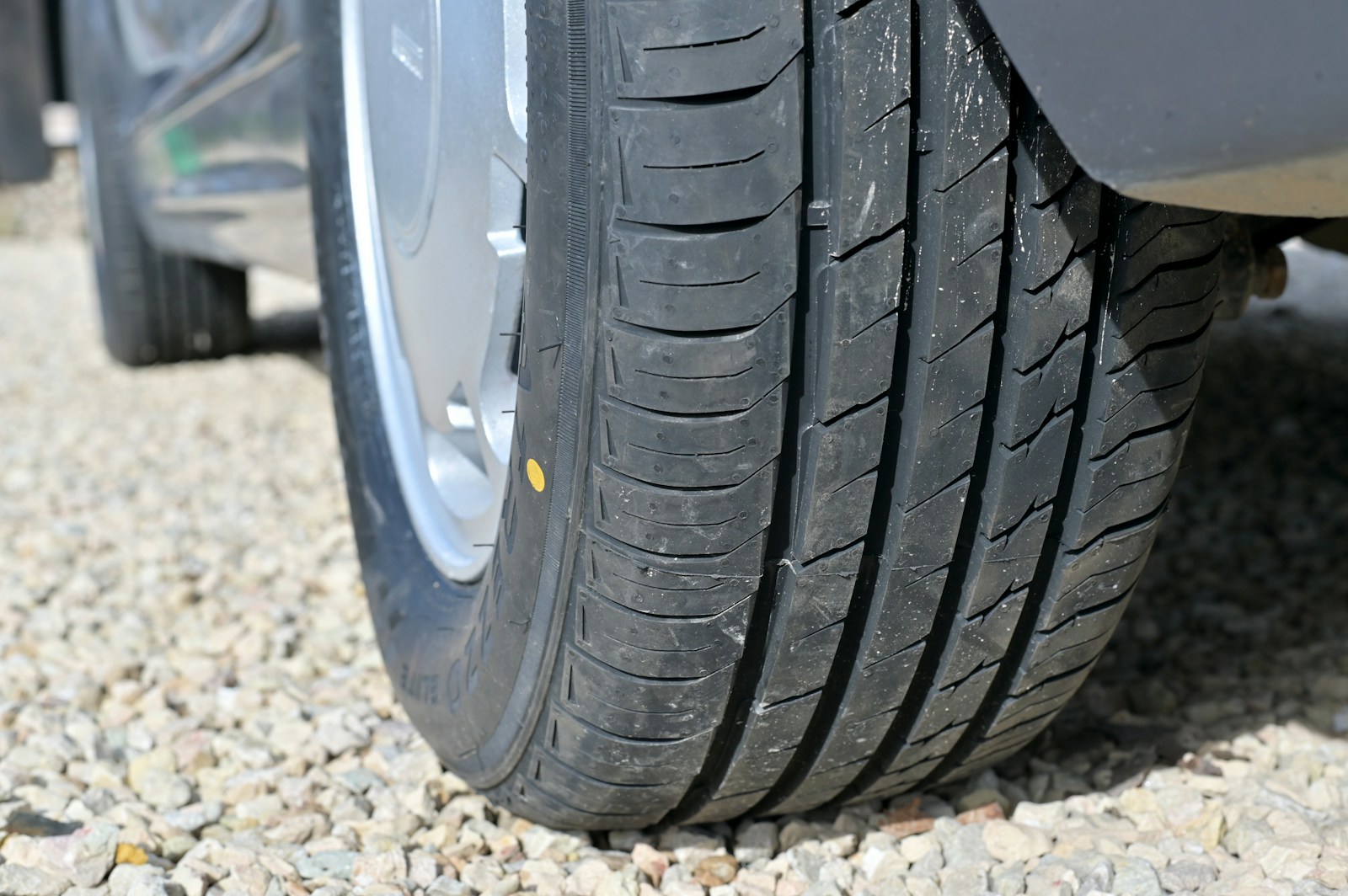
What she saw was… confusing. Both rear tires looked “full,” but the sidewalls didn’t look right—like the lettering and the shape were a little off, like the tires were trying to sit on the wheels instead of being part of them.
She crouched closer, because people always crouch closer when they shouldn’t. That’s when she noticed the detail that made her stomach drop: the “outside” markings on the sidewall weren’t on the outside.
Run-flats, especially certain performance ones, are directional or asymmetric, and they’ll literally say things like “Outside” or have arrows showing rotation. On her car, both rear tires had those cues facing inward, tucked toward the suspension where you’d never see them unless you were on the ground on the shoulder of a highway.
It wasn’t a subtle “maybe.” It was the kind of wrong that makes you wonder how many people had touched the job and still sent it out.
Back at the shop: denial, then the slow realization
She limped it back off the highway at low speed, taking surface roads like she was transporting a cake. Every time the car hit 45–50 mph, the shaking tried to come back, so she kept it slow and pulled back into the same lot she’d left not long before.
The initial vibe inside was almost comical. Same counter, same fluorescent calm, same service advisor who’d handed her the keys with a smile, now looking at her like she was returning a sandwich because it had too much mayo.
She didn’t scream or throw keys or do a dramatic speech. She told them, flatly, that the car became undriveable at highway speed, and she’d checked the tires on the shoulder, and both rear run-flats were mounted inside-out.
There was a beat where the advisor tried to translate that into something that fit the script. A “mounted wrong” complaint is supposed to be a balance issue, maybe a bad tire, maybe a rim bent. “Inside-out” doesn’t land as a normal customer sentence.
So they walked out together. One of the techs came with them—young guy, grease-stained gloves, that forced neutral expression people put on when they suspect they’re about to be blamed for something.
She pointed at the sidewall markings. The tech leaned in, then leaned closer, and for a second he did that thing where you can tell he’s hoping the letters will rearrange themselves if he stares hard enough.
Then the posture changed. Less confident. More quiet. He didn’t argue with the physics of it, because you can’t argue with molded rubber that literally says “Outside” on the inside.
The awkward explanation and the stakes nobody wanted to say out loud
The shop’s first instinct was to shrink it into a simple fix. “We’ll get it back in, remount them, rebalance, get you on your way.” That’s how businesses survive: turn disasters into routine service recoveries.
But she kept circling back to one part they weren’t saying. She’d been at 70 mph. The car wasn’t lightly vibrating; it was shaking hard enough that she thought something was coming apart. Whatever the tires were doing at speed, it wasn’t just “a little inconvenience.”
Run-flats have reinforced sidewalls, and asymmetric designs matter because the tire is built to handle loads in specific ways. Mounting them backwards doesn’t just mess up tread behavior in rain; it can cause weird stiffness, heat, and deformation under load that turns into that terrifying oscillation.
The most uncomfortable part wasn’t even the mistake. Mistakes happen. It was that it happened twice, on both rear tires, on a car that absolutely spends time at highway speed, and it got signed off like it was normal.
Inside the shop, you could feel the shift from “customer complaint” to “liability situation.” Someone went to get a manager. The manager came out doing the calm, slow voice, asking what happened as if the tires weren’t still sitting there confessing in block letters.
They offered to fix it immediately, no charge, and tossed in the standard apology. But she wasn’t just hearing words anymore; she was replaying that moment on the merge lane when the car started to shake and she had to decide whether to brake or ride it out.
What she left with wasn’t just corrected tires
They did remount them. They rebalanced. They test-drove it. On paper, the problem was solved in the neatest way possible.
But she didn’t leave with the feeling she’d come in for—peace of mind. She left with a repaired car and a new mental file labeled “things that can happen even when you pay professionals,” and it was thick with details: the speed, the shoulder, the letters on the sidewall facing the wrong direction like a joke no one was supposed to notice.
She also left with a decision hanging in the air that the shop couldn’t make for her. Do you trust them again because they fixed it? Or do you trust your own gut, which is now permanently tuned to the sound of tires that were installed wrong and waved out the door anyway?
The messiest part is that nothing “happened” in the way people expect a story like this to end. No crash, no heroic rescue, no clean villain monologue—just a customer who got lucky enough to feel the car misbehaving before the situation picked a worse moment, and a shop that had to stand there in the parking lot and look at a mistake that couldn’t be argued away. Even after the tires were corrected, that 70-mph shaking stayed with her, because once you’ve felt a car start to come apart under you, “sorry about that” doesn’t stick the landing.