

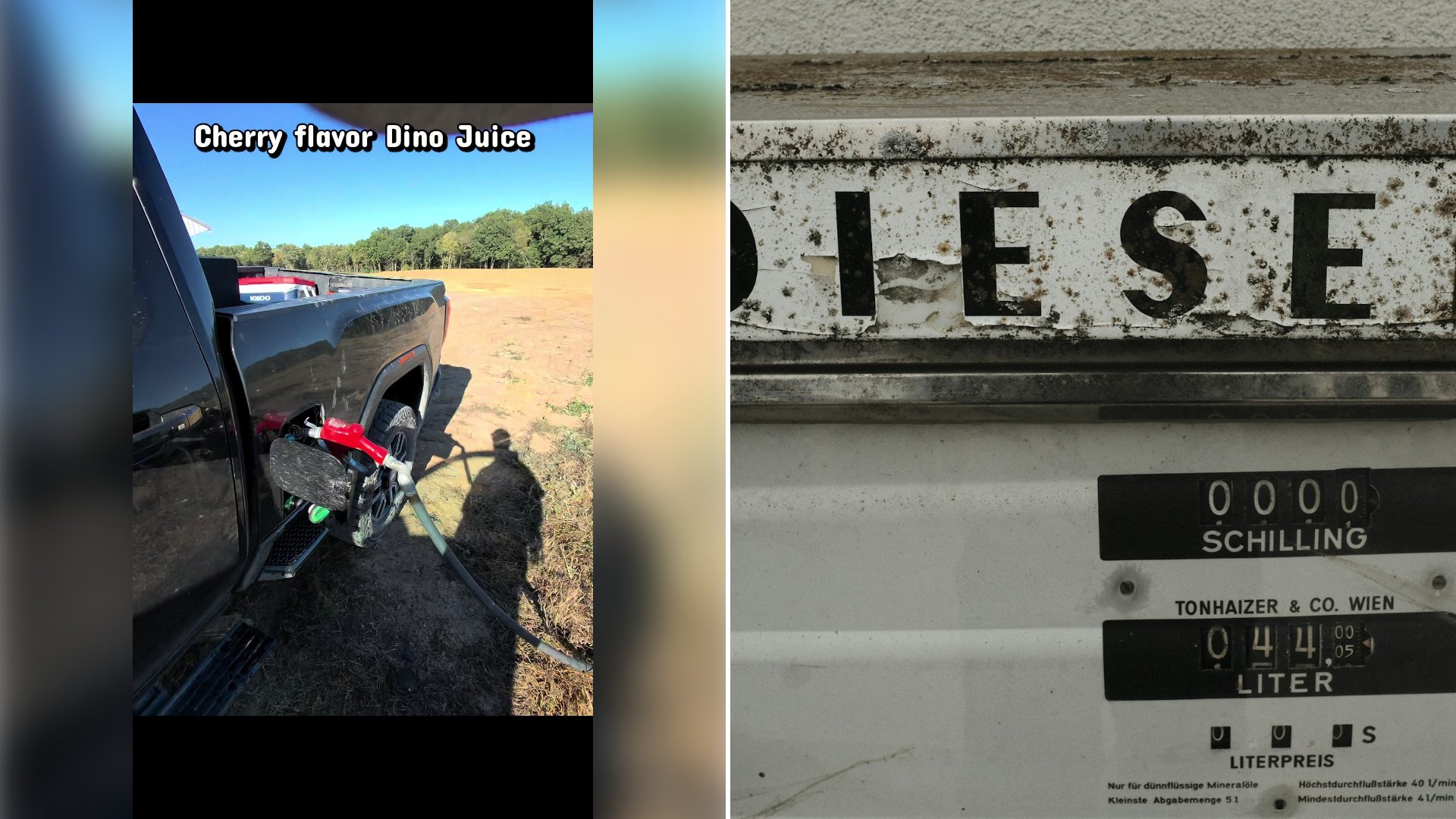
The TikTok account @dig_it_starnes_, which posts as Dig it starnes, put out a video on October 6, 2026 captioned “Good soup” with hashtags for heavy equipment, caterpillar, diesel and truck. Over the opening shots a line of on screen text reads “Cherry flavor Dino Juice.” The camera shows a dark pickup in an open field with a red nozzle in its fuel filler and liquid splashing at the opening, then a gray fuel trailer sitting in the dry grass with a hose running to the truck.
He opens with a joke that is also a news reference: “Did you guys hear the good news? We can start running red dye in our trucks.” Then he plays it straight and sarcastic at the same time. “This is the first time I’ve ever put red dye in my truck, obviously because it’s not allowed and I would never do that,” he says, “because taxes are awesome and we love and trust the government.” Everything he says about law and cost in the clip is his own account, and the video shows only the fueling and the field.
His main claim is that nothing about the fuel is different except the color. “Red dye diesel is identical to on road diesel. It just has the dye in it,” he says. He then answers people who say it is bad for emissions aftertreatment systems, calls that false, and says the dye “does not harm anything,” is used in all heavy equipment, does not void heavy equipment warranties, does not bypass any emission systems and does not affect function. These are his statements, and the video offers no test, label or document to back them.
Then he gets to the money. “The pump right now is about $6 a gallon,” he says, and the off road diesel he buys in bulk is “around four dollars and ninety cents a gallon.” By his numbers the gap is $1.10 a gallon, so a 250 gallon fill, an example of the arithmetic and not a figure from the video, would differ by $275. He adds that “up until now” it has been illegal to use red dyed fuel, though he thinks illegal is a harsh word because “if you get caught, they’re just going to give you a fine,” which he sums up as “legal, for a price.”
The day before the video was posted, on October 5, 2026, the White House issued Executive Order 14435, titled Emergency Tax Relief on Diesel Fuel. The creator does not name it in the clip. According to the text on the White House website, it tells the Treasury Secretary to determine whether relief is authorized and, if so, to defer the federal diesel excise tax incurred from October 5 through December 31, 2026, with no penalties or interest to the extent authorized by law. It also tells the Secretary to direct the IRS to announce that it will not impose the penalties in the tax code for dyed diesel sold for or used on the highway during those dates.
The order has limits that matter for a driver. It asks Treasury to issue guidance on the conditions and covered parties, and to explore ways to eliminate the deferred amounts, which is an instruction to explore and not a forgiveness. It tells the Transportation Secretary, through the Federal Motor Carrier Safety Administration, to continue all compliance enforcement, including audits, inspections and monitoring. It asks the Agriculture Secretary and the White House Office of Intergovernmental Affairs to encourage states to match the relief, so state rules can differ. The order text does not mention the Environmental Protection Agency.
Before the order, the baseline was set out by the Internal Revenue Service. Its Publication 510 says dyed diesel used in a highway vehicle for a taxable use is subject to a back tax, generally 24.4 cents a gallon, that the vehicle’s operator is generally liable, and that the penalty is the greater of $1,000 or $10 per gallon of dyed fuel involved, in addition to any tax. The publication also says dyed diesel is meant for nontaxable uses, and that the notice on the pump reads “Dyed diesel fuel, nontaxable use only, penalty for taxable use.”
Put side by side, the video and the documents say different things about different time frames. The creator is talking about savings and sums it up as a risk and reward calculation, while the order covers only October 5 through December 31, 2026 and leaves the details of conditions and state rules to others. A driver who wants to follow his example would need the Treasury guidance, the state’s rules and the engine maker’s own fuel and warranty terms in hand first, and none of those come from this video.
More from Steel Horse Rides
- Creator Explains Why the Toyota Tacoma Holds Its Value So Well and Shares Independent Resale Data for the Tundra, Four Runner and Land Cruiser As Well
- Car Expert Explains California’s New CARS Act Requiring Dealerships To Disclose Full Vehicle Prices Upfront and Offer a Three Day Cancellation Window
- Buyer Catches a Facebook Marketplace Car Flipper Rolling Back the Odometer and Says the Title Was Not Even in His Name, Then Warns Other Shoppers