


Volvo has built its reputation on automotive safety, but the Swedish automaker is now taking vehicle protection to an entirely new level. The company is using AI-generated virtual worlds and advanced software systems to identify and prevent safety problems before drivers even encounter them on real roads. This technology allows Volvo to test thousands of driving scenarios in days rather than months, fundamentally changing how automotive safety systems are developed.
For decades, Volvo Cars has pioneered innovations like the three-point seatbelt and side-impact protection. The latest approach combines data from sensors in new vehicles with computational techniques that recreate dangerous situations in virtual environments. Engineers can then refine safety software to handle rare but potentially life-threatening scenarios without putting anyone at risk.
This shift represents a major evolution in how Volvo approaches vehicle safety. Rather than waiting for accidents to happen and analyzing them afterward, the automaker now synthesizes incident data from emergency braking, sharp steering, and manual interventions to prevent similar situations from becoming dangerous in the first place.
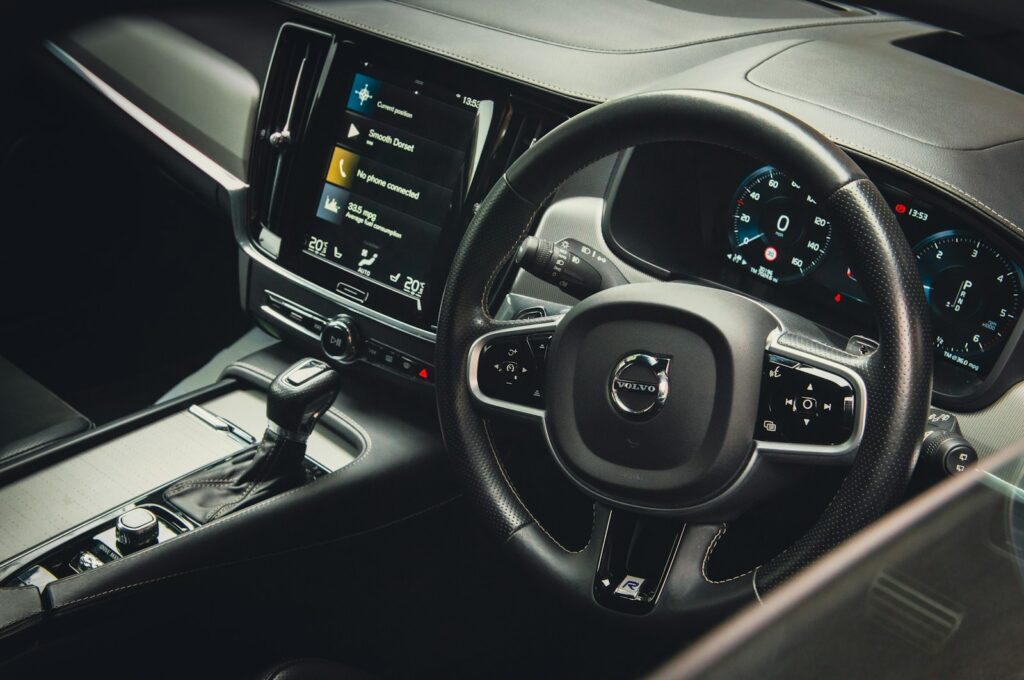
How Volvo Uses Advanced Software and AI to Prevent Safety Problems
Volvo has deployed artificial intelligence and sensor networks to identify potential safety issues before they become noticeable to drivers. The automaker collects real-world incident data, recreates traffic scenarios in virtual environments, and pushes software improvements directly to vehicles already on the road.
Collecting and Analyzing Sensor Data for Predictive Safety
Advanced sensors in Volvo’s newest vehicles capture detailed information about driving incidents, including emergency braking, sharp steering, and manual driver interventions. The company’s safety software development processes this data to understand when and why driver assistance systems activate.
Zenseact, Volvo’s software subsidiary, analyzes these events to identify patterns that signal potential hazards. The sensor data reveals real-world situations where ADAS features engage, providing insights into how drivers interact with their vehicles during critical moments.
This approach allows engineers to study thousands of actual driving scenarios rather than relying solely on test track simulations. The data helps Volvo understand which situations require improved responses from their advanced driver assistance system technology.
AI-Driven Virtual Environments and Gaussian Splatting
Volvo uses AI-generated 3D environments to recreate and test traffic scenarios at unprecedented speed and scale. The company employs Gaussian splatting, a neural rendering technique that produces high-fidelity 3D scenes from collected sensor information.
These virtual environments allow Volvo to simulate rare and complex incidents that would be difficult or dangerous to recreate in physical testing. Engineers can modify variables within these digital worlds to explore how different factors affect safety outcomes.
The automaker collaborates with NVIDIA and WASP (Wallenberg AI, Autonomous Systems and Software Program) to leverage AI supercomputing capabilities. NVIDIA’s technology enables driver assistance systems to rapidly adapt to new driving situations, making each vehicle generation smarter.
The NVIDIA DGX AI supercomputing platform processes massive amounts of data to train safety algorithms more efficiently than traditional methods.
Continuous Software Updates and Over-the-Air Improvements
Volvo pushes software updates directly to vehicles through over-the-air technology, allowing safety improvements to reach drivers without requiring dealership visits. This capability means that insights gained from virtual testing and real-world data analysis translate into immediate enhancements for existing vehicles.
The company’s approach ensures that safety features evolve continuously rather than remaining static after a vehicle leaves the factory. As the AI systems learn from more scenarios, they become better at predicting and preventing accidents.
This update system creates a feedback loop where real-world performance informs virtual testing, which then generates improved software that gets deployed to the fleet. The result is a safety system that becomes more capable over time.
Impact of Software-Driven Safety Systems on Volvo’s Innovations
Volvo’s shift toward software-driven safety has accelerated the development of advanced driver assistance systems while building on decades of physical protection innovations. The integration of AI-powered testing environments with traditional safety features is reshaping how quickly the automaker can deploy new protective technologies.
Real-World Testing and Accident Prevention
Volvo now synthesizes incident data collected by advanced sensors in its vehicles to reconstruct and analyze near-misses and interventions. When a car triggers emergency braking, sharp steering, or requires manual intervention, that information feeds into AI-generated virtual environments.
The company uses Gaussian splatting to create lifelike 3D simulations of real-world incidents. These reconstructions allow engineers to test collision avoidance and run-off road mitigation systems across countless scenarios without putting anyone at risk.
This approach transforms how vehicle safety is designed by enabling rapid iteration of safety software. Features like cross traffic alert and the blind spot information system (BLIS) can be refined based on actual driving conditions encountered by Volvo’s fleet.
Emerging Autonomous and Advanced Driver Assistance Features
Advanced driver assistance systems are evolving rapidly through Volvo’s software-first methodology. The EX90 electric SUV represents the latest platform integrating these capabilities with connected safety features that communicate between vehicles.
Pilot Assist and other semi-autonomous driving functions benefit from the vast testing capacity that AI-powered simulations provide. Engineers can now evaluate how these systems respond to edge cases that might occur only rarely on public roads.
The speed of development has increased dramatically. What previously required years of physical testing can now happen in weeks through virtual validation, allowing Volvo to deploy software updates that make cars safer over time.
Integrated Hardware and Legacy Safety Innovations
Software enhancements work alongside Volvo’s established physical safety architecture. The safety cage, crumple zones, and strategically placed airbags remain fundamental to occupant protection.
Systems like the Whiplash Injury Protection System and Side Impact Protection System have been refined through decades of crash analysis. The company’s systematic approach to understanding accidents dates back to the 1970s when it began collecting field data.
Electric cars like the EX90 present new challenges for safety engineers. Battery placement affects crumple zone design, while the absence of engine noise requires different approaches to pedestrian warning systems. Software-driven safety allows Volvo to address these challenges while maintaining the protective standards established through earlier innovations.
More from Steel Horse Rides: