
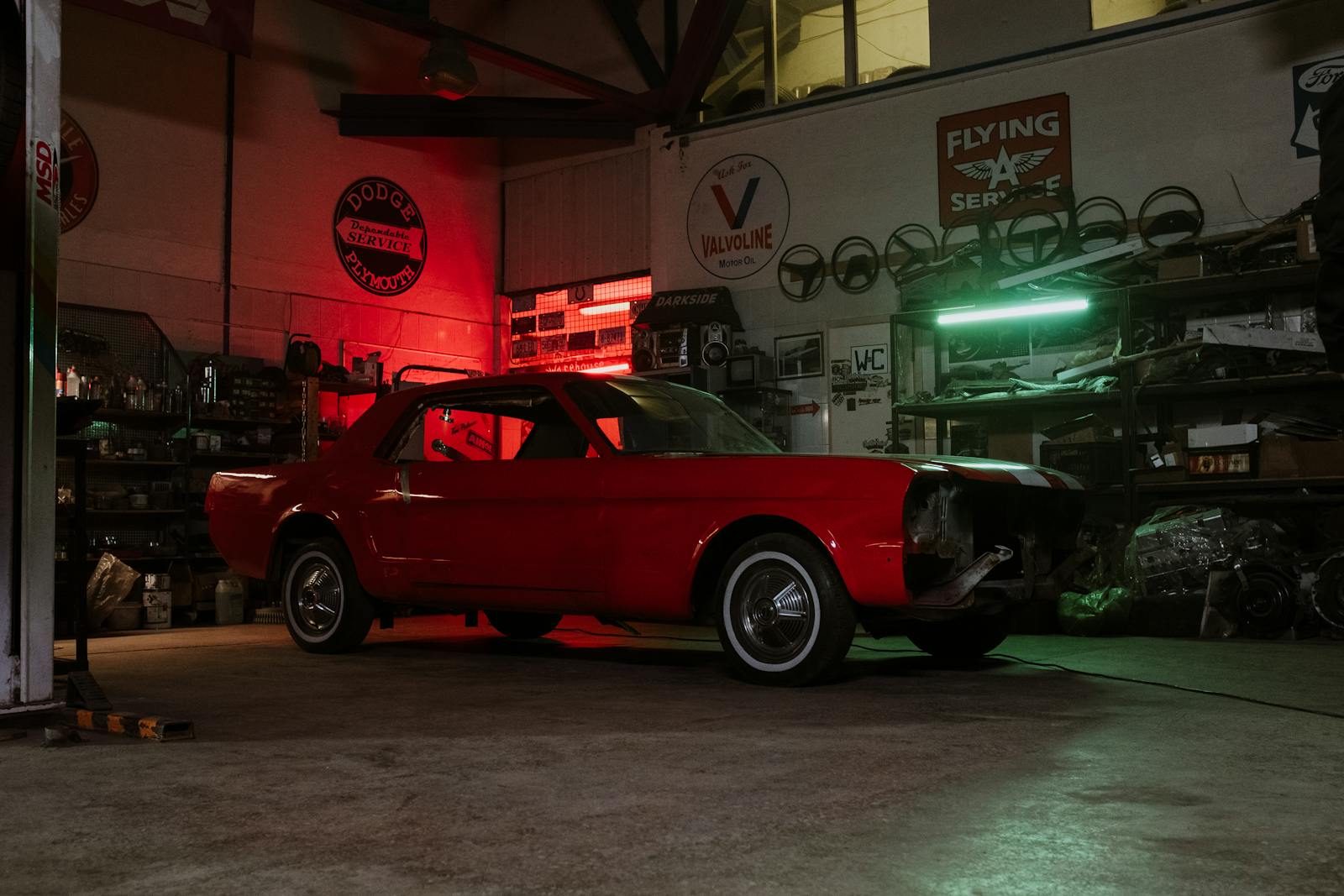

By the time the third “temporary” project car showed up on the curb, the woman across the street had stopped pretending it was a phase. It was always the same routine: a loud trailer clanking up at dusk, a car that looked like it had lost a fight with a guardrail, and her neighbor—mid-30s, always in stained gloves—waving like he was bringing home groceries instead of another half-dead engine.
At first, the street tried to be polite about it. Suburbs come with unspoken rules: don’t be the person who complains about lawn height, don’t start a war over trash bins, and don’t stare too hard at someone else’s mess. But “someone else’s mess” started bleeding into everyone’s daily life when the cars began multiplying and the driveway turned into a rotating exhibit of missing doors, mismatched hoods, and one suspiciously clean set of rims that didn’t match anything else.
The woman wasn’t new to the neighborhood. She’d lived there long enough to know who left their dog off-leash and who never tipped the mail carrier at Christmas. She’d also learned that if you’re going to be annoyed, you should pick your battles. She told herself the clanging, the revving, and the occasional late-night air compressor were just the cost of living near someone who treated his driveway like a junkyard pit lane.

The driveway garage that wouldn’t quit
The neighbor—let’s call him Derek, because every street seems to have a Derek—had a talent for making every conversation sound reasonable. When a couple asked about the car with no wheels parked halfway on the grass, he said it was “waiting on parts.” When the woman asked if he could stop idling for twenty minutes at 6 a.m., he apologized and blamed “new fuel lines.” Always the same soft smile, always a plausible explanation.
But the street noticed patterns. Cars arrived on Fridays and suddenly there’d be a stack of tires on the sidewalk by Saturday. A beat-up Honda would appear, and within a week its headlights were gone and its trunk was sitting open like it was yawning. A few times, people woke up to the sound of metal hitting pavement and looked out to see Derek sliding something long and wrapped—like a bumper—into the side gate.
None of it was illegal in a way that was easy to call in. The cars were usually on his property, and technically he wasn’t running a business, just “working on his stuff.” The woman kept her frustration tucked away until the night she heard a drill whining past 11 p.m., walked outside, and caught the sharp smell of fresh spray paint drifting through the air like someone was trying to cover a crime with primer.
The first missing part and the bad timing
The thing that kicked the whole street into a different gear wasn’t the noise, or the eyesore, or even the way the driveway looked like it had a parts catalog exploded across it. It was the older guy two houses down—quiet, proud of his older F-150—who knocked on doors on a Tuesday morning asking if anyone had seen a tailgate. He wasn’t dramatic about it, but his face had that baffled anger of someone who knows exactly what’s missing and exactly how heavy it was.
At first, people assumed it was kids or random theft. Tailgates get stolen, catalytic converters disappear, and sometimes you take your lumps and move on. But then the next house over realized their work van was missing a ladder rack, and a woman on the corner swore her boyfriend’s aftermarket wheels weren’t “misplaced” because she’d watched him lock them in the garage the week before.
The timing was what made everyone start glancing at Derek’s driveway without meaning to. Because right around the same week those parts vanished, Derek’s latest project suddenly had a suspiciously new-looking tailgate leaned against it, plus a shiny rack propped behind his fence like it was waiting to be installed. It wasn’t proof, but it was the kind of coincidence that makes people stop giving someone the benefit of the doubt.
The woman didn’t want to be the one to accuse him. She also didn’t want to be the one to ignore it and end up with her own car sitting on blocks. So she did what normal people do when they feel trapped between being paranoid and being naive: she started paying attention. She looked out her window when she heard footsteps in the middle of the night, and she started noticing how often Derek’s side gate creaked open after dark.
“It’s just parts,” until it’s police tape
Things might’ve stayed in the realm of suspicious neighborhood gossip if Derek hadn’t picked the wrong week to get cocky. He hauled in a car that looked too intact for his usual haul, a newer model with tinted windows and a sticker still on the rear windshield. He parked it half in the driveway, half in front, and went at it with the confidence of someone who didn’t expect anyone to ask questions.
Then a police cruiser rolled slowly down the street and didn’t keep rolling. It paused near Derek’s house, backed up, and stopped. The officer didn’t even go straight to Derek first—he walked the curb, looking at the VIN plate area through the windshield like he was checking a grocery list.
That’s when the woman realized the street’s quiet irritation was about to get upgraded into something else. Another cruiser showed up. Then another. A couple neighbors wandered outside pretending to check the mail, which lasted about three seconds before they were just standing there, arms crossed, staring openly.
Derek came out wiping his hands on a rag like this was a routine visit. He talked fast, pointing at the car, pointing at his driveway, gesturing toward his garage as if paperwork lived in there. The officers didn’t match his energy. One of them walked around the car and crouched by the wheel well, then stood up and said something into a radio.
Twenty minutes later, there was yellow tape. Not dramatic, not movie-style, but enough to make everyone’s stomach tighten. Derek’s driveway—where the street had argued about noise and property values—was suddenly being treated like a scene.
Neighbors turn into witnesses, and everyone has receipts
Once there were uniforms on the block, the street’s behavior changed instantly. People who had been politely non-involved for months became extremely helpful. Someone offered security camera footage. Someone else remembered a license plate number from a truck that had been coming and going. The woman realized half the neighborhood had been quietly collecting little mental notes, just in case.
The officer went door-to-door asking if anyone had seen Derek moving parts at odd hours. The woman didn’t embellish; she didn’t have to. She said she’d heard power tools late at night, smelled paint, and seen him drag covered items through the side gate. She also mentioned the detail that stuck in her brain: Derek often worked with the garage door only cracked open, like he wanted air and light but not visibility.
Other neighbors had sharper stories. A guy across the way said he’d confronted Derek once about a “for sale” sign on a car that wasn’t Derek’s, and Derek had acted offended like he’d been accused of stealing oxygen. A woman on the corner admitted she’d once found an unfamiliar set of lug nuts in her yard after a windy night—small, stupid evidence that didn’t mean anything until it did.
Meanwhile Derek’s demeanor shifted. He stopped smiling. His voice went tight, and his hands kept moving like he couldn’t stand having them still. When an officer asked him where he’d gotten a certain rack leaning behind the fence, Derek said something about a trade, then got louder when the officer asked, “From who?”
As the day went on, the street filled with awkward little clusters of neighbors whispering on sidewalks. It wasn’t celebratory. It was anxious and fascinated and guilty all at once, like everyone was realizing they’d watched a slow problem develop and had argued about the wrong parts of it. The woman kept thinking about how she’d been mad about noise, while someone else had been losing actual property.
The chaos spills past Derek’s house
The investigation didn’t stay neatly contained to one driveway. Tow trucks showed up and started hauling vehicles away one by one, each time making the street feel a little more exposed. Every time a car rolled off, neighbors tried to figure out if it was one of Derek’s “projects” or something that belonged to somebody else at some point.
Then came the second wave of panic: people realized they should check their own stuff right now. Garage doors went up and stayed up. Folks walked around their cars photographing VINs, looking under bumpers, checking if their catalytic converter was still there. One guy started his truck and revved it like he could hear theft in the exhaust note.
The woman watched a neighbor she barely knew stand in his driveway holding a detached side mirror like it was a dead bird. He kept saying, “I don’t even remember when I last looked at it.” That line hit hard, because it explained how this kind of thing survives in a quiet neighborhood—nobody wants to live on alert.
Derek’s house turned into the center of gravity for everyone’s resentment. Not just because of the suspected theft, but because the street suddenly had to reckon with how long he’d been allowed to operate in plain sight. People started recalling every weird exchange they’d had with him: the too-easy explanations, the “buddy” offers to help with repairs, the way he always seemed to have exactly the part someone else had been searching for.
And it wasn’t only anger. There was also that uncomfortable thread of sympathy, because Derek lived there too. His partner came home mid-afternoon, saw the tape, and just stood on the porch holding grocery bags like she’d stepped into the wrong address. She didn’t scream or cry. She looked at Derek, looked at the officers, and then went back inside without a word.
By evening, the street felt like it had aged five years. No one wanted to be outside anymore, but no one could stop watching. The woman stood at her window, half-hoping for some clear explanation that would make everything make sense and half-knowing that explanations rarely undo the damage once the neighborhood’s trust has cracked.
The last thing she saw before dark was Derek sitting on his front step, head down, while an officer inventoried items on a clipboard. The driveway was emptying out, but the tension wasn’t. Because even after the tow trucks and the tape and the door-to-door questions, the street was left with the same gnawing problem—nobody knew how much had been taken, who else might be involved, or what kind of person they’d been waving to all those months while he built his “projects” one stolen part at a time.
More from Steel Horse Rides: