
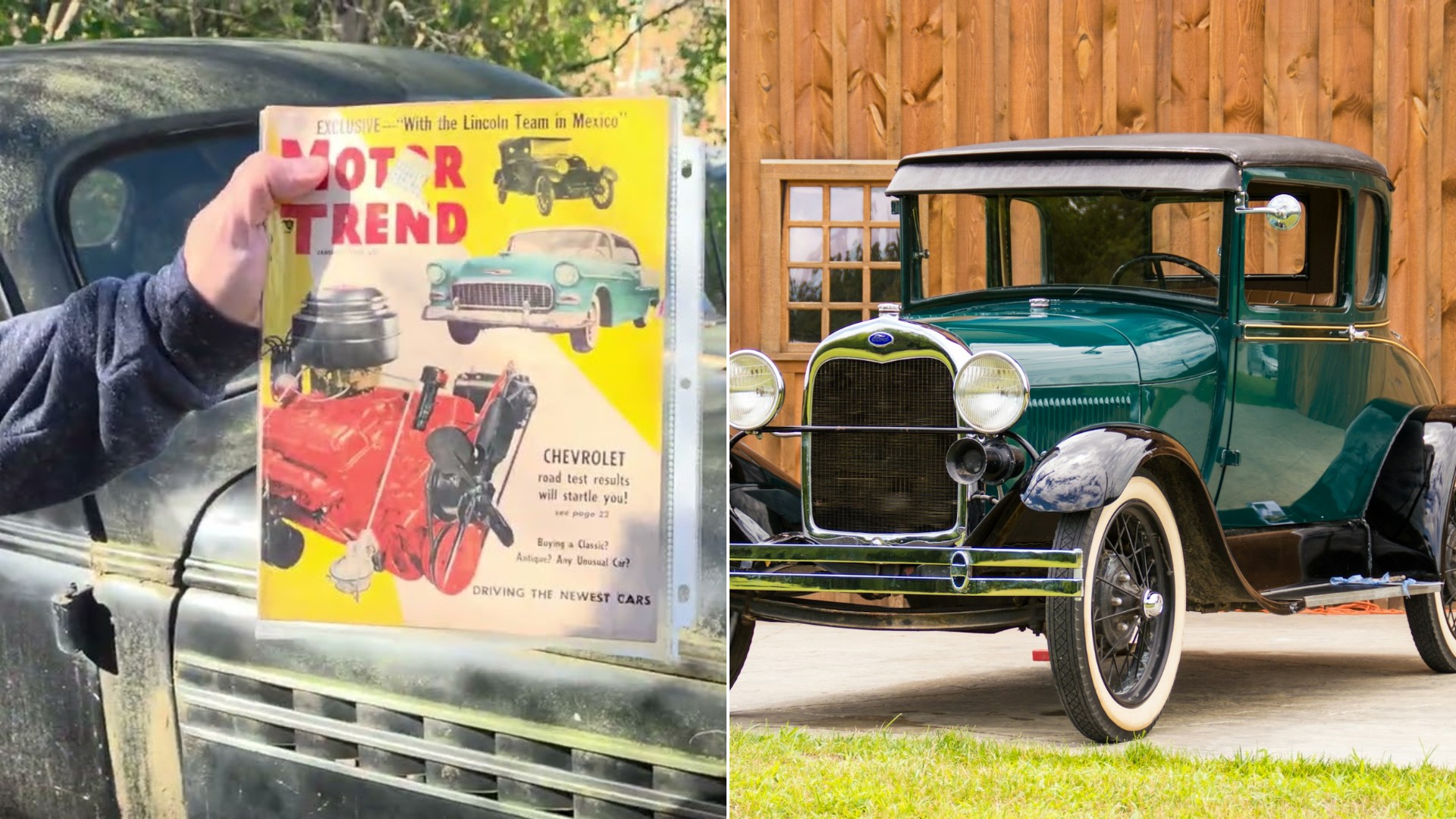

Before the family station wagon and the pickup, there was a car built for one purpose: to put a traveling salesman on the road with his goods. At the Happy Days Collection in Massachusetts, car expert Steve Magnante stopped for a roadside look at a 1938 Chevrolet Master Deluxe two-door five window business coupe, and he found a car that is strange in more ways than one.
Magnante describes the car as basically a stripper built for a traveling salesman to make the rounds and sell goods out of the trunk. Chevrolet built 56,166 of the Master Deluxe five window business coupes in 1938, and the base price was $685. That included an inline six-cylinder engine, though this particular car has had other plans for its engine bay.
Leaf Springs or Knee Action
Two front suspensions were available in 1938. One was a basic live axle with parallel leaf springs and a beam axle. The other was the Dubonnet coil spring setup, which Magnante describes as having the coil springs sitting in a bath of oil, with what Chevrolet called knee action up front. The Dubonnet system, a French patent for independent front suspension, was offered from about 1934 through 1938, which was the final year for it.
This coupe has the leaf spring suspension, which Magnante calls the more durable of the two. It is the basic setup, and fitting for a car built for work instead of show.
Styling Details of a 1938 Chevy
Magnante loves the full-floating headlight pods, which he says were first seen in 1937, and the bullet-style shape. The grille is bright, the Chevrolet bow tie sits proudly up front, and the hood is a two-piece butterfly design. The bumpers are mounted right to the frame and made of spring steel, so they flex a little in an impact and spring back. He points out that impact absorbing bumpers were a good 40 years away.
The car still wears its original 16 inch steel wheels with Chevrolet hubcaps rather than wheel covers. The taillights sit in floating pods with glass lenses, and Magnante calls the paint a nice original patina. The body is a style number 1217, the two-door business coupe, and 1938 was the third year for General Motors’ turret top construction. That meant all steel construction with no fabric inserts, which he notes had been problematic because they leaked. Ford would take another year or so to catch up.
Somebody Was Halfway Through a Small Block Swap
Then Magnante lifts the hood, and the surprise is sitting on it. Somebody was in the middle of installing a small block Chevy. Going by the numbers on the front, he identifies it as a 327 passenger car engine rated at 250 horsepower, topped with a Carter AFB carburetor on a cast iron intake manifold and the ram’s horn exhaust manifolds standard on small blocks of that era. Corvette valve covers add to the look.
He notes that the small block was a revolutionary engine and ties it to a Motor Trend issue from January 1955 that was all about the new Chevy small block, which he calls more important than the Ford flathead. The swap turns the coupe into a bit of a hot rod, a sleeper. The firewall helps, because the Chevy six is a long engine and the firewall is already notched from the factory, so no cutting is needed.
In the cab sits a four-speed Borg Warner T10 transmission, ready to be finished up with the installation. Magnante thinks the stock doghouse would probably work, but the linkage would be tricky, because the T10 is a side shifter whose linkage comes off the side and up through the floor, so some fabrication would be needed.
A Trunk Made for Business
Behind the seat is a plywood panel, and this is where the salesman coupe earns its name. The original idea was to drive from stop to stop, perhaps to florists, selling things out of the back of the car. Magnante jokes that a business coupe is all about the back of the car. The trunk is massive, with an original plywood shelf and the spare tire underneath, clamped in place and not rusty at all. It was the place for long items, bushels of apples or clothing.
Five windows, in this case, means the body has windows on the sides of the greenhouse, and the coupe was also available as a three window. The seat folds up to reveal the gas tank behind it, a tank he estimates at about 15 gallons, which he calls a little spooky. Inside, there are rubber floor mats and no carpeting, since less is more on a business coupe.
A sticker on the car reads Chevy Supply, Mass, since 1962, suggesting parts were bought from that shop. Magnante wraps up the car as a 1938 Chevy Master Deluxe five window business coupe, with the line that less can be more.
What to Know About Cars Like This
A workhorse like this one shows how much has changed. Today’s cars have impact absorbing bumpers, air bags and crumple zones, while this coupe offered a spring steel bumper and a huge trunk. For collectors, a stripped business coupe with original patina and a period correct small block swap in progress is a fun starting point, since the long engine bay and notched firewall make a V8 swap straightforward.
If you are looking at a car like this, check the frame and the trunk floor, and look at the wheels and hubcaps, since original trim pieces are hard to find. A car built to haul goods and survive daily work often has simple mechanical parts that are easy to service, which is one reason these old Chevrolets remain popular with hobbyists today.
More Stories You May Like
- Creator Stumbles on a Massive Classic Car Graveyard in America Where Mustangs, Camaros and Firebirds Are All Selling for Less Than $2,000 Each
- Business Owner Skips the Most Expensive New Truck and Buys a Used 2021 Nissan Titan Instead, Explaining Why It Is the Smarter Move for Tax Write Offs and Bank Financing
- Classic Car Hunter Chases Down a Rare 1969 Mustang 428 Super Cobra Jet With a $50,000 Asking Price, Then Sees What Kind of Shape It Is Really In