

Picture Lime Rock Park in Connecticut for the January 1984 issue of Popular Mechanics. Two Ford Mustangs sit side by side on the same drag strip. One is the new SVO, a turbocharged four-cylinder built by Ford’s own racing division. The other is a plain V8 GT borrowed from a dealer in New York.
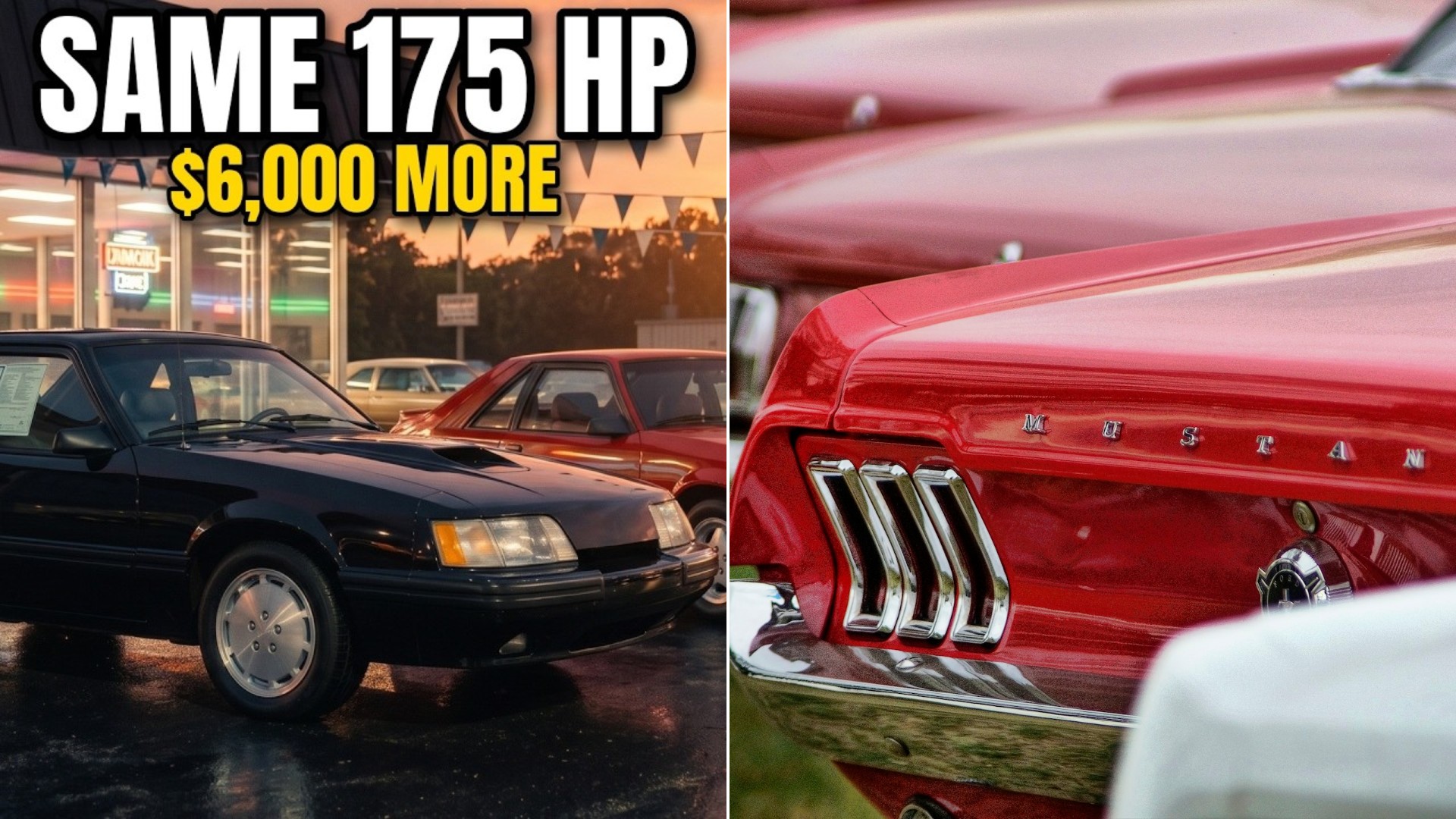
The SVO costs about $6,000 more. Both cross the line at exactly 90 miles per hour. The magazine’s verdict for Ford: “Forget the turbo.”
That is the story told by Car Chronicles, and it gets better.
Same 175 Horsepower, $6,000 Apart
On paper the two cars were already tied. Ford rated the 1984 SVO at 175 horsepower and the 1984 Mustang GT at 175 horsepower. That is half the cylinders and less than half the displacement for the same number.
Popular Mechanics put the SVO’s starting price at $15,970. That was $6,018 more than the GT in the same showroom.
A Department That Named A Car After Itself
In September 1980, Ford announced Special Vehicle Operations, run by Michael Kranefuss, the former competition director of Ford of Europe. The Mustang SVO was the only production car to carry the department’s name.
The company’s theory was that the future of performance was small, turbocharged and clever. So the car got a 2.3 liter four-cylinder from the same family that powered the Pinto and the Mustang II.
Ford had also tried a turbo Mustang twice before. The 1979 Mustang Turbo made 131 horsepower through a carburetor and was gone after 1981. The Turbo GT arrived in mid 1983 with 145 horsepower and was gone after 1984. The SVO was attempt number three.
A European Sports Car Wearing A Mustang Costume
To be fair, the SVO was not a sticker package. It had an intercooler fed by an offset hood scoop, four-wheel disc brakes when the GT still had rear drums, and 16 inch wheels with five lugs. It also had adjustable Koni shocks, a Hurst shifter and a two-level rear spoiler everyone called the bi-plane wing.
There were quirks too. Federal rules wanted an 85 mile per hour speedometer, so Ford fitted one that went to 140 and left the numbers off above 85. A dashboard switch told the computer if you had filled up with regular or premium. It came in four colors with one interior, one body style and one transmission, a five-speed manual.
The Magazines Loved It, Until They Timed Both
Road and Track’s cover said it outruns the Datsun 280ZX Turbo and out-handles the Ferrari 308 and the Porsche 944. It called the SVO possibly the best all-around car for the enthusiast driver ever produced by the American industry, and clocked 7.7 seconds to 60.
Car and Driver got 7.5 seconds to 60 and 128 miles per hour flat out. But it had tested the plain GT a few months earlier, and the V8 got to 60 in seven flat. Through the quarter mile the two were within a tenth of each other.
The Lime Rock Showdown Had Shaved Tires
Popular Mechanics took 11 cars to the track, with racing drivers Sam Posey and Skip Barber among the testers. Ford wanted them to try only the SVO, so the magazine borrowed a GT from a dealer. At the drag strip the turbo ran a 15.8 and the dealer’s V8 a 15.9, with the same trap speed.
The magazine wrote that Ford had put shaved racing tires on its car, worn nearly treadless and illegal for the street. They could be worth about half a second a lap.
On the road course, the SVO won the slalom, and its lap was one tenth of a second off a Porsche 928 S that cost three times as much. But in the braking test it tied for last. The GT stopped 30 feet shorter.
“Absolutely No Low-Speed Torque” And Worse Mileage
Popular Mechanics wrote that SVO had spent a huge effort on a four that delivers acceleration identical to the V8 with 20% worse fuel economy. Measured mileage was 11.2 miles per gallon for the turbo and 14.4 for the V8.
The testers’ unanimous advice to Ford was to put the SVO suspension under the GT V8. The GT finished dead last out of 11 in the voting and the SVO finished ninth, yet the magazine still said the GT was the car to build. Five months later, it drove a second SVO and admitted the first was a ringer.
Ford Gave The Cheap Car The Bigger Engine
For 1985, the GT got 210 horsepower and 270 pound-feet. The SVO stayed at 175, so overnight the cheaper Mustang had 35 more horsepower. Road and Track clocked the new GT at 7.2 seconds to 60.
Ford built about 4,500 SVOs in the first year, then just 1,954 in 1985. A mid-year 1985.5 model got a new turbocharger and dual exhausts for 200 horsepower, but only 439 were built.
By 1986, the GT was down to 200 horsepower, tied again with the SVO. The final count was 3,382 that year and 9,844 in total. Ford had planned about 10,000.
The Turbo Four Won A Trophy In A Thunderbird
The engine did not die. Ford moved the intercooled 2.3 into the 1987 Thunderbird Turbo Coupe with 190 horsepower, and Motor Trend named it Car of the Year. The Mustang that started it was cancelled, and the SVO department went on to the 1993 SVT Mustang Cobra, with a V8.
Forty Years Later, The GT Is Worth More
Hagerty’s price guide for October 2026 puts a 1984 GT hatchback in excellent condition above the 1984 SVO. A plain 1985 Mustang LX with the 5.0 is valued above both. The SVO auction record is $63,800, set at Barrett-Jackson in January 2017 for a 1985 with 7 miles on it.
How To Spot A Real SVO
Check the VIN, because the eighth digit on a real SVO is a T. Look for five-lug 16 inch wheels, rear disc brakes and the offset hood scoop, since a GT dressed up as an SVO still has drums in back.
Single headlamps mean a 1984 or early 1985, while flush headlamps mean a 1985.5 or 1986. And there was never an automatic SVO, whatever the seller says.
Now the question Car Chronicles leaves with you: it is 1984, you have $16,000. Do you take the SVO, or the GT with the same horsepower, and keep $6,000 in your pocket?
More Stories You May Like
- Owning A New Car Now Costs $12,863 A Year Or $1,071.92 A Month, According To AAA, And Depreciation At $4,422 Is The Single Biggest Cost
- New Car Payments Hit A Record $787 A Month, And 25.5% Of Loans Run 84 Months Or Longer, While Total Interest Averages About $9,938
- Slapping A Trailer Hitch On Any SUV Without Checking What The Vehicle Is Rated To Tow Is A Costly And Dangerous Mistake, Because Hitch Class Is Not Tow Rating