

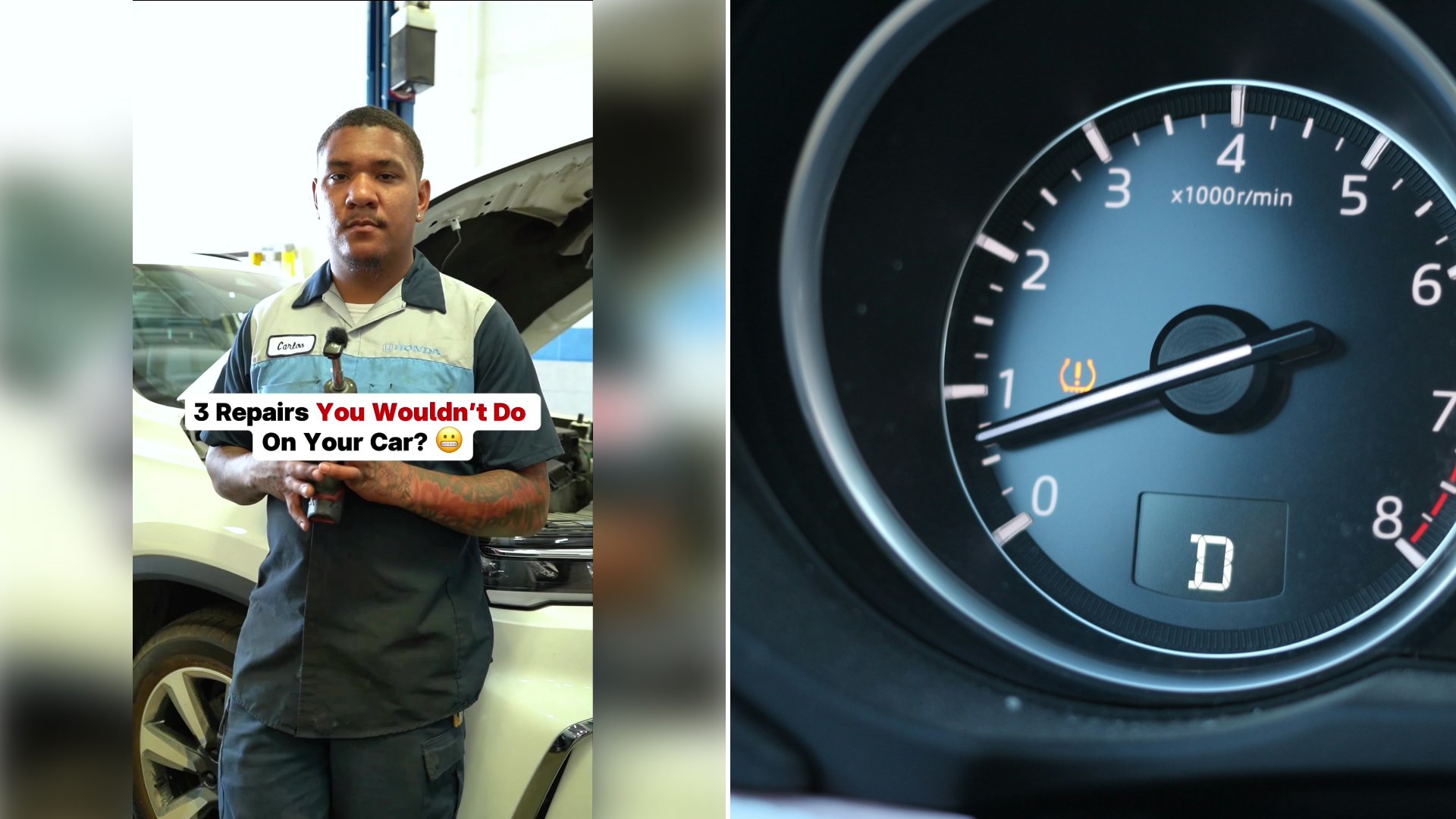
“What are three repairs you wouldn’t even do on your car?” That is the question put to a worker in the service shop in a short clip posted by @columbia.honda, the account of Columbia Honda. He stands in the shop in a two tone work shirt, holding a microphone, with a white SUV parked hood up behind him, while the title card reads “3 Repairs You Wouldn’t Do On Your Car?”
His answers come fast and each one comes with a reason: a tire pressure sensor light, minor oil leaks, and expensive repairs on an old car that still drives. The dealership’s caption frames it this way: “Not every car repair is worth paying for,” adding that “fixing a minor issue costs more than it’s worth, especially when the car still runs perfectly fine.”
Repair one: the tire pressure sensor light
“First thing I’ll probably say is a tire pressure sensor light,” he says, “just cause I see a lot of people coming here and the lights on and they have bad sensors, but it’s really costly to replace all the sensors.” The clip flashes the amber tire warning symbol on screen as he talks. His own verdict is personal: “And me personally, I don’t really care about a tire light.”
His point is about sensors that have failed, not about tires that are low, and that difference matters. Under the federal rule that created these systems, Federal Motor Vehicle Safety Standard No. 138, published by the National Highway Traffic Safety Administration, the warning must come on when a tire is 25 percent or more below the vehicle maker’s recommended cold inflation pressure, and within 20 minutes of driving once that point is reached. The same rule covers passenger cars, SUVs and light trucks of 10,000 pounds or less, and required every covered vehicle to have the system by September 1, 2007.
The rule also gives drivers a way to tell the two situations apart. Systems must warn of a malfunction, either through a separate yellow telltale or by flashing the low pressure light for 60 to 90 seconds before it stays on. A light that comes on steady and stays on is the low pressure warning the system was built to give.
Repair two: a minor oil leak
“Another thing is oil leaks,” he continues. He draws a clear line: if it is “dripping on the ground physically and it’s a bad oil leak, obviously would fix it.” A small seep is different. “Minor leaks, I just probably leave those until it gets worse and I absolutely have to fix it.”
Oil that reaches the ground is also what local stormwater agencies warn about. The City of Wenatchee in Washington warns on its stormwater page that “one pint of oil can make a slick larger than a football field” and tells drivers to check for leaks regularly and fix them promptly. The City of Kirkland’s fix vehicle leaks page recommends a drip pan or cardboard under the vehicle until a leak is repaired, and cites a city code that bans letting vehicle fluids reach streets or storm drains.
Repair three: a job worth more than the car
The last one is about money. “If you have an old car that still runs and drives perfectly fine, but you got something wrong with it that may cost more than the car is worth,” he says, his advice is to “just let it rock out. It’s an old car.” He gives no dollar figures for any of the three repairs.
Before you skip any of these on your own car
Check the tires before you decide the light is a bad sensor. Use a gauge on all four tires cold and compare the readings to the pressure on the vehicle’s tire placard. If a tire is low, the light is doing its job; inflate it and see whether the light goes out after driving.
Watch how the light behaves at start up. Under FMVSS No. 138 a malfunction is shown by a separate telltale or by the low pressure light flashing for 60 to 90 seconds before staying lit. Ask the shop to confirm which one you have before agreeing to sensor replacement, and ask whether one sensor or all of them have failed.
If you live with a dead sensor, the system cannot warn you anymore. Make a gauge check part of every fuel stop or at least once a month.
Test a leak with cardboard. Leave a sheet under the engine overnight, as Kirkland suggests, and look in the morning. Spots on the cardboard put you in the “dripping on the ground” group he says he would fix.
Track the oil level on a seep. If you decide to wait, as he says he would, check the dipstick at regular intervals and write down how much you add. A level that drops faster each time means the leak is getting worse.
Get a written estimate before deciding a repair is not worth it. His third rule depends on comparing the repair cost to what the car is worth, so you need both numbers on paper, and you need to know whether the fault affects brakes, steering or tires before you choose to “let it rock out.”
More from Steel Horse Rides
- 7 Maintenance Shortcuts That Can Get Expensive Fast
- Mechanic Inspecting a Brand New 2026 Ford F250 Straight Off the Line Says It Already Has a Trans Fluid Leak and That 70 Grand Still Cannot Buy a Good Working Truck
- Houston Mobile Mechanic Pulls a Brake Caliper in a Driveway, Hears “You’re Charging Me $500 for That?” and Tells the Customer to Find Someone Who Will Do It for Thirty Bucks