
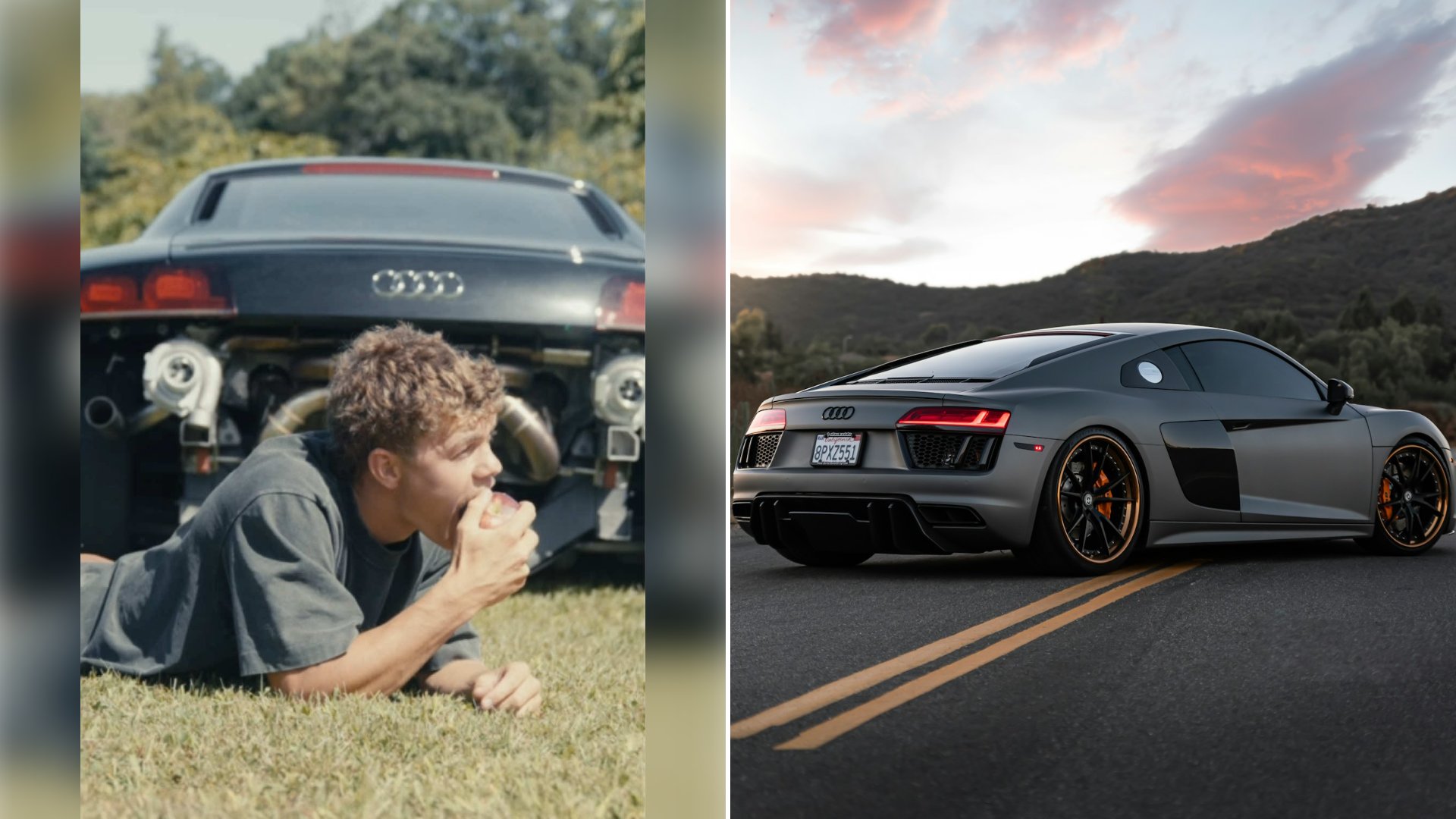

A video from the account David (@c6kid) shows a man lying in the grass biting his knuckles behind a visibly modified Audi R8, with a caption that doubles as a dare: “Tell me I don’t have a twin turbo r8🥴.” Tagged #carmaintenancetiktokcontest, #carsoftiktokcontest, #turbo, #supercar, and #c6kid, the video shows a genuine turbocharger kit mounted at the rear of the car and pulled in 80,900 likes, 265 comments, 5,946 saves, and 1,591 shares.
@c6kid Tell me I don’t have a twin turbo r8🥴#carmaintenancetiktokcontest #carsoftiktokcontest #turbo #supercar #c6kid
Adding forced induction to an R8 is a bigger departure from factory engineering than it might look. A 2015 report from carsales.com.au notes that Audi’s own engineers chose to keep the R8 naturally aspirated specifically for its throttle response, running a 5.2-liter V10 in the flagship trim, even as nearly every rival, the Mercedes-AMG GT, McLaren’s 570S and 650S, the Porsche 911 Turbo, and the Ferrari 488 GTB, had already gone turbocharged for more torque earlier in the rev range. Audi did eventually plan a turbocharged entry-level R8 for other reasons, but the V10 that powers higher trims was never designed from the factory around a turbo’s added heat, pressure, and airflow demands.
That gap between a naturally aspirated design and a forced-induction one is exactly what separates a professional twin-turbo kit from a riskier DIY install. A kit from specialist builder Bar-Tek, built specifically for the R8’s V10, bundles the turbochargers, intercooler, all mounting hardware, and custom engine and transmission control software into one package, running around 0.5 bar of boost while deliberately leaving the engine’s stock compression ratio untouched to protect reliability. Even with that level of engineering behind it, the maker still recommends reinforcing other parts of the drivetrain, especially the clutch, once power climbs toward the kit’s claimed ceiling of up to 1,000 horsepower.
TorqueCars’ breakdown of turbocharging in general spells out why those reinforcements matter rather than being optional upsells. Turbochargers can run at temperatures up to 1,100 degrees and extreme shaft speeds, so a failed oil seal or a worn bearing is the most common failure point under sustained boost. Past roughly a 70 percent power increase, the guide says upgrading internals like forged pistons becomes necessary rather than optional, and any power gain beyond stock also demands more fuel, meaning larger injectors and a stronger fuel pump, plus an ECU remap tuned specifically to the turbo’s boost curve rather than left on a naturally aspirated map. Whether this particular R8 got that same level of supporting work is impossible to tell from the clip alone, but it’s the difference between a twin-turbo build that survives daily driving and one that doesn’t.
More from Steel Horse Rides
- Owner Says the Seats in a 1986 Toyota 4Runner Smell Exactly How You Would Imagine, Then Pulls Out the Carpet and Asks Followers to Pick the Color for the New Kit
- Mechanic Pulls a Snapped Crankshaft Apart in Two Pieces on the Shop Bench, Says the Car Drove In Like That and Jokes the Customer Only Wanted an Oil Change
- Narrator of a Repair Clip Says a Car That Shook Every Time the Owner Hit the Gas Had an Engine Mount Cracked Clean in Half, Then Explains Why the Impact Wrench Is Not the Last Step