

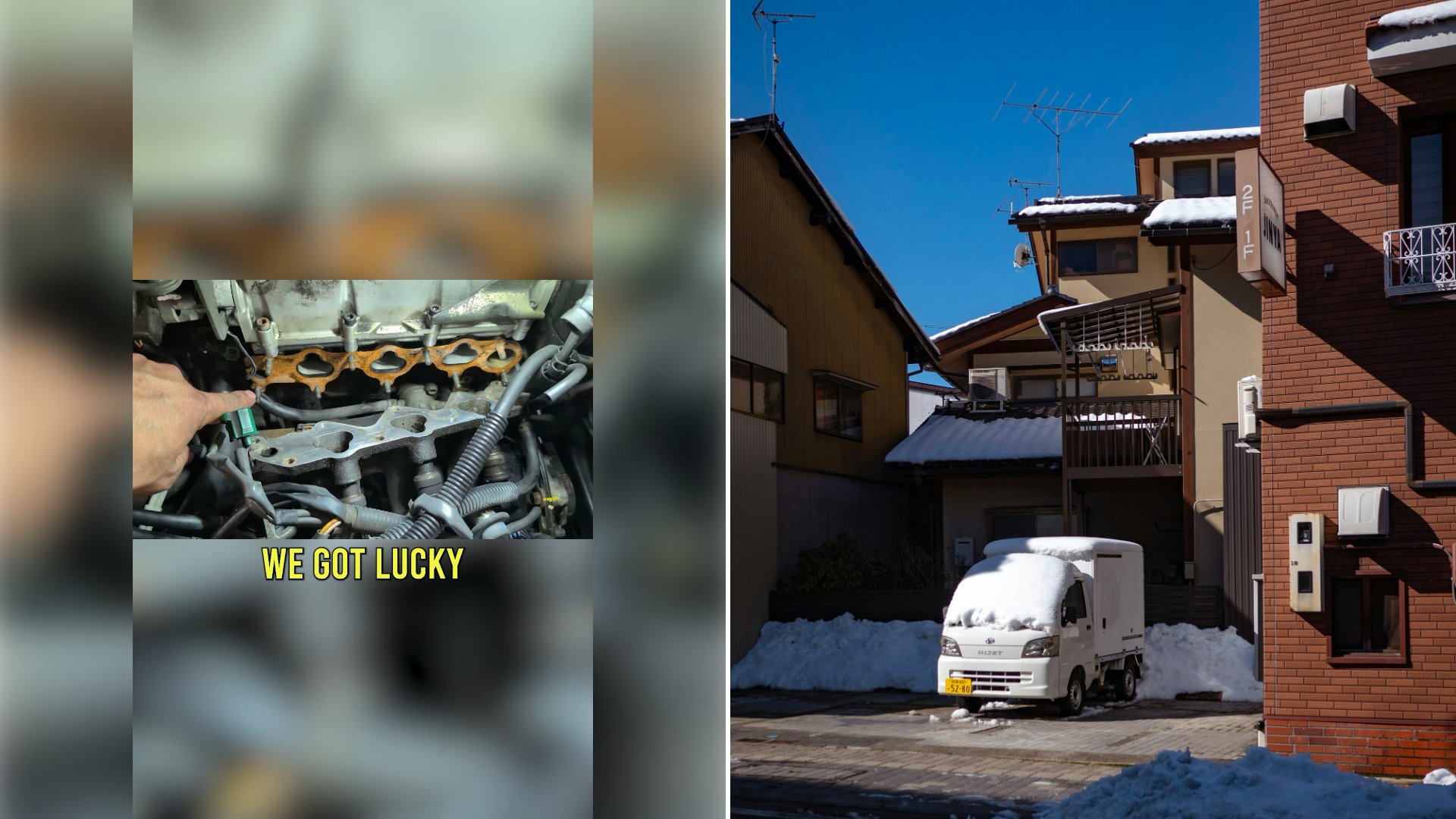
A video from the verified account @jubbalandcars walks through a real diagnostic scare on a thirty-year-old Japanese kei car, an Autozam AZ-1, after white smoke started pouring from the engine bay. As the caption explains, “Reviewing 30-year-old vintage JDM imports always comes with real mechanical risk, no matter how much mechanical sympathy you practice.” The clip has pulled in 54,400 likes, 152 comments, and 311 shares.
White smoke from an engine bay is one of the more alarming things a car can do, and for good reason. As outlined by NAPA’s repair guidance, thick, persistent white smoke almost always means coolant is finding its way into the combustion chamber, with the most common explanation being a blown head gasket and the worse-case scenarios running to a cracked cylinder head or engine block. That is a serious and expensive diagnosis on any car, and it is exactly the fear the caption is naming when it says mechanical sympathy alone can’t protect an engine on a car this old. But as the caption also makes clear, the aging rubber cooling hoses on the car, not the head gasket, were the real point of failure, degrading under thermal expansion until they suddenly leaked.
The Autozam AZ-1 itself is one of the more unusual survivors of Japan’s kei car boom. Produced by Mazda under the Autozam brand from 1992 to 1994, according to details compiled on its Wikipedia entry, the car packed a turbocharged 657cc Suzuki-sourced engine into a mid-engine, rear-wheel-drive layout with gullwing doors, all while weighing roughly 1,587 pounds. Mazda built only 4,392 of them before the model was discontinued, a run dwarfed by competitors like the Honda Beat and Suzuki Cappuccino, which is part of why surviving examples command such attention whenever one shows up on social media, especially one still being driven and diagnosed rather than parked as a static collectible.
That rarity is exactly why a scare like this one matters more than it would on a common car. A failed cooling hose is a comparatively minor and inexpensive fix, a far better outcome than the internal engine damage white smoke usually signals, but it is also a reminder of what owning a thirty-year-old kei car actually requires: assuming every rubber component is living on borrowed time, regardless of how well the car has otherwise been maintained. For a car this scarce, catching that kind of failure before it becomes a blown head gasket isn’t just good mechanical sympathy, it’s the only thing standing between a cheap hose replacement and losing one of a shrinking number of surviving examples.
More from Steel Horse Rides
- Owner Says the Seats in a 1986 Toyota 4Runner Smell Exactly How You Would Imagine, Then Pulls Out the Carpet and Asks Followers to Pick the Color for the New Kit
- Mechanic Pulls a Snapped Crankshaft Apart in Two Pieces on the Shop Bench, Says the Car Drove In Like That and Jokes the Customer Only Wanted an Oil Change
- Narrator of a Repair Clip Says a Car That Shook Every Time the Owner Hit the Gas Had an Engine Mount Cracked Clean in Half, Then Explains Why the Impact Wrench Is Not the Last Step