

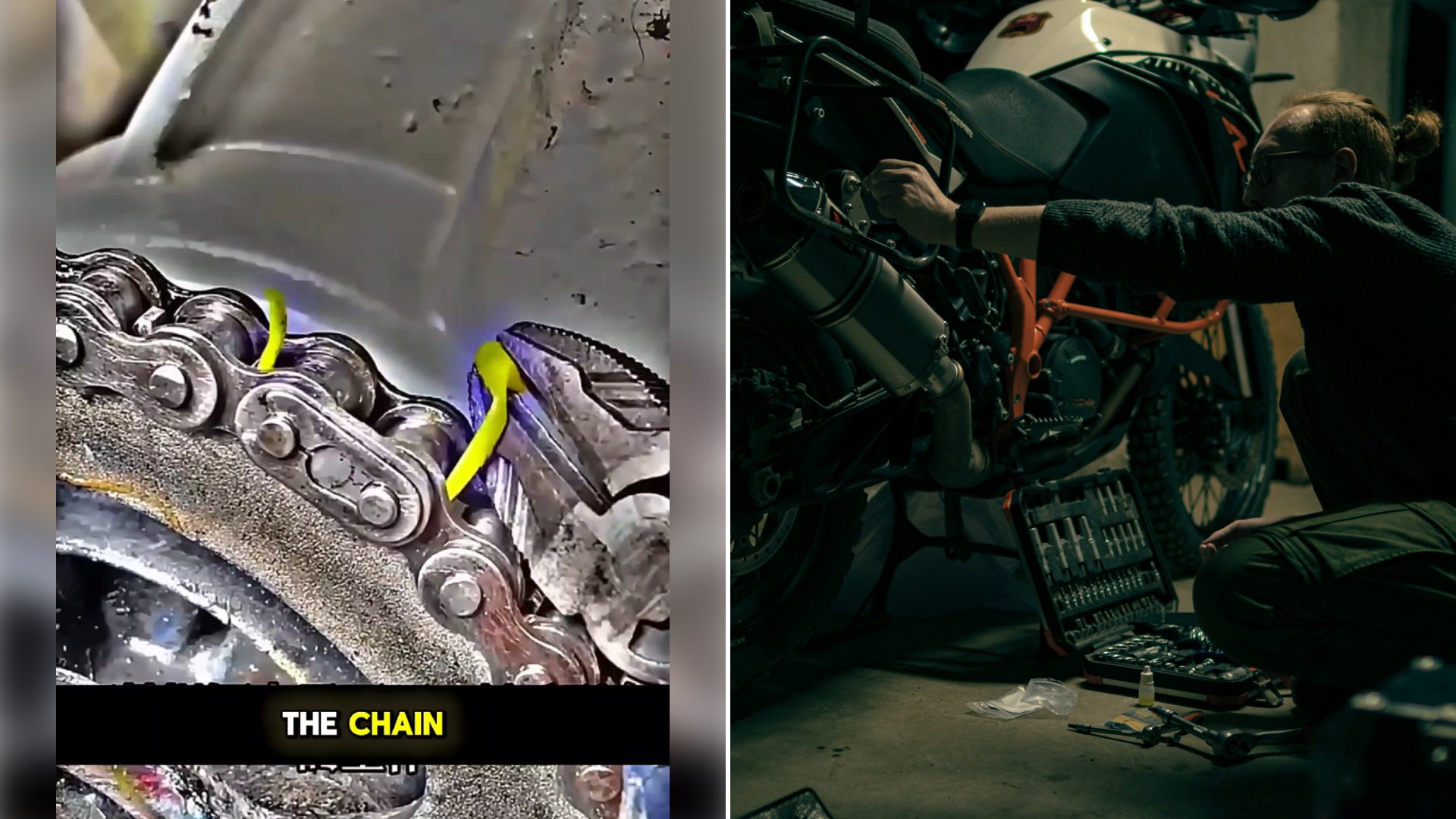
The TikTok account @curafur posted a one minute narrated clip under the caption “How Does This Zip Tie Fix a Chain?” with hashtags for car repair, car tips and car fixes. The narration opens with a question: “Many people don’t understand why, when a motorcycle chain has broken, the mechanic doesn’t first grab a tool and pull it hard.”
According to the narration, the mechanic does something much smaller. “Instead, he gets a yellow plastic zip tie and threads it through the middle of the two chain sections.” The close up footage shows hands holding the two loose chain ends against the rear sprocket while a yellow tie loops through the end links.
The narrator is clear about what the zip tie is not. It is “not responsible for bearing the pulling force while riding,” the voice says, and “simply acts as a temporary third hand.” The chain itself is under tension, which makes it hard to keep both ends aligned, so the mechanic first uses the zip tie to pull them to the right distance until the roller holes on both sides roughly line up.
Once the ends meet, the video moves to the part that actually holds the chain together. The mechanic takes out the special chain connector, “also known as a master link,” inserts the two pins through the chain from one side and then fits the outer chain plate. “What actually locks it in place is the small spring clip at the end,” the narration says, and once the clip fits into the grooves on the pins, the master link “will not come out on its own.”
The last steps are a cleanup and a check. The mechanic cuts off the yellow zip tie and turns the rear wheel “to check whether the chain link moves freely.” The closing line gives the whole point of the trick: a zip tie that costs a few cents “isn’t actually repairing the chain,” and its real purpose is to turn a job that needed two or three hands into something one person can finish.
The clip does not say which chain or motorcycle is on screen, and it does not show the master link being matched to the chain.
The clip method in the video also is not the only kind of master link. A service bulletin published by Ducati for its own models, hosted in the National Highway Traffic Safety Administration’s records, describes a riveted closing link instead, which is pressed with a chain tool until the distance between the outer plates falls inside a listed range, then checked with a magnifying glass for cracks. A rider who has a riveted link on the bike needs that tool and those measurements, not a spring clip and a zip tie.
The same bulletin explains why a chain breaks or needs a link in the first place. It says to lubricate the chain at least every 400 kilometers, or about 250 miles, and to check chain tension after the first 100 kilometers on the road and every 400 kilometers after that. It warns that over tightening accelerates wear and can break links. It tells owners to replace the chain if they find cracked plates or pins, spinning pins or scratched rollers, and says average chain life is about 20,000 kilometers when the chain is maintained as instructed.
The pieces the video leaves out are the ones a rider should take from the chain maker’s own instructions: the right link for the chain, and the correct tension and lubrication schedule afterward.
More from Steel Horse Rides
- Mechanic Shows a Simple Hack To Adjust Cam Timing on a Honda Engine Without Taking the Whole Thing Apart and Explains When It Works and Why It Matters
- Rider Shows What Countersteering Feels Like From the Seat of a Motorcycle and Explains Why Pushing the Right Bar Actually Turns the Bike Right
- Creator Rescues a Nineteen Eighty Nine Honda Gold Wing That Sat Two Years in a Shed After the Owner Got Scared To Ride and Shows How It Cleaned Up for Nine Hundred Dollars