

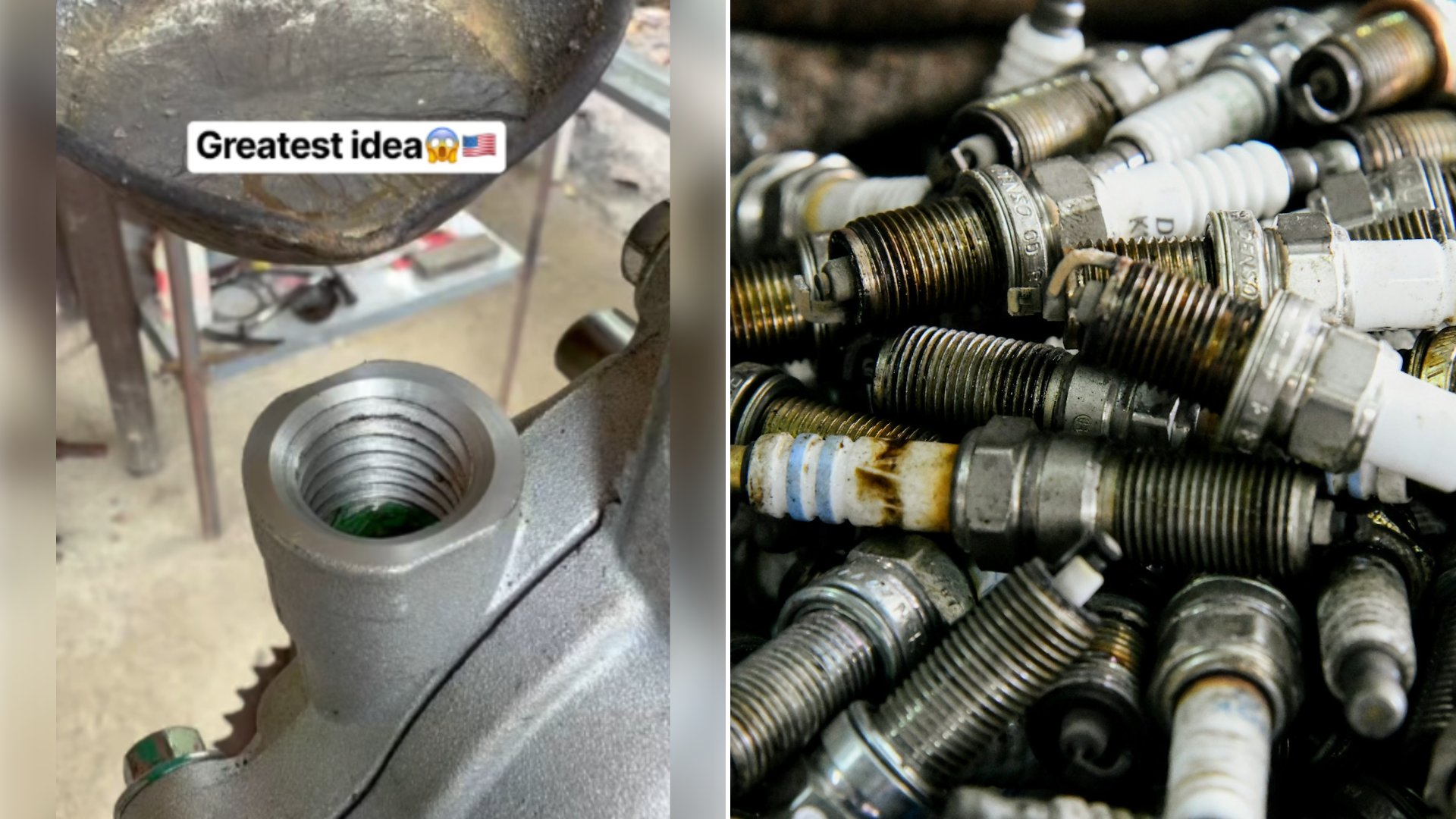
The TikTok account @tips_vat1 posted a three minute clip captioned “Only real expert mechanics know” with hashtags for usa, automobile, diy, trending, trend and viral. A line of on screen text, “Greatest idea,” sits in the middle of the frame from start to finish. Nobody speaks and no other captions appear, so the video tells its story entirely through the steps.
It opens on a threaded spark plug port in a raised boss on a silver metal engine casting. A pouring vessel tips over the opening and bright molten metal runs into the hole until it is full. The clip does not say what the metal is, why the original threads needed replacing, or what engine this is.
Once the poured metal has set, a dark metal block is pressed down on top of the boss. A sanding disc then flattens the surface until the top of the boss is smooth, and the original hole is gone, filled solid. A pointed tool marks the center. From there the repair is ordinary machining: a drill bit starts the new hole, a larger bit follows, and the bore is opened up until a clean round opening shows where the threads will go.
A tap, the cutting tool that forms internal threads, goes in next. After the cut, the hole shows fresh bright threads. The last seconds show a spark plug being started by hand and then snugged down with an open end wrench until it sits against the boss. The clip ends there. It does not show the engine being started, a torque value, or the repair being tested under heat and pressure.
The most dangerous step is the first one, and it is the one the clip passes over fastest. The U.S. Department of Labor reported in a 2023 release from the Occupational Safety and Health Administration that water contacting molten metal can cause a steam explosion, and described two 2022 incidents at Ohio metal plants. In the first, a supervisor suffered third degree burns. In the second, an electric arc furnace exploded and a furnace attendant died weeks later, and OSHA said the company had not protected its attendants from potential steam explosions.
OSHA lists the safeguards it expects around molten metal: containment for the material, adequate personal protective equipment and training on how to use it, and protection against steam explosions. The frames in the clip show the pour and then the hands working on the cooled casting, so what protection the person wore is not visible.
The finish also matters, because a spark plug seat is not a place where a mistake stays small. The plug maker NGK Spark Plugs says in its own installation guide that torque is one of the most critical parts of installation. Under torquing leaves the plug not fully seated, which slows heat transfer and can lead to pre ignition, while over torquing can stretch the shell, crack or break threads, and also cause pre ignition. The guide lists different torque ranges for aluminum heads and cast iron heads, and tells installers to clean the hole first and to install plugs only in a cool engine because thread damage can occur when the metal is hot.
For a reader with a stripped spark plug port of their own, the clip is best read as a demonstration, not a procedure. The steps it shows in order are fill, flatten, center, drill, tap and install. What it does not show are the things the plug maker names as the ones that matter: the right torque for the head material, a clean hole and a cool engine. Anyone who attempts a thread repair on an engine should look up the maker’s torque figure for that engine and head before tightening the plug.
More from Steel Horse Rides
- Mobile Mechanic Says Every Amateur Silicone Job He Takes Apart Is Caked in Sealant and Takes an Hour to Clean Yet Never Leaks, Then Asks if More Is Actually Better
- Narrator of a Repair Clip Says a Car That Shook Every Time the Owner Hit the Gas Had an Engine Mount Cracked Clean in Half, Then Explains Why the Impact Wrench Is Not the Last Step
- Mechanic Pulls a Snapped Crankshaft Apart in Two Pieces on the Shop Bench, Says the Car Drove In Like That and Jokes the Customer Only Wanted an Oil Change