

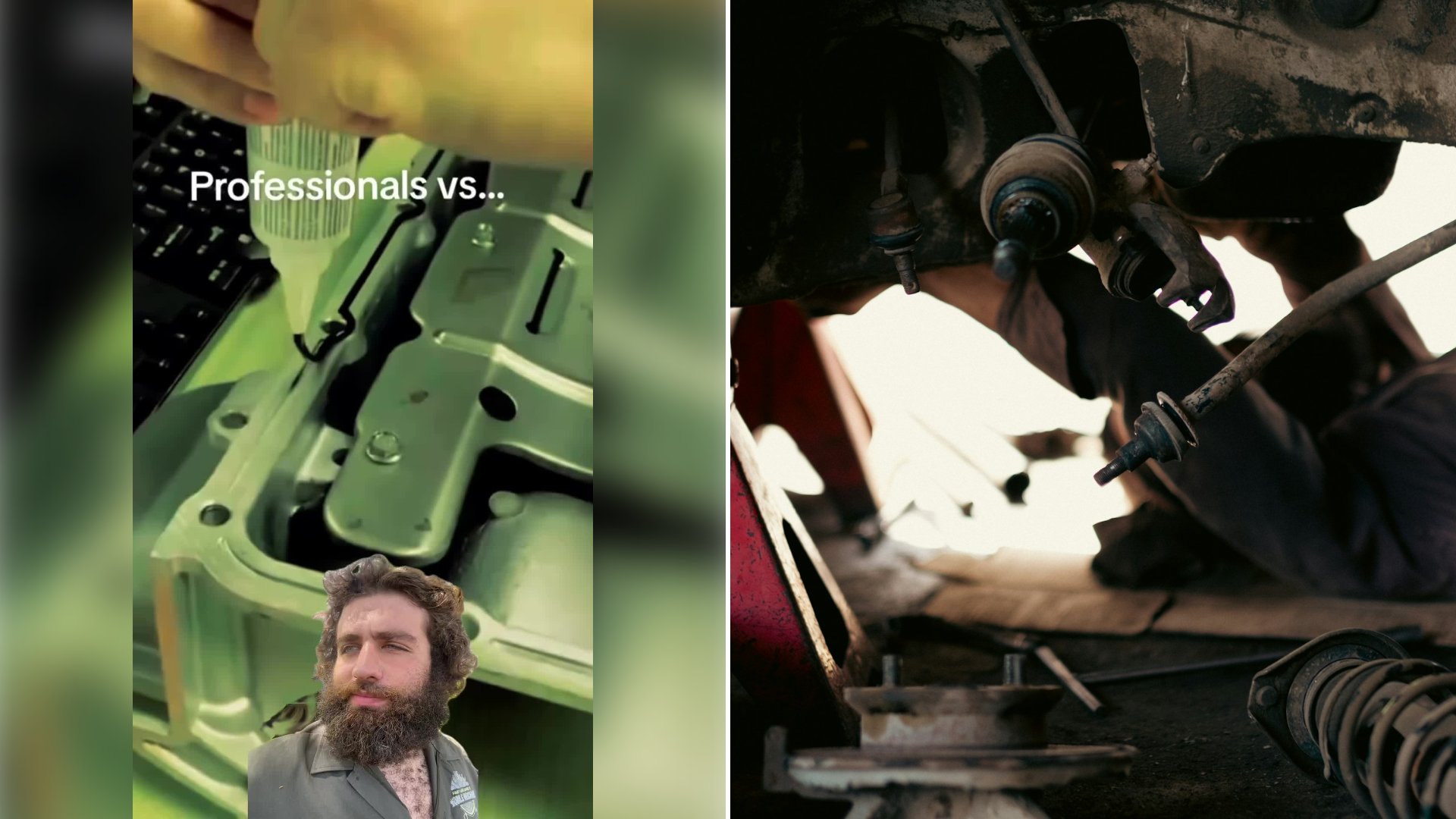
“It takes me a good hour to clean it all off, but I’ve also never seen them leak.” That is the puzzle a Palm Beach area mobile mechanic who posts as @mobile_mechanics lays out in a short clip with a one line caption: “Could more, actually be better?”
The video opens with him reacting over two pieces of borrowed footage. The first, labeled “Professionals vs…,” shows a machine laying a thin, even black bead of sealant along a cast aluminum part. “That is a pro doing it,” he says. The second, labeled “Me and bro,” shows a flange buried under a thick, lumpy layer of gray silicone. Neither clip is his own work.
The “flip flop mechanic” question
Then he steps in front of his yellow service van to make his point. “Whenever those flip flop mechanics do it that way, it works,” he says, using his slang for amateurs who pile sealant on. He is wearing flip flops himself while he says it.
He knows what the tube says. “The directions on the tube tell you to put a quarter inch thick bead across the mating surface, and that’s allegedly the proper way to do it and how you make it last the longest.” But his experience on teardown jobs points the other way: “Anytime I’ve done a job and I had to undo something that a flip flop mechanic did, I see a whole bunch of silicone on the mating surface.” A quick insert shows a part caked in old red sealant.
He does not claim to have settled it. “Now, in automotive work, the premise of more is better is usually false,” he says. “But with silicone, maybe.” He ends on a joke about trying it himself.
What the sealant maker actually says
His observation is about joints that did not leak, but Permatex’s own instructions for its Ultra Black gasket maker answer the question differently. According to the company’s technical data sheet, the nozzle should be cut for a bead of 1/16 inch to 1/4 inch, and a 1/8 inch bead is usually enough for most applications. The bead goes on one surface as a continuous line, tracing the inside of the gasket area first and then around the bolt holes.
The method matters as much as the amount. Permatex says to assemble the parts immediately while the material is wet, tighten the flange by hand only until the material begins to seep out the sides, let it set for at least two hours, then tighten again by about a quarter to a half turn. The sheet says the product dries tack free in two hours and fully cures in 24 hours, with times varying by temperature, humidity and gap, and that for best results it should cure overnight.
So the quarter inch he quotes is the top of the Permatex range, not the usual target, and the thick “flip flop” layer he describes goes well beyond it.
Why excess sealant is a risk
Lycoming, the aircraft engine maker, published a safety tip describing a case where a mechanic used sealant to hold a screen gasket in place; as it hardened, pieces “broke loose and eventually blocked the engine’s small oil passages causing oil starvation and engine failure.” Lycoming’s guidance is to use only sealants approved in its overhaul manual and service publications, and it calls for its approved RTV on crankcase parting surfaces to be applied “as a very thin film.”
Doing an RTV joint at home
Remove all the old material first. He says cleaning off a thick job takes him an hour, and Permatex’s directions start with removing old gasket material, recommending its gasket remover for most materials but not for plastics or painted surfaces.
Clean and dry both faces. Permatex calls for a solvent that leaves no residue, such as a brake and parts cleaner, before any sealant goes on.
Cut the nozzle before you start. Aim for the 1/8 inch bead Permatex says suits most jobs, and keep it continuous, tracing the inside of the gasket area and then around each bolt hole.
Assemble wet and go finger tight. Stop when sealant just begins to seep from the edges, wait at least two hours, then do the final quarter to half turn, and give it overnight before filling with oil if you can.
Check the service manual for your engine before you buy a tube, and use whichever gasket, sealant and bead size it lists for that joint.
More from Steel Horse Rides
- Mobile Mechanic Pulls a Customer’s Locked Up Chrysler Engine in a Driveway the Same Day and Finds an Oil Pan Full of Thick Tan Sludge Along With Serious Internal Damage
- Owner Who Paid $2,000 for a Ford Powerstroke 4×4 With Milky Oil in the Coolant Rules Out Head Gaskets With a Glove, Then Spends Eight Hours Digging Out a Blown Oil Cooler Seal
- Mobile Mechanic Walks Up to a Blue Dodge Pickup That Dies the Second It Starts, Cleans One Valve, Watches the Idle Shoot to 2000 RPM and Comes Back With a New Part to Fix It