

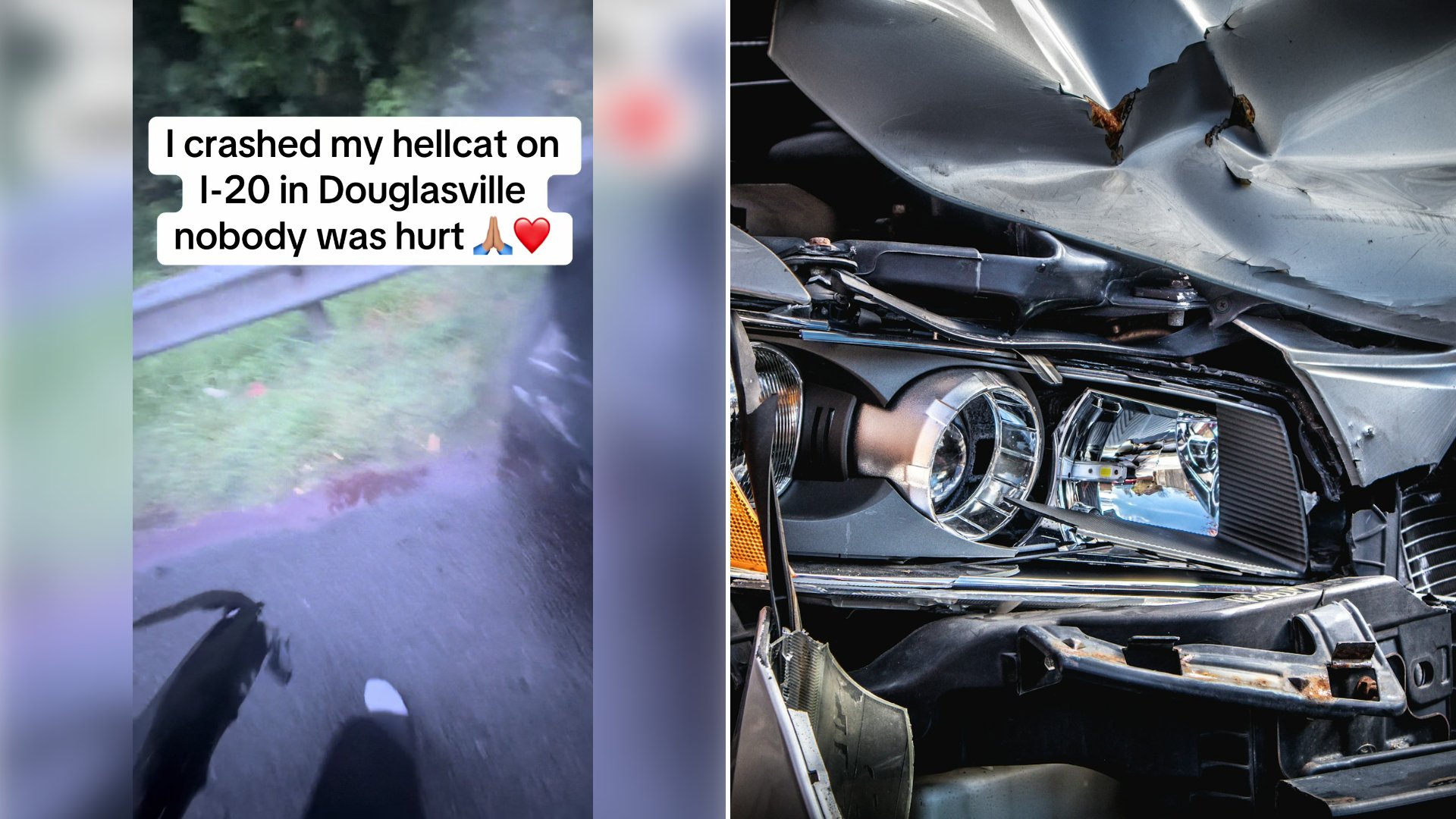
A TikTok creator who posts as @srtpovcat pulled his phone out in the minutes after wrecking his own Hellcat on the interstate, and the footage he posted is not a highlight reel. It is first person, a little shaky, and focused almost entirely on relief. The car is pulled onto the shoulder, visibly damaged, and the driver talks through what just happened in the flat, slightly stunned tone that shows up after something scary ends better than it could have. He is not bragging about the car or blaming other drivers. He is checking that everyone involved walked away, and saying so on camera.
That tone is the whole point of the clip. Hellcats carry a reputation built on launch videos and dyno numbers, and this video is the other side of owning one: a supercharged Dodge with well over 700 horsepower does not forgive mistakes on a highway the way a commuter sedan might. The driver’s own narration does more to make that point than any caption could, which is likely why the video has resonated with viewers who have either had a scare of their own or have been waiting for one.
@srtpovcat
High horsepower cars like the Hellcat lineup have become a case study for insurers precisely because of moments like this one. Modern Dodge Charger and Challenger Hellcat models produce between roughly 707 and over 800 horsepower depending on trim, and that power is delivered through a chassis that, while capable, is still a mass-market platform underneath the supercharger. Insurance data has consistently shown that vehicles with very high horsepower-to-weight ratios carry higher claim frequencies and higher average claim payouts than comparable cars with more modest output, which is part of why Hellcat variants routinely sit among the more expensive vehicles to insure in their class. It is not that the cars are poorly engineered; it is that the power is available at any moment a driver’s foot asks for it, on roads shared with everyone else.
Interstates add their own layer of risk on top of raw horsepower. Highway speed crashes involve more kinetic energy than a similar incident at city speeds, and a loss of control at highway velocity gives a driver far less room to correct before hitting a barrier, another vehicle, or the shoulder. Federal crash data has long shown that a disproportionate share of serious single vehicle crashes happen on high speed roads rather than surface streets, simply because there is less margin for error once something goes wrong. A car with the output of a Hellcat can accelerate out of a lane change or a merge faster than a driver expects, and that gap between expectation and reality is where a lot of these incidents start.
None of that is lost on the people commenting under the video, many of whom own high horsepower cars themselves and recognize exactly the moment the driver is describing. The response has leaned supportive rather than critical, with commenters focusing on the fact that everyone walked away and that the driver was honest enough to post the aftermath instead of quietly repairing the car and saying nothing. It is a reminder that a lot of serious crash content performs well not because it glorifies the wreck, but because it is honest about the stakes of driving something this powerful, and because the person behind the camera clearly understands exactly how lucky he got.
More from Steel Horse Rides
- Son Takes His Dad for a Ride in His 1,000 Horsepower Hellcat Chrysler, and the Back Seat Camera Catches Dad Twisting Around Mid Ride to Look at Everyone Behind Him
- Driver on His First Test Drive of a C7 Corvette Z06 Grips the Wheel on the Highway While the Clip Says He Had the Salesman in the Passenger Seat Sweating for His Life
- Restorer Rescues a Dead 1967 Ford Mustang Found Buried Under Leaves and Shows the Careful Steps a Decades Dormant Engine Needs Before It Can Safely Run Again