

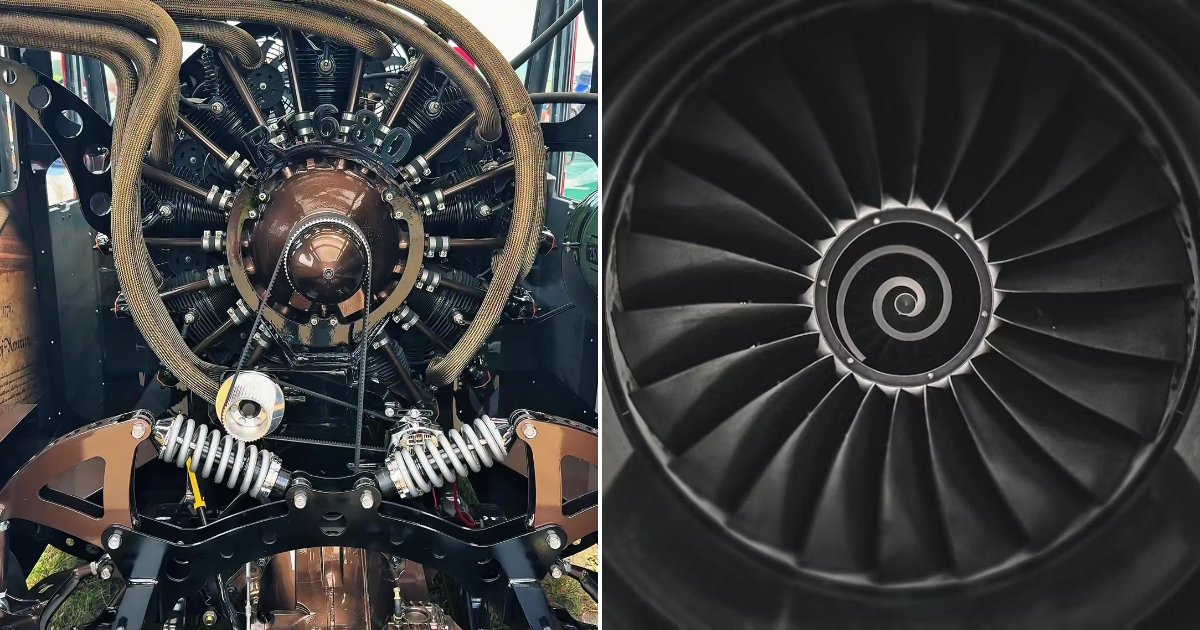
Some builds are practical. Some are wild. And then there is the mail truck with a biplane trainer engine sitting in its rear compartment, belts spinning, nine fans cooling nine cylinders and a pair of oversized bombs hiding the fuel and oil.
It is called Project Airmail, and its story starts with a rusty 1984 GMC mail truck that was pulled out of a field.
The truck was toured in detail by @internalcombust, who walks around it slowly and points out the clever choices from every angle.
@internalcombust
A radial engine in a mail truck
The owner did not stop at an engine swap. He put in a nine cylinder radial, the R-680 from a Stearman, a biplane trainer from the years between the world wars. In this configuration it makes around 220 horsepower and a great deal of torque.
Radial engines arrange their cylinders in a circle around the crankshaft, and they were common in early aircraft. They are not usually found under the roof of a postal truck, which is part of the fun. The engine turns a belt drive that looks like a supercharger on a muscle car, with a pulley at the top that is twice as big as the one at the bottom. The explanation offered is that this engine only revs a little over two thousand rpm.
Drivetrain from an unexpected donor
The transmission comes from a Chrysler Concorde, a front wheel drive car with a longitudinal engine. It is a three speed, though for now only second gear and reverse work. The owner jokes that the engine makes so much torque he could probably do a wheelie in second gear, which leaves everyone imagining what first gear would do.
The axles and wheels also come from the Concorde. Everything else around them is custom, including the control arms and the chassis, which were cut on a plasma table from designs made in CAD software. Even the suspension is a showpiece. It is a cantilever layout, and the owner chose to mount it that way purely because it looks cool, with springs in a one to one ratio.
The details that make it special
The bombs on the side look like the real thing, and they are functional. One holds all the engine oil and the other holds all the gas. The front fenders come from a 1937 Chevrolet, the headlight buckets from a 1939 Chevrolet and the bezels from a 1949 Studebaker. The grille is from a 1952 Ford, and the number on it, which would normally read eight, has been turned into a nine for the nine cylinders.
Inside, the airplane style yoke is 3D printed and modeled on the one in a Ford Trimotor. The center console was also 3D printed and finished over. Behind the seats are nine nine inch fans, one for each cylinder, to keep the engine cool. The exhaust collectors even merge to look like a minigun, so smoke will come out in order when the truck is moving.
The sheet metal is perhaps the quiet star. Shaping panels like these takes dimple dies, bead rollers, hammers and an English wheel, which is a skill many people consider a fading art. The truck is also said to light up after dark.
Why builds like this get so much love
A custom build like this pulls from several worlds at once: aviation history, old school fabrication, modern tools like CAD and 3D printing, and plain imagination. It is a reminder that creativity in cars is not limited by what the factory offered.
It also shows how a lot of people approach a big project. They pick a theme, in this case airmail, and let it guide every decision from the fenders to the number on the grille.
Planning your own wild swap
Most of us will never put an aircraft engine in a truck, but the planning lessons are useful for any ambitious build.
- Choose a clear theme early, so each part choice supports the story.
- Pick a donor drivetrain that fits the weight and power, and learn its limits before building around it.
- Design the gearing around the engine’s usable speed range, as this builder did with his belt drive.
- Plan cooling carefully, since engines in enclosed spaces need real airflow.
- Build safe fuel and oil systems, keep them away from heat sources and have them checked by someone qualified.
Unusual engine swaps can create serious fire and structural risks if they are not engineered properly. Ask an experienced fabricator or inspector to review the plans, and check what your local registration rules require.
The finished picture
What makes Project Airmail memorable is the care in the small things, from the grille number to the fans to the cantilever springs. Whoever is looking at the truck can see that every piece was a choice, and that is what turns a rusty field find into a rolling piece of art.
Credit for the original post goes to @internalcombust on TikTok.
More from Steel Horse Rides
- Watch a cheap, wrecked Mitsubishi Lancer get torn apart piece by piece and reborn as a jaw dropping slammed custom show car nicknamed the Frankenlancer.
- Creator Turned A Five Hundred Dollar Beat Up Race Trailer Into A Completely Custom Luxury Camper After Weeks Of Nonstop DIY Renovation Work
- Enthusiast Is Showing Off A Rare 1948 Tucker That Somehow Lets The Driver Shift Every Single Gear Without Ever Taking Their Hands Off The Steering Wheel