

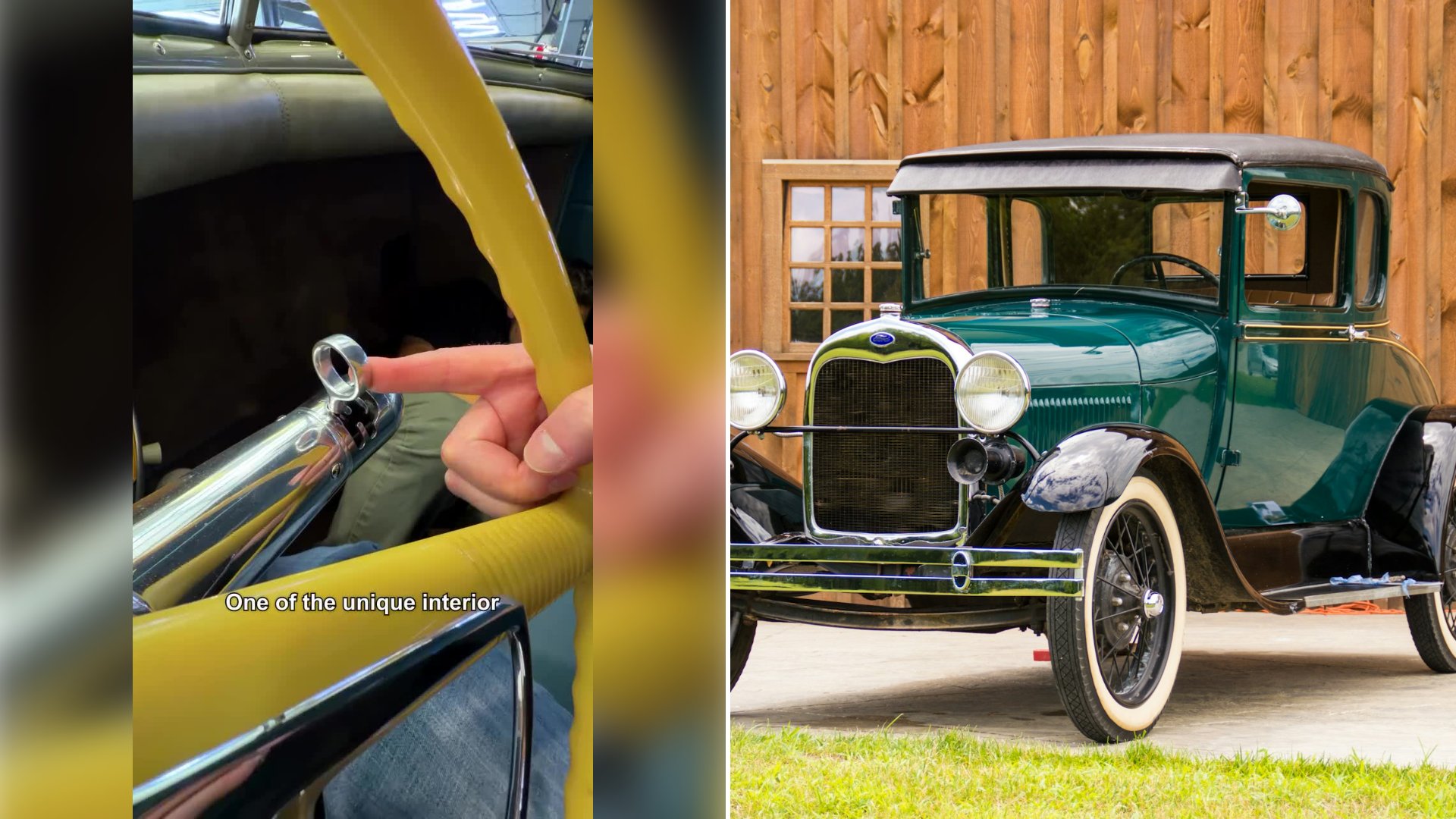
A video making the rounds shows an enthusiast climbing behind the wheel of a genuine 1948 Tucker and walking through one of the car’s strangest party tricks: a column-mounted shift mechanism that lets the driver run through every gear without ever letting go of the steering wheel. In the clip, the Tucker owner demonstrates the reach of the shifter, explaining how the car’s preselector-style transmission setup was built to keep both hands on the wheel at all times, a feature that feels almost futuristic for a car built nearly eighty years ago.
The demonstration comes from creator @aydeealdanass, who has built a following showing off rare and unusual classic cars up close, the kind of vehicles most people only ever see behind a velvet rope at a museum.
@aydeealdanass
What the clip doesn’t get into is just how unusual the full story of the Tucker 48 really is. Preston Tucker founded the Tucker Corporation in Chicago in 1944, promising a radically safer, more advanced postwar car built around ideas that were nowhere close to mainstream at the time. The production car, officially called the Tucker 48 but nicknamed the “Torpedo,” packed in features automakers wouldn’t standardize for decades, including a padded dashboard, a windshield designed to pop out on impact rather than shatter inward, a perimeter frame surrounding the passenger compartment, and a third “Cyclops” headlight mounted in the center of the nose that turned with the steering to light up corners before the rest of the car got there.
The transmission quirk shown in the video traces back to the company’s rushed production timeline. Tucker’s engineering team had originally designed a complex torque-converter drivetrain for the car, but when that system couldn’t be finished in time, the company adapted a pre-selector gearbox originally built for the Cord 810, repositioning its controls so a driver could select and execute gear changes without removing a hand from the wheel. It was a workaround born out of necessity, but it became one of the car’s most memorable engineering footnotes.
The engine underneath that transmission has its own strange backstory. Tucker’s production car ultimately used a rear-mounted, flat-six engine adapted from a Franklin aircraft and helicopter engine design, converted to run on standard gasoline and water cooling instead of the air-cooled setup it was originally built for. Mounting a helicopter-derived engine in the rear of a passenger car was almost unheard of in 1948, and it gave the Tucker a low center of gravity that made it unusually stable for its size.
None of it was enough to save the company. The Tucker Corporation collapsed in 1949 after the Securities and Exchange Commission launched an investigation into the way Tucker had raised money from investors and dealers before the car was fully in production. Tucker and several executives were indicted on stock fraud and conspiracy charges; all were ultimately acquitted, but the legal fight and the negative press that came with it drained the company’s cash and its credibility at the same time. Only 51 Tucker 48s were ever completed before the factory shut down, making it one of the shortest production runs of any American automaker in the twentieth century.
What makes the car shown in this video even rarer is how many of those 51 units are still around. By most published collector estimates, roughly 47 of the original 51 Tuckers survive today, an extraordinarily high survival rate for a car this old, largely because owners recognized almost immediately that they had something historically significant on their hands rather than just a used car to drive into the ground. Surviving examples routinely sell for well over a million dollars at auction when they do change hands, and most of the remaining cars live in museums or long-term private collections rather than daily rotation.
That scarcity is exactly why a video like this one draws attention from people who don’t normally stop scrolling for classic car content. It isn’t just an old car with a quirky feature, it’s a hands-on look at a piece of a production run so small that most Americans will never see one of these cars in person, let alone watch someone actually work the controls that made it unusual in the first place.
More from Steel Horse Rides
- Collector Shows Off Preston Tucker’s Own 1948 Tucker 48 With Its Converted Helicopter Engine After an Eight Year Restoration Won Best in Class at Pebble Beach
- Restorer Pulls a Pontiac GTO Body From an Acid Dip Tank and Shows How It Gets Neutralized and Pressure Washed To Reveal the Metal Underneath the Rust
- Builder Finishes a 1968 Chevy Nova Pro Touring Restomod That He Started Back in 2008 and Explains Why These Builds Take So Long To Complete