

These days, a real Hemi Cuda is the kind of car that makes collectors whisper. But a man who has kept a 1970 Hemi Cuda for 30 years says it was not always that way. “People used to junk Hemis,” he says, and he remembers when a matching numbers Hemi Cuda changed hands for just $32,000.
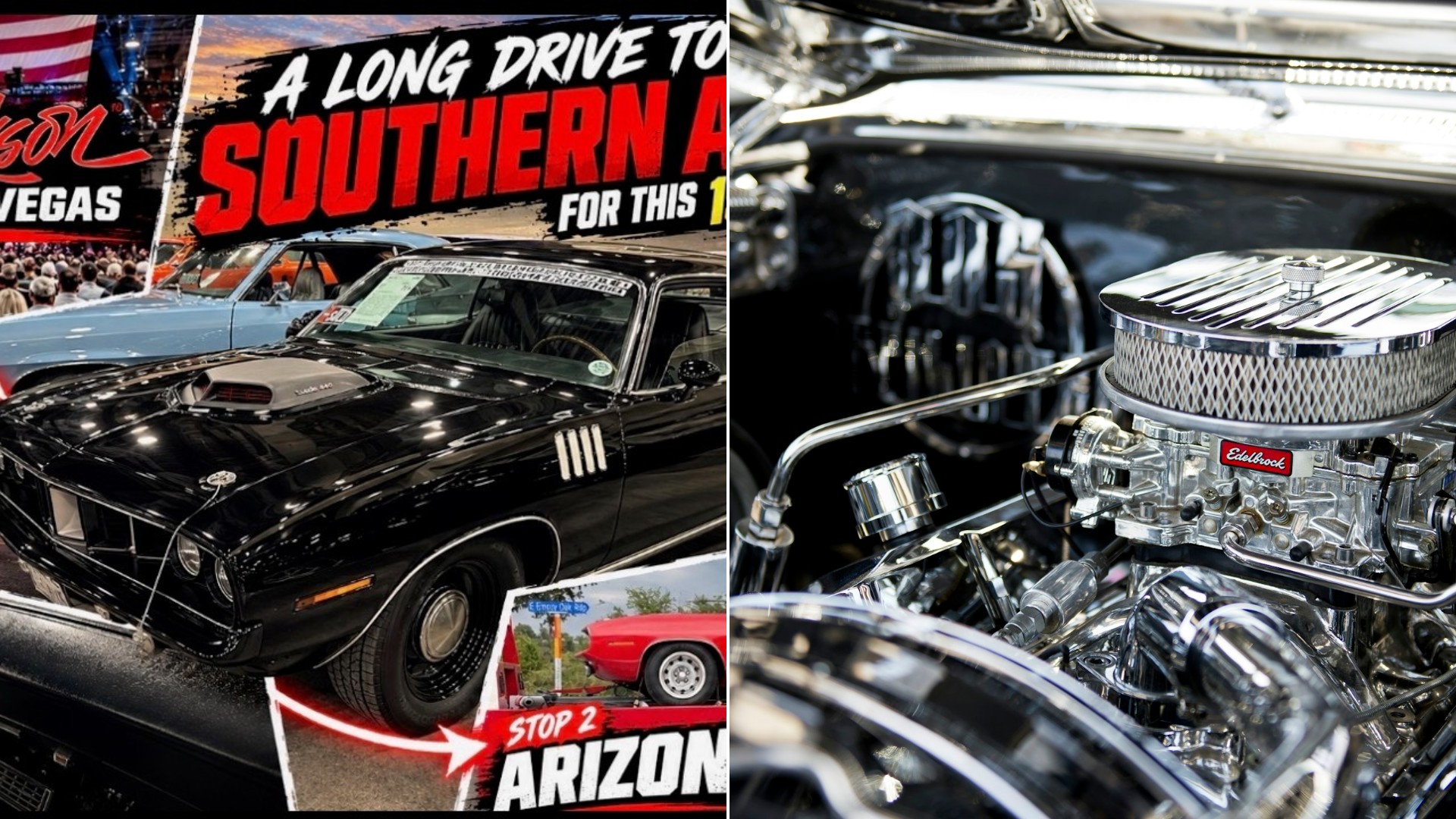
That moment comes in an episode of “Chasing Musclecars” from the Mopars5150 channel, which follows a muscle car buying trip from Las Vegas to the Arizona border. The team behind it is Troy and Tony of American Steel Classics, with Davis flying solo on the road.
From Barrett-Jackson To The Mojave
The trip starts at Barrett-Jackson in Las Vegas, where the team is hunting rare muscle cars. At the block, the announcer talks up a 1971 model with multiple build sheets, a military purchase, numbers matching and a four speed. “It checks every box,” the announcer says. “It’s one of the best cars that have gone across this stage.”
The team ends up buying a black 1971 440 Six Pack Cuda there. Then Davis takes off alone, hauling a trailer across the Mojave to pick up the purchases, and heads south of Tucson, practically on the border of Mexico. The goal is a Rally Red 1970 Plymouth Hemi Cuda with the legendary 426 Hemi and a four speed, a deal the team struck earlier in the week.
Davis is honest about what lies ahead. The car is “not numbers matching, but the guy’s owned it 30 years.” Davis adds: “I’m sure he’s got some crazy stories and some pretty cool paperwork. Other than that, I’m going in blind.”
A Dream Car From A Lifetime Ago
The owner meets Davis at the border and shows off the car. “Dream car from my whole life,” he says. “I was a street racer when I was young and always wanted a 70 Hemi Cuda. I thought that was the ultimate muscle car. Took me a lot of years, but I finally got one.”
The motor was just rebuilt and has “about 10 miles on it,” he says. His advice to the next owner is simple: take it easy for at least the first 100 or 200 miles. The engine has been stroked to a 472, built by Larry Shepard, with Joe Liberty doing the transmission. As for the rest of the car, “The car is rotisserie restored. You can eat off the bottom of this car.” It has stainless steel brakes and a chrome ball drive shaft. The rear window louvers are not original, and there was no build sheet. He tore the interior apart himself.
The Price Story
This is the part that sticks with you. “Back when we did these cars 30 years ago, they weren’t worth a lot of money,” the owner says. He went down to Englishtown with a buddy, and the buddy bought a Hemi Cuda, a matching numbers build sheet car, for $32,000.
He also remembers looking at an A12 car owned by Frank Battleston in the late 1990s. At that time it was the highest priced A12 car at 275 thousand dollars, and it was the most correct A12 car in the world. “I hate to say this to you, but people used to junk Hemis,” he says. “It wasn’t until the late 90s that the prices went through the roof.”
He explains why. Many of the cars were sold with automatics so a family could use one car. The wife could drive to the grocery store, and the husband still had something to drag race on Friday night.
Why He Is Selling
The owner began selling off his Mopars about 20 years ago when he moved from Maine. Over the years he has owned A12 cars, 440 cars, Coronet R/Ts, GTXs and Road Runners, and he even had a 1928 Dodge sedan that he planned to turn into a Mopar museum. Now he is 74 and says “tomorrow’s not promised.” He wants to scale down to one car plus a Max Wedge Ram Charger car he is finishing.
He still has three or four other cars for sale, including a cheap one at $6,000. He also shows a 1972 decal he ordered from a matchbook ad that cost about $10 and has held up nicely for 50 years. And in a twist any collector will smile at, he says his other, unrestored, ratty looking car gets more attention than the Hemi Cuda.
A Storm And A Safe Place
The episode also brings a practical problem. Davis hears a storm warning for Arizona, and a buddy near Phoenix offers a room so the car does not have to sit outside overnight.
What To Know Before You Buy A Muscle Car
The big lesson in this story is how much the value of muscle cars has changed. A few ideas for anyone shopping for a classic of any kind:
- Paperwork matters. The announcer at the auction made a big deal of build sheets and numbers matching. The seller at the border said there was no build sheet on his car, and Davis noted the car is not numbers matching. Documentation can make a major difference in what a car is worth.
- Ask about the work. The owner described a rotisserie restoration and a freshly rebuilt motor. Ask who did the work and when.
- Respect the break in period. The owner asked the next driver to go easy for the first 100 or 200 miles on the new motor. It is good advice for any freshly rebuilt engine.
- Plan the trip home. Davis hauled the purchases on a trailer, and a buddy offered a room so the car would not sit outside during a storm. A valuable car deserves a safe ride and a dry place to sleep.
- Listen to the stories. The seller’s memories of buying and selling cars when they were cheap give a feel for the history that no price guide can.
Looking Back
It is hard to picture a time when a Hemi Cuda could be had for $32,000 and people were happy to junk a Hemi. Yet the owner lived it. He raced when he was young, kept chasing his dream car until he got one and held onto it for 30 years. Now, at 74, he is ready to let it go and enjoy a simpler collection.
For anyone who has ever wished they had bought something just a few years before the world caught on, his story rings true. The cars were always special. It just took the rest of us a while to notice.
More Stories You May Like
- Business Owner Skips the Most Expensive New Truck and Buys a Used 2021 Nissan Titan Instead, Explaining Why It Is the Smarter Move for Tax Write Offs and Bank Financing
- Detailer Shares How a One Man Team Can Finish a Full Car Interior in Just Two Hours, and Step One Happens Before the Vacuum Ever Comes Out
- Barn Find 1977 Ford F250 Sat Untouched For Thirty Five Years With Only Seventeen Thousand Miles And The Detailer Says The Dirt Is The Thickest He Has Ever Seen