

Before you spend big money on an engine swap, it helps to know where you are starting. That is why Late Model Restoration put Nathan Anderson’s 2000 Mustang GT on the dyno. The result was 227.6 horsepower and 292.3 pound feet of torque, a solid baseline for the Gen 2 Coyote swap Nathan has in mind.
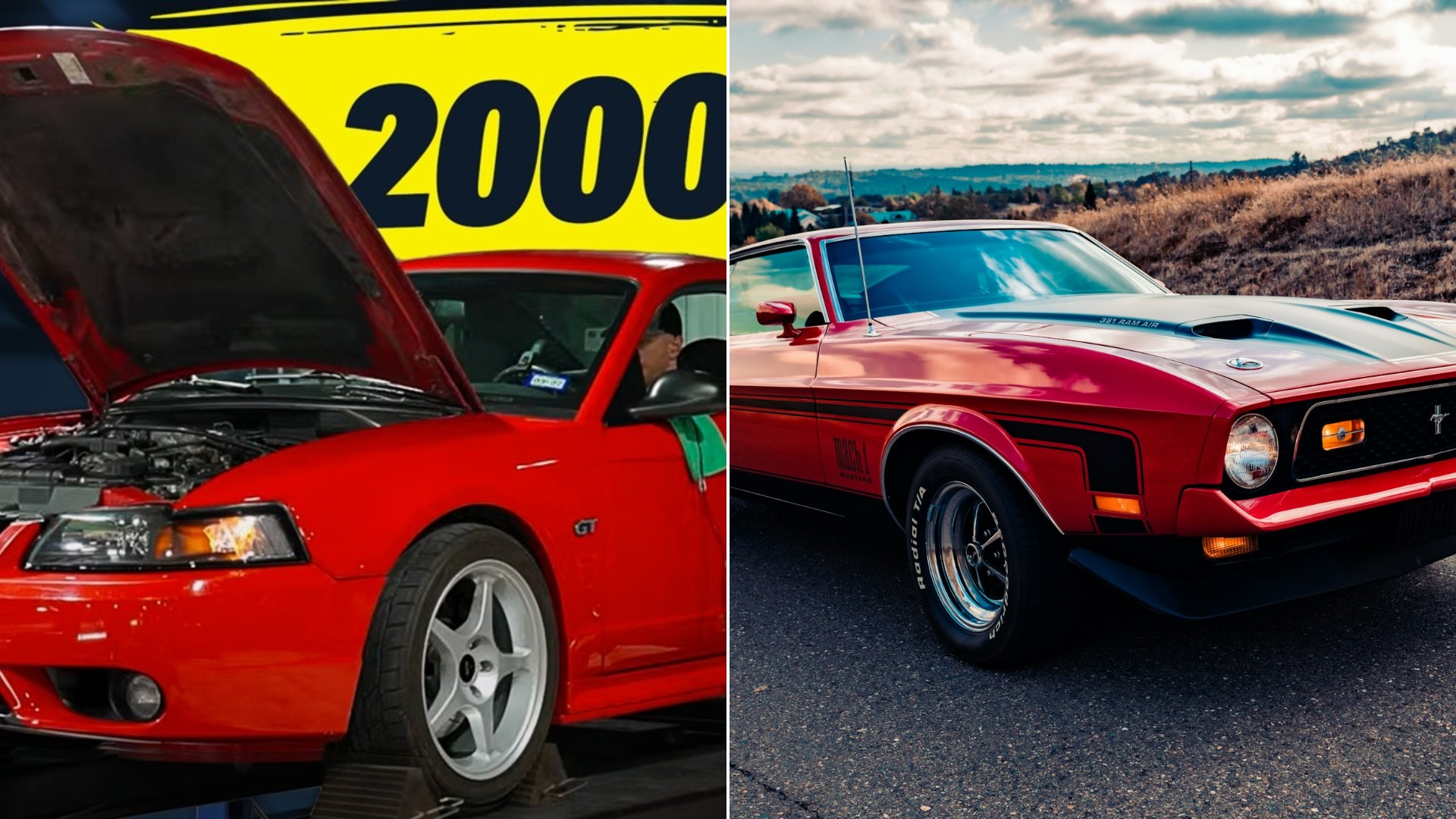
The host says this is actually Nathan’s second performance rear 2000 Mustang GT. The first one was an automatic, a pretty clean car, but he ended up selling it and going a different route. As the host puts it, we are car guys.
Nathan has been featured on the channel before, including a 1999 electric green Cobra dyno, a complete cooling system job, and the IRS conversion he installed in this car. He is checking boxes. He has the independent rear suspension in the car, QA1 coilovers and brakes, and he did a core support refresh as well.
What Is Under The Car
The engine is out of a 2001 Mustang, which the host says does not really matter. It has a Dorman intake, factory exhaust manifolds, and a Bassani free-flowing X pipe that leads into a custom side exit exhaust the host says looks pretty trick. Nathan is also going for a 2000 Cobra R clone, which he has mentioned in his other videos.
The transmission is a TR-3650 five-speed, so the pull was made in fourth gear, which is one to one. The driveshaft is the factory steel one, and when Nathan did the IRS conversion he went with 3.73 rear gears. The wheels are an SVT-style 2000 Cobra R design, 18 inches in diameter, with a 285/35/18 tire.
The tank held 93 octane fuel, since this two-valve engine needs to make as much power as possible. To Nathan’s knowledge the car has a Diablo canned tune.
The Numbers
The host did two pulls, and the result was right where he expected. He guessed 225 horsepower and somewhere around 270 to 275 pound feet of torque. The first run made 226 horsepower at 4,700 rpm, and the torque surprised him a bit at 289.9 pound feet at 3,500 rpm.
The second run was a bit better. The car made 227.6 horsepower at 4,600 rpm and 292.3 pound feet of torque at 3,500 rpm. Those are wheel numbers, measured at the tires, so they read lower than the engine’s rating at the crank.
How It Compares
The host pulled up two earlier runs for context, with the caution that this is not an apples-to-apples comparison, since the cars were slightly different and the dyno was in a different area at the time. The old Keeping Comp car, with the Dorman intake, made 225.1 horsepower at 5,200 rpm and 267.5 pound feet of torque at 3,400 rpm.
He also pulled up the OG PI intake run, which made 240.2 horsepower at 4,900 rpm and 273.8 pound feet at 4,300 rpm. That car was the Keeping Comp car before the Coyote swap and some intake manifold comparisons. In a nutshell, the host says, these two-valve engines make close to the same power even with slightly different modifications.
For perspective, a stock 2000 Mustang GT was rated at 260 horsepower at the crank, so the numbers at the wheels fit with what you would expect from a healthy 4.6 liter with bolt-ons and a canned tune.
The Coyote Plan
Nathan is dreaming of a Gen 2 Coyote swap, along with a new transmission and what the host calls supporting pieces, all to turn the car into a really good HPDE car. The Gen 2 Coyote is the 5.0 liter engine Ford introduced in the 2015 Mustang GT, rated at 435 horsepower from the factory.
The host says Nathan does everything the way he is supposed to, and a Gen 2 Coyote with the supporting parts should add a big power increase and roughly 100 pound feet of torque over this baseline. A baseline like this matters because it shows exactly what a swap changes, with real before and after numbers.
It also gives Nathan something to point to when he plans the budget. A dyno sheet with the starting numbers at the wheels tells you how much work the clutch, driveline and cooling will have to do after the swap.
Why A Baseline Run Is Worth Doing
The host also notes the car stayed close to what he predicted, which tells him the engine is healthy and the tune is doing its job. That is useful information for anyone planning a big project, because it rules out surprises hiding in the starting point.
Many owners skip the dyno until after the big mods, which makes it hard to know what the money bought. A baseline run on a known car in good tune, with the same fuel, same gear and same operator, gives you something to compare against later. Running a car twice also shows consistency, since the second pull was a touch higher than the first.
Nathan could not be there for the session because he had to jump into a meeting, but the host thanked him for lending the car. For a Mustang fan, it is a good reminder that the humble 4.6 two-valve still has a place in the hobby, and the next chapter for this particular GT sounds like a fun one.
More Stories You May Like
- DIY Mechanic Compares Engine Oil Prices And Finds The Same Bottle At Home Depot Costs Thirteen Dollars Less Than At The Auto Parts Store Across The Parking Lot
- Detailer Shares How a One Man Team Can Finish a Full Car Interior in Just Two Hours, and Step One Happens Before the Vacuum Ever Comes Out
- Classic Car Hunter Chases Down a Rare 1969 Mustang 428 Super Cobra Jet With a $50,000 Asking Price, Then Sees What Kind of Shape It Is Really In