

Online critics told him that pouring liquid down the carburetor is not how an engine works. One builder set out to prove otherwise on a locked-up 383 big block Mopar, and he got his proof, at least on that first point. The engine itself is another matter.
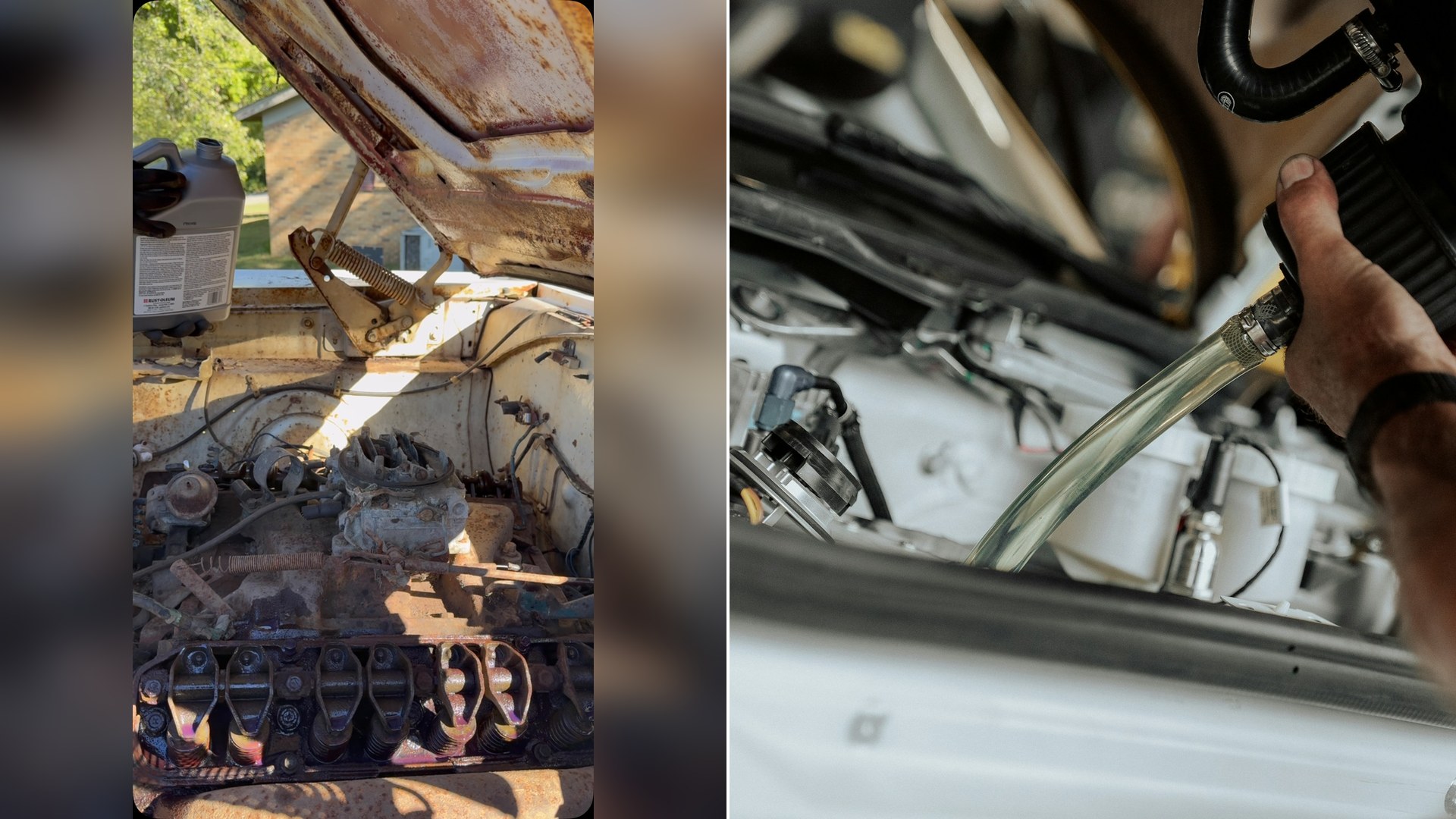
The builder posts as mcmillanbuildz on Instagram, and the engine belongs to a project 1968 Plymouth Roadrunner. This is part two of his effort to free it up.
View this post on Instagram
Boiling Oil, Penetrating Oil And Mystery Oil Went Down Every Nook He Could Reach
He says he had already tried a few unorthodox methods to loosen the engine. He dumped boiling oil, penetrating oil and mystery oil into every nook and cranny he could find, then let it all sit overnight.
Next came the test of whether anything had broken loose. He took the valve covers off again, grabbed a breaker bar, and gave the engine a try by hand.
“Unfortunately, she’s still stuck,” he says. The soak had not done the job.
“That’s Not How An Engine Works” Said The Online Critics, So He Put Their Comments On Screen
Next he went deeper. He unhooked the throttle linkage and removed the carburetor, then the intake manifold bolts, and used a pry bar to lift off the intake.
That let him pull the valley pan, the tray that sits over the lifters in the valley of the engine. On top of it, he found some of the rust dissolver he had poured down the carburetor, still floating there.
He says he got a lot of heat on the internet from people claiming that was not how an engine works. He shows those comments on the screen. And once the valley pan came off, the same rust dissolver was sitting in and around the lifter gallery. In his view, that settled it.
The point stands: the liquid had traveled exactly where he said it would, and the haters had been wrong about it.
Still A Locked Engine, So Next Came Priming The Oil System
Proving a point is not the same as freeing a motor. “Nonetheless, we still have a locked up engine,” he says.
His next idea was to prime the oil system. He pulled the distributor, carefully guided out the intermediate shaft, and used a 5/16 hex head to spin the oil pump by hand.
That ran into trouble right away. The hose for his oil pressure gauge was cracked. A quick trip to the parts store for a plug fixed it, he says, and he got back to work.
Good Oil And White Sludge Started Coming Through, But The Crank Would Not Turn
At first, a lot of the dissolver and other products he had poured into the crankcase came through. Before long, a mix of good oil and white sludge started moving through the system.
He tried the breaker bar one more time. “Yeah, not happening,” he says.
The verdict on the engine is still out. To learn what is stopping it, he says the heads have to come off so he can look at the tops of the cylinders.
For a 1968 Plymouth Roadrunner project, a stuck 383 is a common hurdle. The 383 was a popular big block in Mopar muscle cars of the era, and many survivors have sat for decades before someone takes on the work of waking them up.
Why A Big Block Locks Up And What Builders Try Before Tearing It Down
An engine that will not turn by hand is usually stuck for a reason. Moisture that gets into a cylinder can rust the walls and rings, and an engine that sat for years may have pistons stuck in the bores. Rusted valves and lifters can also hold things up.
The common first steps are the ones this builder followed. Remove the spark plugs, soak the cylinders with penetrating oil, let it sit, and then try turning the crankshaft by hand with a breaker bar on the crank bolt.
Patience matters. Many builders recommend repeating the soak over several days and working the bar back and forth gently, since forcing it can break parts.
What To Take Away Before You Try Freeing A Stuck Engine At Home
Do not use the starter to try to break a locked engine loose. That can damage the starter, the flexplate or the flywheel teeth, or worse.
Check the oil system before you ever start the engine. Spinning the oil pump with a drill or hex tool and watching for oil to reach the top end is a smart step, and it is exactly what this builder did.
Expect surprises. A cracked gauge hose, sludge in the crankcase and a stubborn crank are all normal on a project car that has sat. And if the heads have to come off, count it as the next step of the plan, not a failure.
On this Roadrunner, the tops of the cylinders should show what has been holding the 383 back once the heads are off.
More Stories You May Like
- Locked Up 383 Big Block Mopar Engine In A 1968 Plymouth Roadrunner Gets Boiling Motor Oil, An Entire Jug Of Rust Dissolver And A 24 Hour Soak To Try To Bring It Back
- Mechanic Who Built More Than 2,000 Hemis Says The Dreaded Tick Comes From A Cam Design That Stops 0.88 Millimeters Short Of The Oil Gallery, And Now He Is Building A New Lifter
- Mopar Unveils Six Turn Key V8 Crate Engines From 385 To 1,025 Horsepower With A Warranty Of Three Years Or 100,000 Miles, And No Price Is Announced Yet