

Walk into almost any car dealership and you will hear buyers say the same handful of things within the first few minutes. According to @nextridenate, a car salesman based in Altoona, Pennsylvania, some of those everyday phrases quietly work against the very people saying them. In a short video, he lays out five things you should never say at a dealership, and exactly what to say instead. He warns that customers say one of them “all the time.”
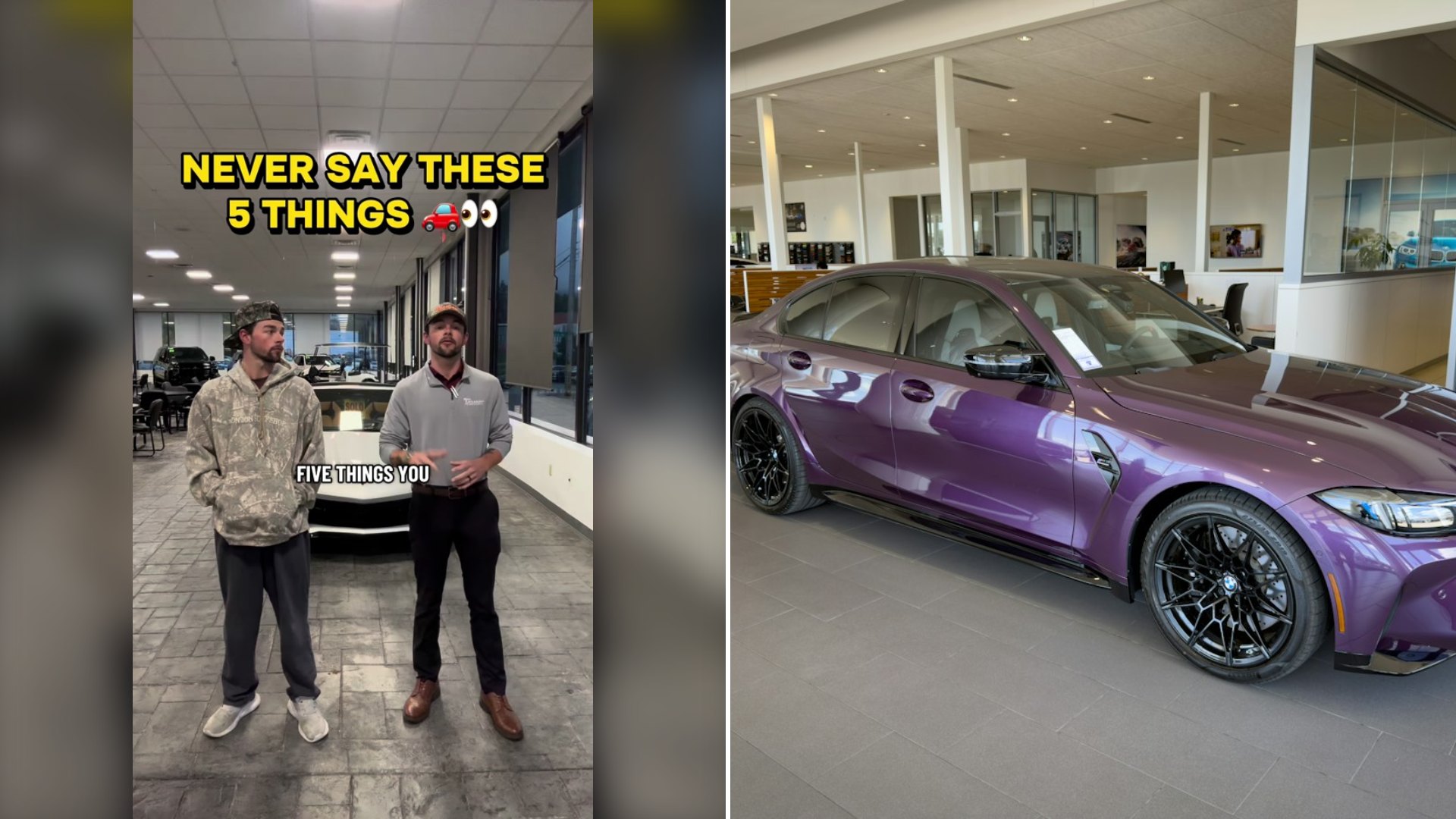
His message is not about tricking anyone. It is about asking questions that get you the full picture. “Buying a car doesn’t have to be you versus the dealership,” he says. “Ask the right questions, understand the numbers, and make a decision that works for you.”
Here are his five phrases to drop, along with his suggested replacements.
1. “What’s your lowest price?” Instead, he suggests asking, “What’s the best overall deal you can put together for me?” His reasoning: “the lowest price doesn’t always mean the best deal.” A low sticker number can come with add-ons, fees, a weak trade offer, or a higher interest rate that cancels out the savings.
2. “I only care about the monthly payment.” Swap it for, “Can we go over the payment, loan term, interest rate, and total amount financed?” As he puts it, “the low payment can hide a very expensive loan.”
3. “I need to be at $300 a month.” A softer version works better: “I’m trying to stay around $300 a month. What do we have to do to make that realistic?” That keeps the conversation open instead of handing over a hard target.
4. “I’m just looking.” Rather than shutting down the conversation, give a little direction. His example: “I’m early in the process, but I’m looking for an SUV with good gas mileage and within my budget.”
5. “I’m not telling you what I want from my trade.” Try instead: “I’d like to know what my vehicle was worth and how it affects my next purchase.” His key point is one many buyers miss: “Your trade value and the next vehicle’s price are two separate numbers. Make sure you understand both.”
@nextridenate
Why the Monthly Payment Can Fool You
His warning about monthly payments is the one that can cost buyers the most. A payment can be made smaller simply by stretching the loan over more months, and the total cost climbs as the term gets longer.
Here is a simple example. Say you finance $25,000 at a 7 percent interest rate. Over 60 months, the payment is about $495 and you pay roughly $4,700 in interest. Stretch that same loan to 84 months and the payment drops to about $377, which sounds great. But the interest climbs to nearly $6,700, about $2,000 more, and you will be making payments for seven years. Longer loans also make it more likely you will owe more than the car is worth for a long stretch, which becomes a problem if you want to trade it in early or if it is totaled.
That is why he wants buyers looking at four numbers together: the payment, the loan term, the interest rate, and the total amount financed. If someone only talks about the payment, ask to see the rest in writing.
Keep the Trade and the New Car Separate
When a trade-in, a new car price, and financing are all blended together, it becomes very hard to tell whether you got a good deal. A generous trade allowance can be offset by a higher price on the new vehicle, and a big discount can be offset by a low trade offer.
Before you visit the dealership, get a sense of your current car’s value. Look it up on pricing guides such as Kelley Blue Book or Edmunds, and consider getting a written offer from a used car buyer such as CarMax. Those offers give you a real number to compare against. Then, at the dealership, ask for the price of the new vehicle and the value of your trade as two separate figures.
More Ways to Walk In Prepared
A few more habits can make your next purchase smoother and cheaper.
- Get preapproved for a loan first. A credit union or your own bank can tell you what rate you qualify for. If the dealer can beat it, great. If not, you already have financing ready.
- Ask for the out-the-door price. This is the total you will pay including taxes, title, registration, and dealer fees. It is the most honest number to compare between dealerships.
- Question every add-on. Extended warranties, paint protection, nitrogen-filled tires, and similar extras are often optional. Ask what each one costs and whether you can decline it.
- Read before you sign. Make sure the numbers on the contract match what you agreed to, including the interest rate and loan term.
- Be willing to walk away. There will always be another car. Taking a night to think it over is perfectly reasonable.
His last point is worth remembering. A car purchase does not have to feel like a battle. When you come in with clear questions and a firm grasp of the numbers, you are far more likely to drive away with a deal you feel good about long after the new car smell fades.
More From Steel Horse Rides
- Dealers Use Lowball Trade In Offers And Bundled Deals To Hide What You Really Pay, So Negotiate Your Trade And Your Purchase Price Separately
- Volkswagen Tells ID.4 Owners To Stop Charging Past 80 Percent While A Battery Fire Recall Waits On A Fix For More Than 22,000 Vehicles
- That Cheap Classic Car Project Can Turn Into A Rust Bucket That Costs More To Restore Than It Will Ever Be Worth, So Budget The Real Cost Of Bodywork Before You Buy