

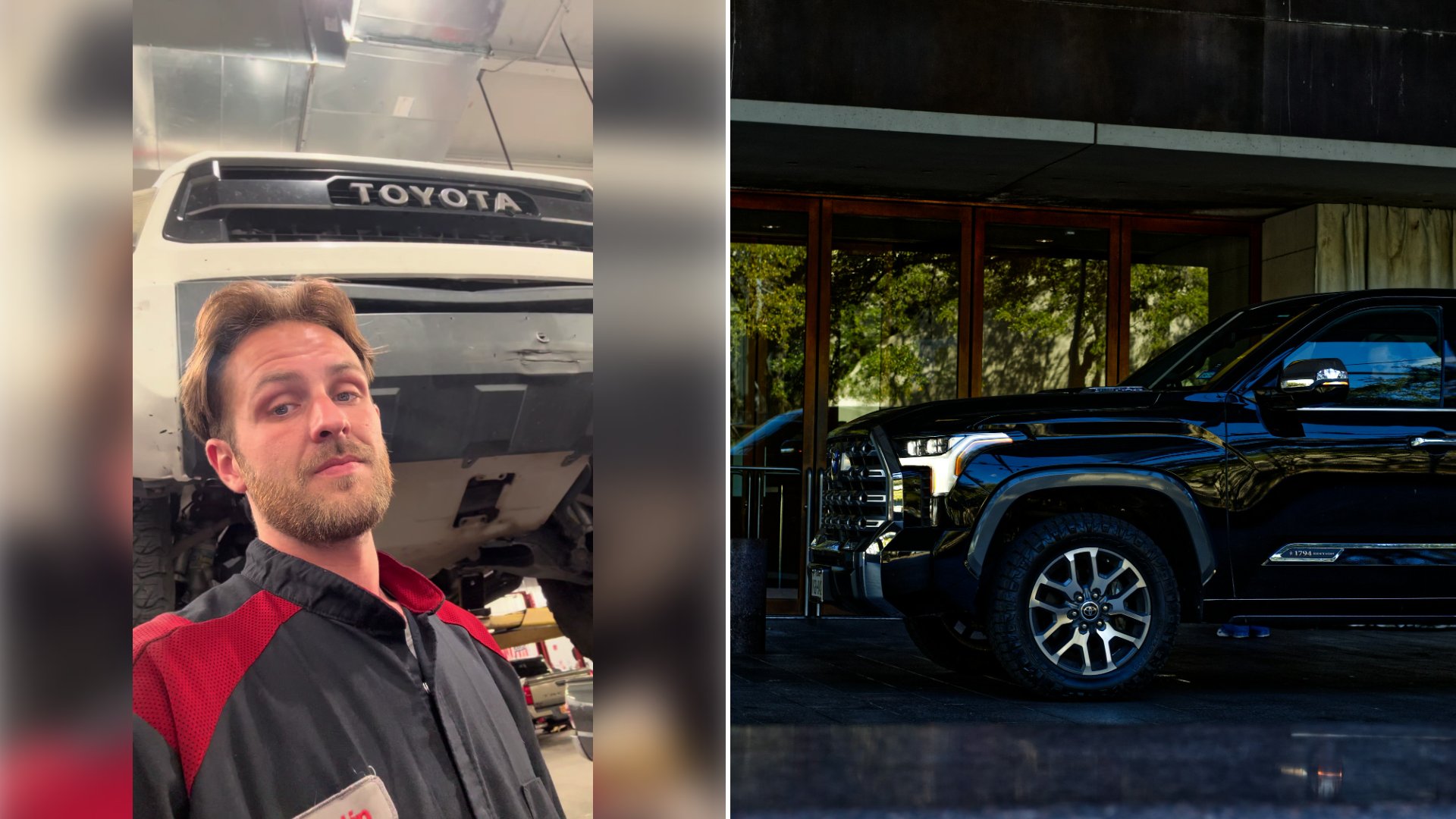
A Toyota dealership technician films himself under a white pickup raised on a lift in a service bay and opens a selfie style TikTok with a question: do viewers really want to see why none of them are trying to be technicians anymore? The account is @thatyotaguy1, the caption just asks what everyone thinks, and he walks through one repair ticket on camera to make his case.
The job is a fuel tank replacement on a 2019 Tundra. He shows the labor time guide on a screen, with the line for removing and replacing the tank with the skid plate, and reads the numbers out loud. The book shows 2.3 hours, and he says the warranty time is 1.4. Those hours are what a flat rate technician gets credited for, no matter how long the job actually takes at the lift.
Then comes what he calls the part that makes it worse. After he quotes the job, the service advisor comes out and says the owner has an aftermarket warranty. The company behind that plan, he says, will pay Toyota warranty time. He asks for a drum roll and shows the screen, where the figure is a checked box for 0.8 hours.
“So we went from 2.3 to point eight,” he says, and describes it as a sad reality of being a dealership technician that happens more often than people think. He goes on to describe a pattern. A ticket comes in, he diagnoses it, sends up a quote, and then someone comes back asking him to get an operation code because they forgot the customer has an aftermarket warranty. The pay then falls on him. He says he still has to put the tank in for 0.8 instead of 2.3.
The video does not show a pay stub, a shop rate, or what his hourly figure works out to, so how much money the difference represents is left to the viewer. It also does not say whether the aftermarket plan’s lower payout was disclosed to the customer, or whether the shop had any way to adjust its time. Everything here is one technician’s account of one ticket, and he is the only person heard.
Outside facts show the setting is a common one. The Bureau of Labor Statistics says the median pay for automotive service technicians and mechanics was $50,620 a year in May 2025, with those working at automobile dealers at a median of $59,920. It says that some repair shops pay technicians on an hourly basis while others pay them based on the amount of work completed, which is the structure the video describes. The agency also projects about 66,200 openings a year on average over the decade ending in 2035, many of them from workers who leave the occupation or retire.
The U.S. Department of Labor adds some of the legal background in its fact sheet on automobile dealers. It says certain mechanics at dealerships are exempt from federal overtime under section 13(b)(10)(A) of the Fair Labor Standards Act, but that the federal minimum wage still applies to nonexempt employees. It also says employers may credit commission draws against minimum wage obligations when pay is settled at the end of the pay period. The page does not mention flat rate by name, so it does not speak to the case in the video.
The video’s complaint is not about technicians being underpaid in general, but about the gap between the labor time a customer is quoted and the time a third party will pay for. That is a narrow claim and the clip supports it only as far as the technician’s screen and his words go. What it gives viewers is a simple and clear example of flat rate math from the person who lives with it, with an invitation at the end to share what they think.
More from Steel Horse Rides
- Mobile Mechanic Says a Dealership Blamed a Timing Chain for Up to Five Thousand Dollars, Then He Pulls a Clogged VVT Solenoid and Watches Every Camshaft Code Disappear
- Narrator of a Repair Clip Says a Car That Shook Every Time the Owner Hit the Gas Had an Engine Mount Cracked Clean in Half, Then Explains Why the Impact Wrench Is Not the Last Step
- Mobile Mechanic Says Every Amateur Silicone Job He Takes Apart Is Caked in Sealant and Takes an Hour to Clean Yet Never Leaks, Then Asks if More Is Actually Better