

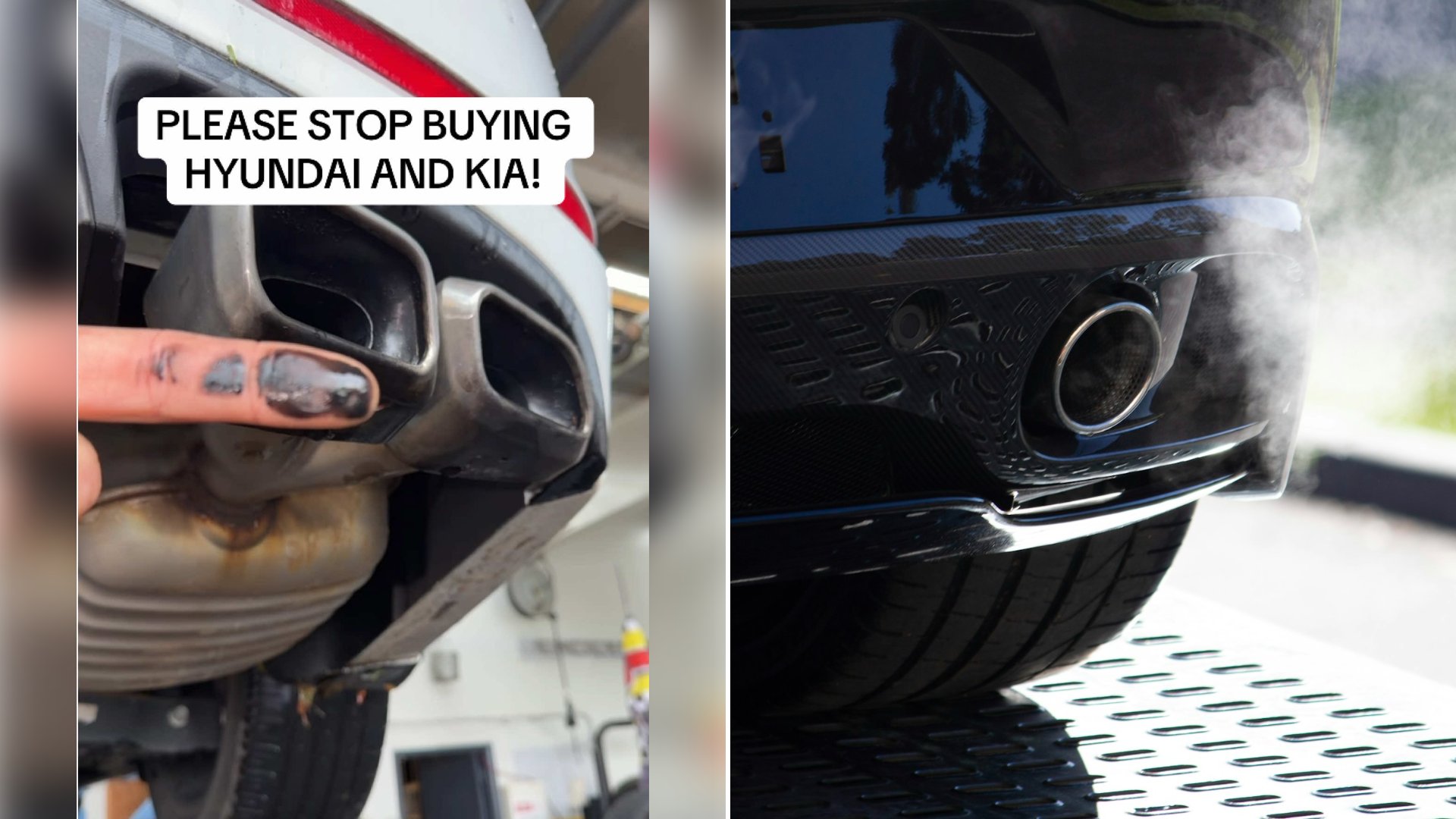
A video from the account theclawboss opens with a blunt warning stamped across the screen: “PLEASE STOP BUYING HYUNDAI AND KIA!” The shop shows a mechanic running a finger around the inside of an exhaust tip on a Kia K5 up on a lift, pulling it back coated in thick black soot, the caption reading simply “Stop buying Hyundais and Kias!” Tagged #hyundai and #kia, the video pulled in 31,800 likes, 2,409 comments, 2,325 saves, and 3,703 shares.
@theclawboss Stop buying Hyundais and Kias!
That sooty fingertip is a diagnostic shorthand mechanics reach for constantly, and in a Hyundai or Kia from the past decade and a half, it points at one of the most expensive problems the two brands have ever had to answer for. Safety Research & Strategies, which has tracked the issue since it surfaced, reports that the defect centers on the Theta II GDI engine, built in 2.0-liter and 2.4-liter versions and installed across the Hyundai Sonata, Santa Fe, and Tucson and the Kia Optima, Rio, Sorento, Soul, and Sportage, mostly in 2011 through 2019 model years. Metal debris left over from crankshaft machining can block the oil passages feeding the connecting rod bearings, starving them of lubrication; the result is knocking, an oil pressure warning, premature bearing wear, and in enough cases to trigger a federal response, an engine that stalls outright while it’s being driven.
The scale of what followed is what makes this more than one shop’s opinion. Safety Research & Strategies counts more than 1.6 million vehicles covered in the recalls tied to the issue, including 470,000 Sonatas recalled in 2015 and roughly 618,000 more Hyundai and Kia vehicles in 2017, on top of a separate wave of 11 recalls covering over 2.5 million vehicles for non-crash engine fires between February and December 2020. NHTSA eventually fined Hyundai and Kia a combined $210 million, the largest civil penalty the agency had levied on an automaker at the time, over how the companies handled the defect. The Drive’s guide to spotting a failing Theta II engine calls metallic-looking oil the single most common symptom owners report, alongside knocking or tapping from worn bearings and warning lights tied to low oil pressure.
Both automakers eventually responded with warranty relief that goes well beyond a standard powertrain warranty: Kia extended coverage on 2011 through 2014 Optima models with the 2.0L or 2.4L GDI engine to 10 years or 120,000 miles, while Hyundai extended the engine short block warranty on recalled Sonatas, and a $1.3 billion class-action settlement added a lifetime warranty covering inspections and future repairs tied to the defect, transferable to used-car buyers who weren’t the original owner. For anyone driving an affected Hyundai or Kia from that window of years, The Drive’s guidance is to check the VIN against the recall campaign before assuming a knock or an oil light is routine, since the lifetime coverage only helps if the repair gets documented through the right channel rather than paid for out of pocket at an independent shop.
More from Steel Horse Rides
- Buyer Says He Bought a 90K Mile Bentley Continental GTC Sight Unseen at Auction, Then Finds a Check Engine Light, a Parking Brake Failure and a Fuel Door That Won’t Open
- Mechanic Pulls a Snapped Crankshaft Apart in Two Pieces on the Shop Bench, Says the Car Drove In Like That and Jokes the Customer Only Wanted an Oil Change
- Narrator of a Repair Clip Says a Car That Shook Every Time the Owner Hit the Gas Had an Engine Mount Cracked Clean in Half, Then Explains Why the Impact Wrench Is Not the Last Step