

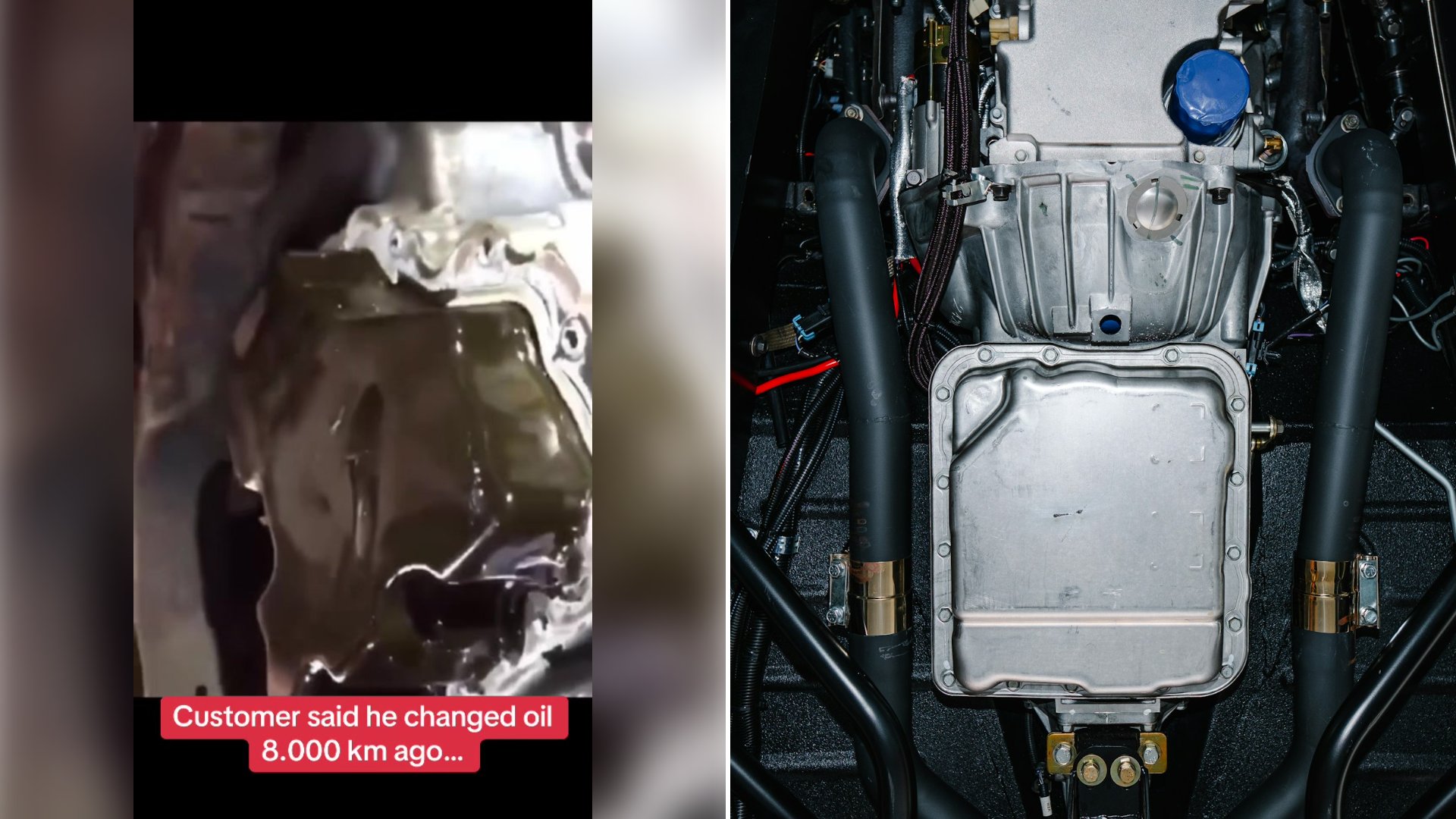
A 60 second clip from @confused.mechanics, the TikTok account that goes by Confused Mechanics, opens on a dark, oil soaked engine pan and never leaves it. Text pinned across the whole video reads “Customer said he changed oil 8.000 km ago…”, which is the claim the footage sets out to test. The caption adds only four hashtags: mechanic, confusedmechanic, justrolledintotheshop and confused.
The first frames show the pan with a slick of black fluid in it and a hand reaching in. A voice tells whoever is working to “Pull it down,” then “Hold it right there for a second.” Within seconds another line comes through clearly: “I’ve never, ever seen anything like that.”
What comes out is not liquid. Sixteen seconds in, a voice says “That’s formed to the oil pan,” and a few seconds later, “That’s what was inside the oil pan.” The frames bear that out. The dark mass holds a rough lump shape as hands work at it, and across the second half of the video it is pulled away in thick pieces with torn edges instead of pouring.
The commentary stays plain and a little dumbstruck. One voice jokes that “somebody’s trying to make some jello,” and another says “It’s like your kid’s science project.” Then comes the verdict: “It’s slime.” The person pulling at it admits “I can’t even pull it out,” and the clip ends on a comparison, “I feel like I’m picking the giant’s nose here.”
What the clip does not say matters as much as what it shows. It never shows the vehicle, its make, its mileage or the oil that was last put in, and nobody on screen says what caused the buildup or what happened to the engine afterward. The only service history in it is the customer’s, and it reaches viewers as a line of on screen text. That is a customer’s statement, not a finding. The footage cannot show how old the oil was, only what was sitting in the pan when it came off.
For scale, 8,000 kilometers is about 4,970 miles, a distance that falls inside many oil change schedules. Sludge is exactly what modern oil specifications are written to resist. The American Petroleum Institute says its current gasoline engine category, API SP, introduced in May 2020, is designed to give more stringent sludge and varnish control, and that its obsolete SH and SF categories may not protect adequately against sludge buildup. The institute also tells owners to read their owner’s manual before choosing from its charts.
The grade of oil matters too. According to the U.S. Department of Energy’s fueleconomy.gov, running a grade the manufacturer did not specify can cost 1 to 2 percent in fuel economy, which is a small number that shows how much the engine maker’s recommendation is meant to decide. The practical rule is the one in the manual: use the grade and specification it names, and the interval it gives for your kind of driving.
Paperwork is what settles a claim like the one in the video. The Federal Trade Commission says to keep records of maintenance such as oil changes, warns that a warranty company could ask for them, and says a claim might be denied without them. It also says you do not have to use the dealer for maintenance to keep your warranty in effect. A receipt that lists the date and the odometer reading makes it easy for anyone to check, either way, what was done and when.
Between visits, the dipstick is the cheapest check an owner has. Oil that looks thick, gummy or unusually dark on the stick, or an oil pressure warning, is a reason to have a shop look before the next scheduled change, not after.
More from Steel Horse Rides
- Mechanic Opens on a Clean Valvetrain Under the Words 3k Mile Oil Changes Versus 10 to 20k, Then Cuts to a Sludge Caked Engine and Notes This CRV Only Had 80k on It
- Mechanic Loosens a Drain Plug Under a Car on a Lift, Then Probes the Hole With Bare Fingers as Thick Black Sludge Runs Down His Arm and He Grins at the Camera
- Mobile Mechanic Drops the Oil Pan on a Car the Customer Says Just Shut Off on the Highway With No Unusual Noises, and It Comes Down Full of Broken Engine Parts