

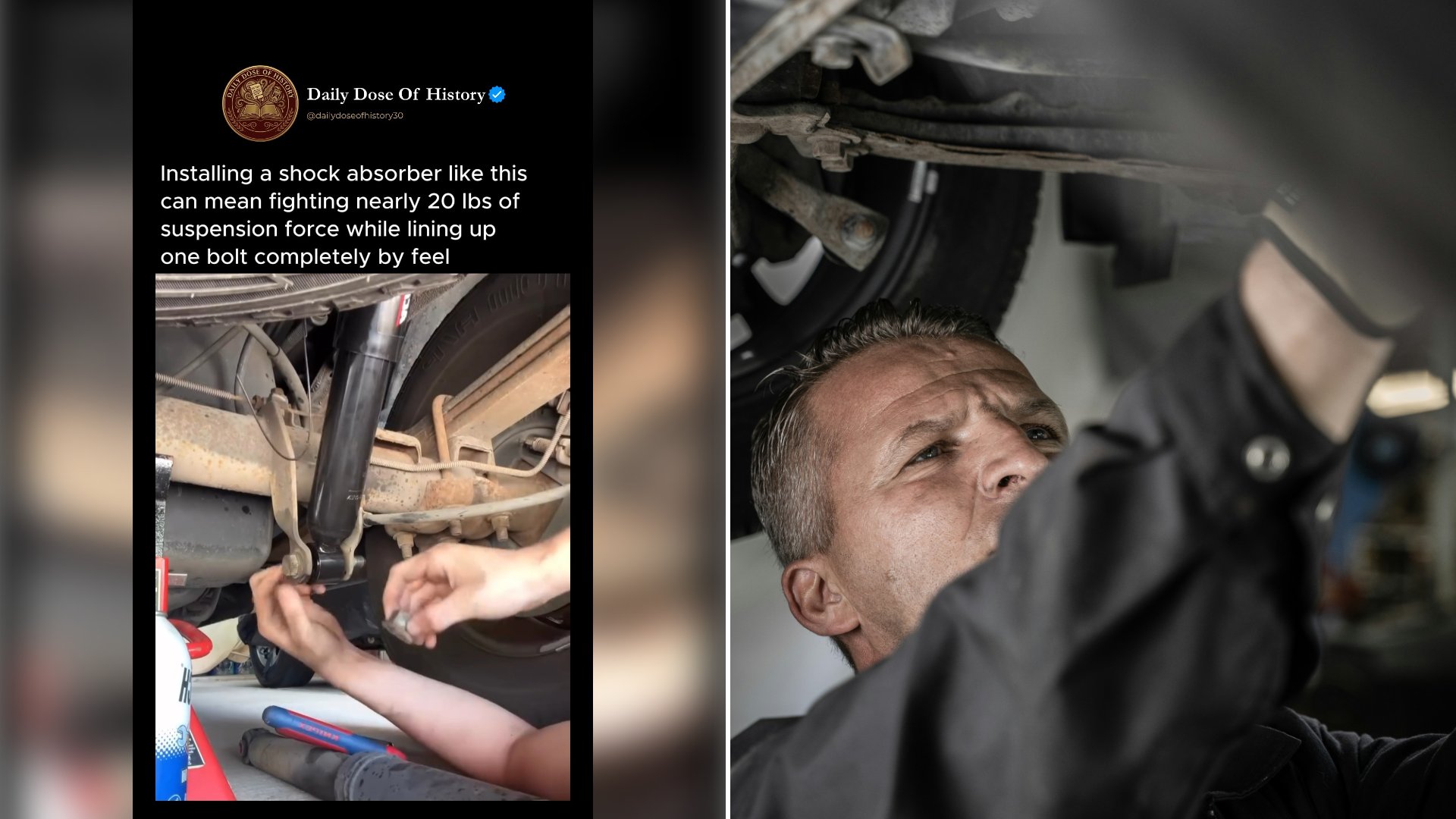
@dailydoseofhistory30 shared a 25 second clip of a rear shock absorber being fitted to a truck, with a line of text over the top of the video that sets up the whole job: “Installing a shock absorber like this can mean fighting nearly 20 lbs of suspension force while lining up one bolt completely by feel.”
The caption makes the same point at greater length. Replacing a rear shock absorber on a truck “can look like a simple job,” it reads, “but getting the new shock perfectly aligned can be surprisingly frustrating.” When the suspension shifts or the axle puts pressure on the mounting points, even a tiny difference in position can make the bolt holes difficult to line up. The account does not say who filmed the repair: the caption closes with “DM for credit/removal,” and a banner reading Daily Dose Of History runs across the top of the frame.
The footage is shot from beside the truck’s rear axle, looking up at the shock. A long black shock body stands against the axle housing while one dirty hand and forearm hold it from above. A second arm reaches up from below the frame, first with a red handled tool and later with an open palm held under the bottom of the shock, where it ends in a round mounting eye. The hands keep shifting the shock against the bracket for the full length of the clip. The caption says the old rear shock has been removed and the replacement is being positioned underneath the axle before it is secured. The clip itself shows only that positioning stage, with no old shock on screen, and it ends with the hands still working at the mount, so it does not show the bolt going home.
The caption also explains why the part matters. In the account’s words, springs support the vehicle’s weight while shocks slow how quickly the suspension compresses and rebounds, and worn shocks can let a truck bounce excessively, feel less stable on uneven roads and put extra stress on other suspension and tire components.
The caption ends with a warning that working underneath a vehicle takes serious caution and that the truck should be parked securely and supported with properly rated equipment before anyone gets under it. A tip sheet from the Washington State Department of Labor and Industries on jack safety, issued in April 2021, gives the same instruction in more detail: never use the jack to support the vehicle after lifting, transfer the full weight to heavy duty jack stands, set the parking brake and chock the wheels, confirm the vehicle’s recommended lift points, and remove the jack before anyone crawls underneath.
More from Steel Horse Rides
- Technician Hauls a Dashboard Out Through a Driver’s Door as the Text Over Him Says He Has Replaced Over 1,000 Audi Evaporators but Only 3 for BMW and Thanks BMW Engineers
- Mobile Mechanic Drops the Oil Pan on a Car the Customer Says Just Shut Off on the Highway With No Unusual Noises, and It Comes Down Full of Broken Engine Parts
- Mobile Mechanic Finds a Steady Coolant Drip Under a Red Car at a Gas Station After a Driver Asks for Money, Then Offers to Fix It in the Morning