

A couple of road trippers were sitting beside the highway with a problem that sounds expensive: a clutch pedal that kept sinking toward the floor. They had just left Los Angeles, they were aiming for San Francisco, and they were ready to hand money to anyone who could swap a clutch master cylinder.
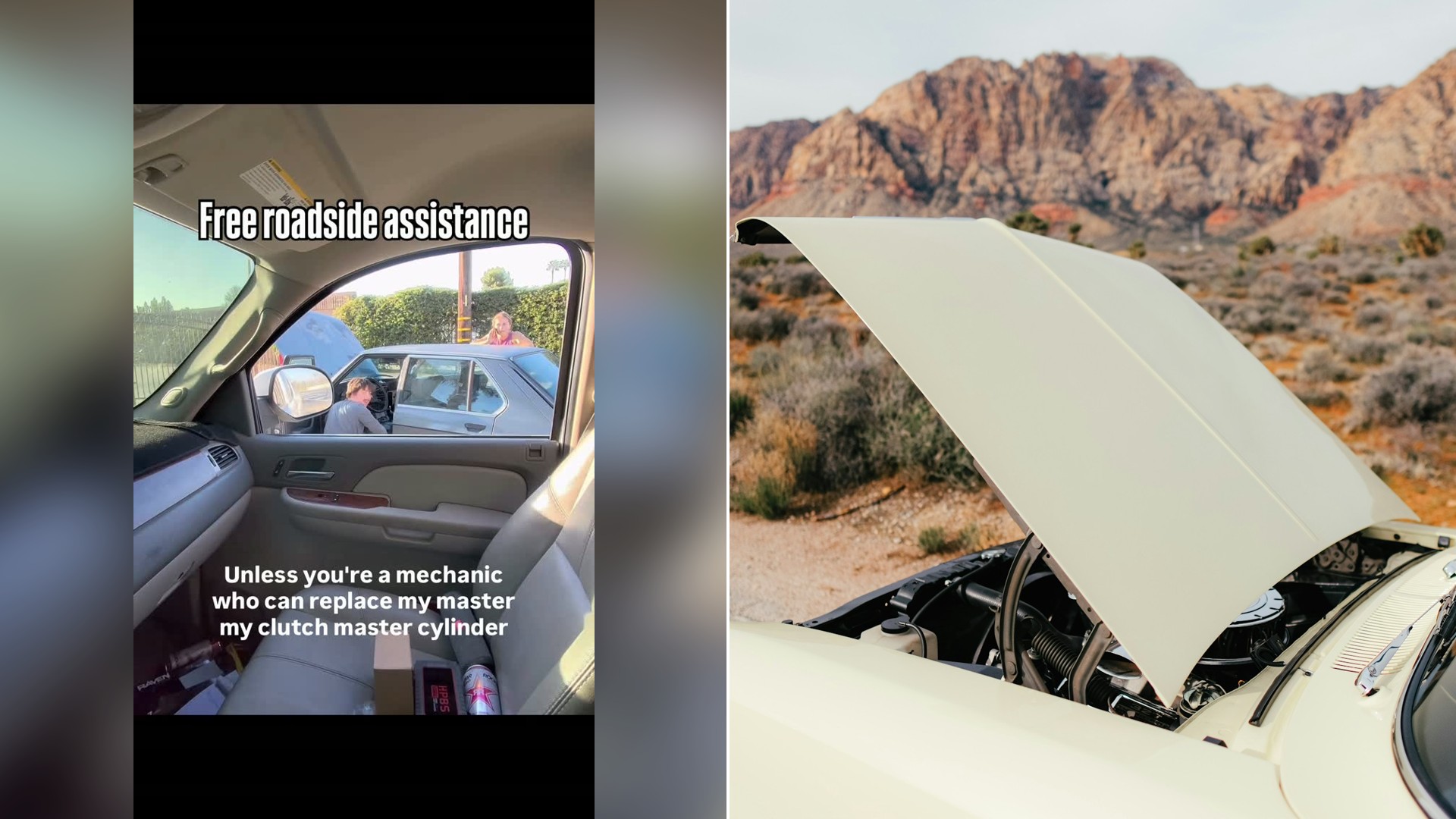
Then a mobile mechanic pulled up, asked if they needed help, and fixed it in a few minutes with nothing more than the cap on a reservoir. The encounter was posted by curbside_brakes_bakersfield under the caption “One for the books.”
The mechanic opened with a simple question, “You guys good? You guys need help?” The driver answered with a half joke, saying they needed a mechanic who could replace a clutch master cylinder. The reply was the one they were hoping for. “No, I am a mechanic. I’m a mobile mechanic.”
View this post on Instagram
“I Can Feel The Bite Point Getting Lower And Lower” Is How The Driver Described A Clutch Going Away
The driver explained what the car was doing. Very randomly and very intermittently, he said, he could feel the bite point of the clutch start to get lower and lower. His theory was the master cylinder, because, as he put it, the slave side had already been done at some earlier point.
That theory made sense on its face. A hydraulic clutch uses two main parts, a master cylinder that the pedal pushes and a slave cylinder at the transmission that does the work. When the pedal slowly sinks or the engagement point wanders, the master cylinder is a common suspect, which is why the driver had already planned for one.
The cherry on top of the bad day, the driver said, was that he actually owned the part. It was sitting in his garage at home, a long way behind them. Picture that for a second: the exact fix, on a shelf in the wrong city, while the car and the vacation are stuck on the shoulder.
“It Was Under A Vacuum” Turned A Roadside Disaster Into A Free Fix
The mechanic took a look at the reservoir, which was right there and easy to see. Then he tried something small. “Sometimes you have to finesse it to where it gets the air out,” he said, and he took off the cap on the brake master cylinder. “There it goes. There it goes.”
The change was easy to see on camera. The mechanic pointed out that the system had been under a vacuum, and once the cap came off the pedal started doing better. “It’s getting better. It’s getting stronger,” he said. He then went to grab his tools so the driver could test it himself and, if it held up, get back on the road.
The travelers had been chatting about the trip all along. They told him they had been listening to an audiobook and that they were headed for the Bay. The mechanic joked that, with the clutch behaving like that, they probably would have made it all the way to San Francisco in fifth gear, unless they hit traffic. Everybody laughed, because anyone who has driven a manual car through stop and go knows exactly how that would have gone.
“Let Me Know When You Get There” Was The Only Payment He Wanted
When it was time to settle up, the mechanic offered a business card. The travelers were so relieved they waved off the small stuff, and he waved off any talk of money in return. His line was simple: “That’s what we’re here for.”
He asked for one thing instead. He wanted them to post and let him know how the trip went. “Let me know how it goes,” he told them, and he said it again as they parted, with a cheerful “no worries, guys, I got you.”
It is the kind of story that makes the rounds for a reason. A stranger stops, spends a few minutes, asks for nothing, and a vacation survives. In a world where a roadside breakdown can easily mean a tow truck, a motel and a missed weekend, that is a good feeling to read about.
What To Do If Your Clutch Pedal Starts To Sink
Nobody should treat this one cap trick as a cure for every soft clutch, but the story does point to some sensible habits for drivers of manual cars. These are general tips, not a repair manual.
First, notice the pattern. A clutch that sinks only now and then, or that engages at a different point on different days, is telling you something about the hydraulics. On many vehicles the clutch fluid comes from a reservoir that is shared with or connected to the brake system, so it is worth knowing where yours is and what the fluid level looks like.
Second, remember that hydraulic systems need to move fluid in and out smoothly. Air in the lines or trouble at the reservoir can make a pedal feel spongy or low, and that is why a mechanic will often start with the simple checks before reaching for parts. A quick look at the reservoir level and condition costs nothing.
Third, if the pedal drops to the floor and the car will not shift, stop driving it. Pull over somewhere safe, put on your hazards, and call for help. A clutch that fails fully can leave you unable to select gears, and a busy highway is no place to find that out.
Finally, keep a few basics in the car: a flashlight, a phone charger, and the number for a roadside service. And if a friendly mobile mechanic ever pulls over and asks whether you need help, do what these travelers did and say yes. Then do what he asked, and let him know how the trip went.