

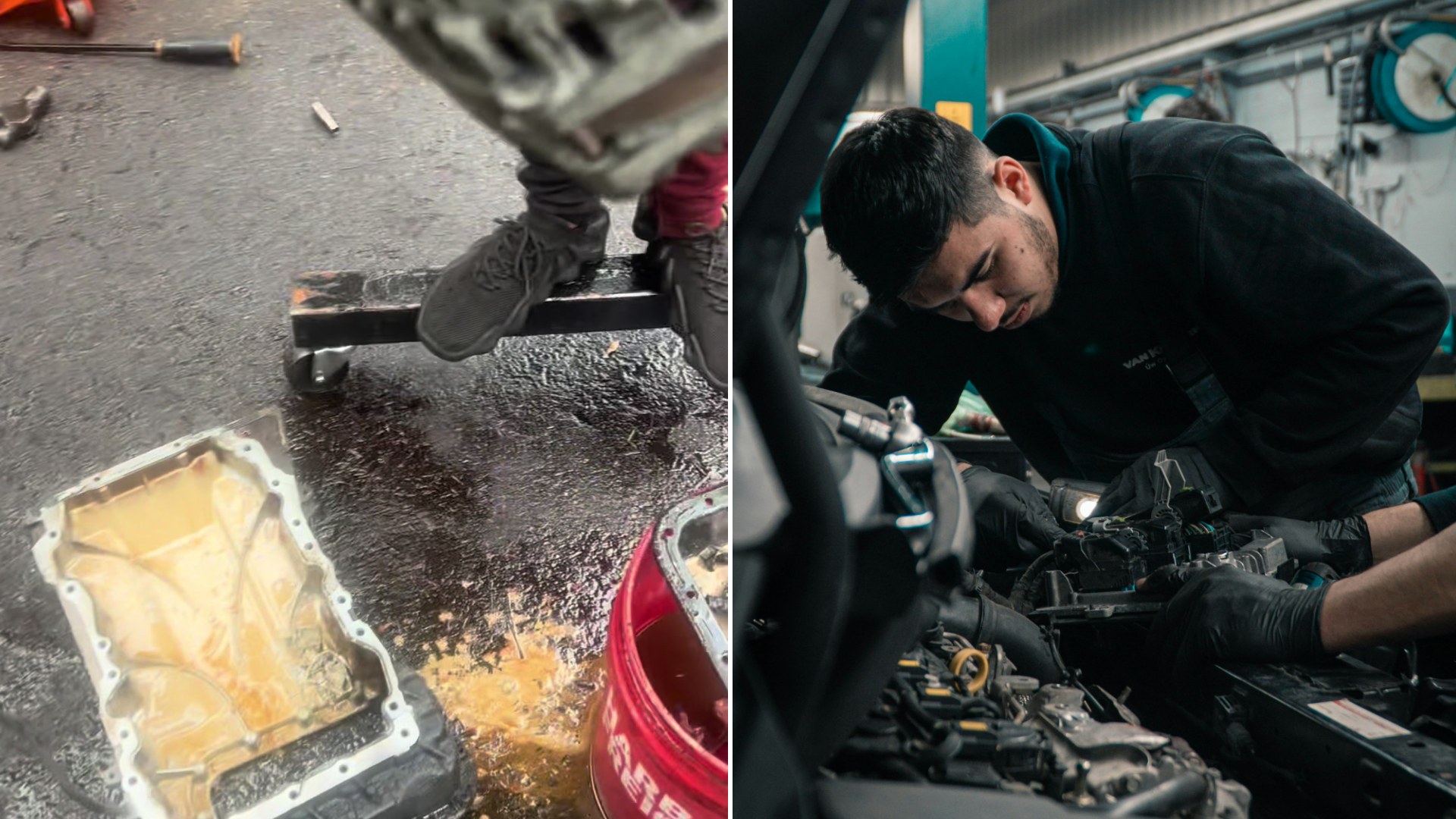
An engine that locks up usually keeps its secrets until somebody takes it apart. In a 41 second clip from the Detroit mobile repair business @247mobilemechanicdetroit, the taking apart has already happened, and the first thing on screen is the answer. An oil pan sits on wet pavement, filled nearly to the rim with a thick tan sludge the color of caramel.
The caption sets it up in capital letters: “CUSTOMER SAID THEIR ENGINE LOCKED UP… THEN WE FOUND THIS!” It continues, “We pulled the engine the SAME DAY and discovered serious internal damage, along with what appeared to be oil and coolant contamination.”
The clip plays as a tour of the evidence. The camera moves in on the pan, where the sludge is thick enough to hold ridges and swirls instead of settling flat. A red five gallon bucket sits next to it, and a thin stream of the same tan liquid runs down into several inches of opaque brown fluid already collected at the bottom. A few seconds later the pan is resting on top of the bucket, and a small cylindrical object is lying in the muck.
From there the video moves to the engine itself, hanging from a chain over the pavement, and the camera pushes in close on the underside of the block. A quick shot inside the car shows a Chrysler badge on the steering wheel and the instrument cluster lit up. The last few seconds show the engine on a red hoist at the nose of the car in a residential driveway, with the front of the car taken apart around it.
The rest of the caption is about the business. It says that for the rest of 2026 the focus is on “Chrysler, Dodge, Jeep & Ram vehicles,” and it lists engine repairs and replacements, diagnostics and no start problems, overheating issues, and brakes and suspension, in Detroit and the surrounding areas. Anyone who wants a labor quote is told to send the “YEAR, MAKE, MODEL, ZIP CODE & ISSUE.”
The reason that pan is worth a long look is the color. Healthy engine oil runs from amber to nearly black, and it pours. Oil that has turned tan, opaque and thick has usually been churned together with coolant. The usual routes for coolant to reach the oil are a failed head gasket, a cracked cylinder head or block, or a failed oil cooler. The caption does not say which one happened to this engine, and it is careful to say only what the contamination “appeared to be.”
What makes the mix so destructive is that coolant ruins the oil’s ability to keep metal parts separated. Bearings that ride on a thin film of oil start riding on something closer to a milkshake. They wear, they overheat, and eventually something grabs. That is how a slow internal leak ends with a customer saying the engine locked up.
The warning signs tend to show up well before that point, and most of them take a minute to check. Pull the dipstick and look at the underside of the oil filler cap for tan or milky residue. Watch the coolant reservoir, because a level that keeps dropping with no puddle under the car means the coolant is going somewhere. Pay attention to a temperature gauge that creeps higher than it used to, and to white exhaust with a sweet smell. A little pale film under the cap can also come from condensation on a car that only makes short trips, so one sign alone is not a verdict. A shop can pressure test the cooling system and test the coolant for combustion gases to settle the question.
The cost of waiting is the gap between a repair and a replacement. Caught early, the fix may be a gasket or a cooler. Driven until it seizes, it is an engine. If the temperature gauge spikes or the oil pressure light comes on, pull over and shut it off. If the engine has already locked, do not keep cranking it. Have it towed or have a mechanic come to the car.
Before agreeing to an engine replacement, get the labor quote in writing and ask a few direct questions. Where is the replacement engine coming from, how many miles are on it, and what warranty covers the engine and the labor? Will the radiator, hoses and oil cooler be flushed or replaced, so the old contamination does not get pumped straight into the new engine? Can you see what came out of the old one? This clip is a good model for that last question, because the pan, the bucket and the block are all on camera.
If the work is happening in your driveway, ask how the old fluids will be caught and hauled away. Coolant is toxic to pets and children, and it should leave in a sealed container, the way the tan mix in this video goes into the bucket.
More from Steel Horse Rides
- Mechanic Opens The Oil Pan And Finds Metal Shavings That Explain Why The Dealer Wanted The Sale Done Before Closing
- Houston Mobile Mechanic Pulls a Brake Caliper in a Driveway, Hears “You’re Charging Me $500 for That?” and Tells the Customer to Find Someone Who Will Do It for Thirty Bucks
- Car Reviewer Sees White Smoke Pour From the Engine Bay of a 30 Year Old Autozam Kei Car and Finds a Rotted Factory Coolant Hose Instead of a Failed Head Gasket