

Six classic Corvettes, tucked away by one Texas family near Corpus Christi, and a price tag of $390,000 for the whole lot. That was the setup when veteran collector car buyer @john_clay_wolfe made the trip to see them. He looked at every car, did his math, and drove away with just two of them. The way he picked those two is a lesson for anyone who has ever stood in a garage wondering what an old car is really worth.
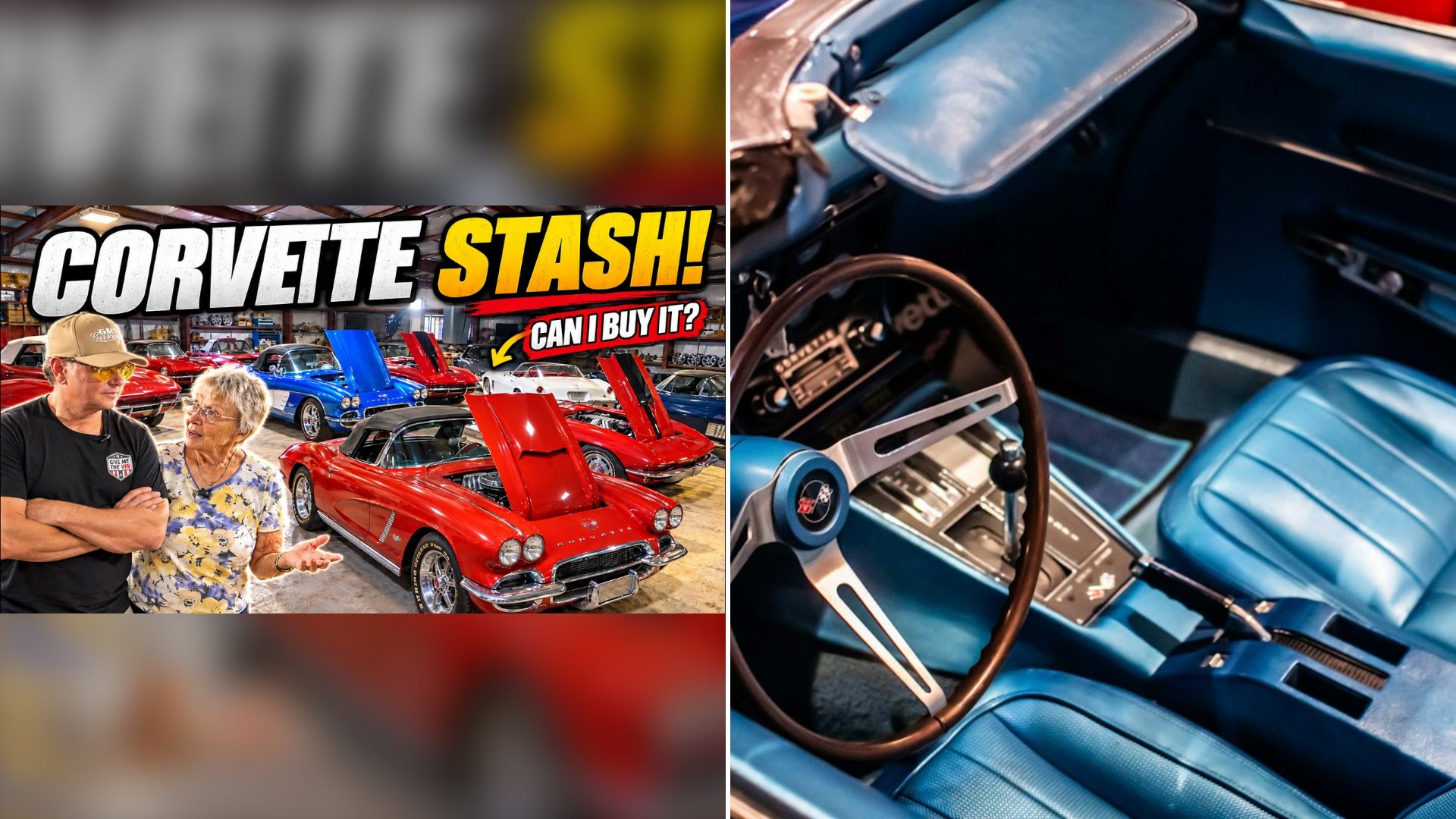
John Clay Wolfe has built a business out of buying classic cars, muscle cars and entire hidden collections, and he hosts a weekly car-buying radio show. In this video he walks the property, inspects the collection, asks about how the family came to own the cars, and then works his way toward an offer.
On paper, six Corvettes sounds like a dream find. In person, not every car was what it seemed from a distance. Some of the six were unfinished projects, and some had been altered from the way they left the factory. Those details matter enormously in the Corvette world, where originality often drives the price more than shiny paint.
Two Big-Block Convertibles Stood Out
Two of the cars were in a different league. One was a 1965 Corvette convertible with the 396 big-block engine, and the other was a 1967 convertible with the 427 big-block. Both were described as matching-numbers cars, meaning the engine and other major parts are the ones originally installed at the factory, as confirmed by stamped codes.
That pairing is special for Corvette fans. The 1965 model year was the only year Chevrolet offered the 396 in a Corvette, and it arrived the same year the car got four-wheel disc brakes. The 427 took over in 1966, and the 1967 cars, the last of the second-generation Sting Ray body, are some of the most sought-after Corvettes ever built. A big-block convertible with its original drivetrain is the kind of car serious collectors line up for.
The family wanted $390,000 for all six. Wolfe’s ceiling for the whole collection was about $320,000, a gap of roughly $70,000. Rather than haggle endlessly over cars he did not really want, he changed the deal. He skipped the four unfinished or altered cars entirely and offered to buy only the two big-block convertibles. The family agreed, and he bought the pair for $175,000.
That is a striking split. Two cars made up close to half of the family’s asking price for the entire collection, while the other four were cars he decided were not worth taking on at all.
Why He Passed on the Projects
A big chunk of the video is devoted to what Wolfe calls the philosophy of projects, and his advice to buyers is simple: pick finished cars over projects. It sounds obvious, but it runs against the instinct many of us have to grab the cheaper car and “fix it up.”
Here is why that instinct so often backfires. A project car’s price looks low, but the bill to finish it is almost always higher than people expect. Parts for older Corvettes can be hard to find and expensive, body and paint work on fiberglass cars is specialized, and labor at a restoration shop adds up by the hour. It is common for owners to spend more finishing a project than they would have paid for a completed car in the first place, and then still end up with a car that is worth less because it is no longer original.
Altered cars carry their own problem. Once an original engine has been swapped out or a car has been modified away from factory specifications, many collectors will pay much less for it, no matter how nice the work is. That is why the two matching-numbers convertibles carried so much of the value in this collection.
If You Are Selling a Collection
Plenty of families end up sitting on cars like these after a parent or grandparent passes, or after decades of plans to “get around to it.” If that is your situation, a few steps can help you get a fair result.
Gather the paperwork first. Titles, original window stickers, build sheets, receipts and any records of who owned the car before you all help prove what a car is. For matching-numbers claims, buyers will want to see the stamped engine codes and compare them to the car’s VIN and records.
Know that a whole collection rarely sells for the sum of its parts. A buyer taking everything has to find a home for the weaker cars, so he will price that in. As this video shows, it can make sense to sell your best cars separately and deal with the projects another way.
Get more than one opinion. A classic car appraiser who specializes in the make, auction results for similar cars, and price guides such as Hagerty’s valuation tool can give you a realistic range before you sit down at the table.
Do not oversell the condition. Experienced buyers will crawl under the car and check the numbers. Being upfront about what has been changed builds trust and keeps the deal from falling apart late.
If You Are Buying
Wolfe’s rule of thumb works for regular folks too. Set your maximum before you go, the way he did, and stick to it. Buy the best example you can afford rather than the most cars you can afford. And if a seller insists on an all-or-nothing package, it is perfectly fair to say you only want the one or two cars that truly fit your plans.
Finally, pay for an inspection by someone who knows the specific model. Classic Corvettes have well-known trouble spots, including frame rust and the condition of the fiberglass and bonding, and a specialist can spot problems a general mechanic might miss. A few hundred dollars up front can save you from a project you never meant to buy.
More From Steel Horse Rides
- That Cheap Classic Car Project Can Turn Into A Rust Bucket That Costs More To Restore Than It Will Ever Be Worth, So Budget The Real Cost Of Bodywork Before You Buy
- Pickers Checked Out A Hidden Garage Of Cars Next Door Including A Big Block 1967 Chevelle And A 1967 Corvette The Owner Refuses To Put Any Price On
- Gas Prices Hit A Record Autumn High Of $4.36 A Gallon In Early October, Up From $3.12 A Year Ago, With California Drivers Paying $6.34 While Ohio Drivers Pay $3.71