

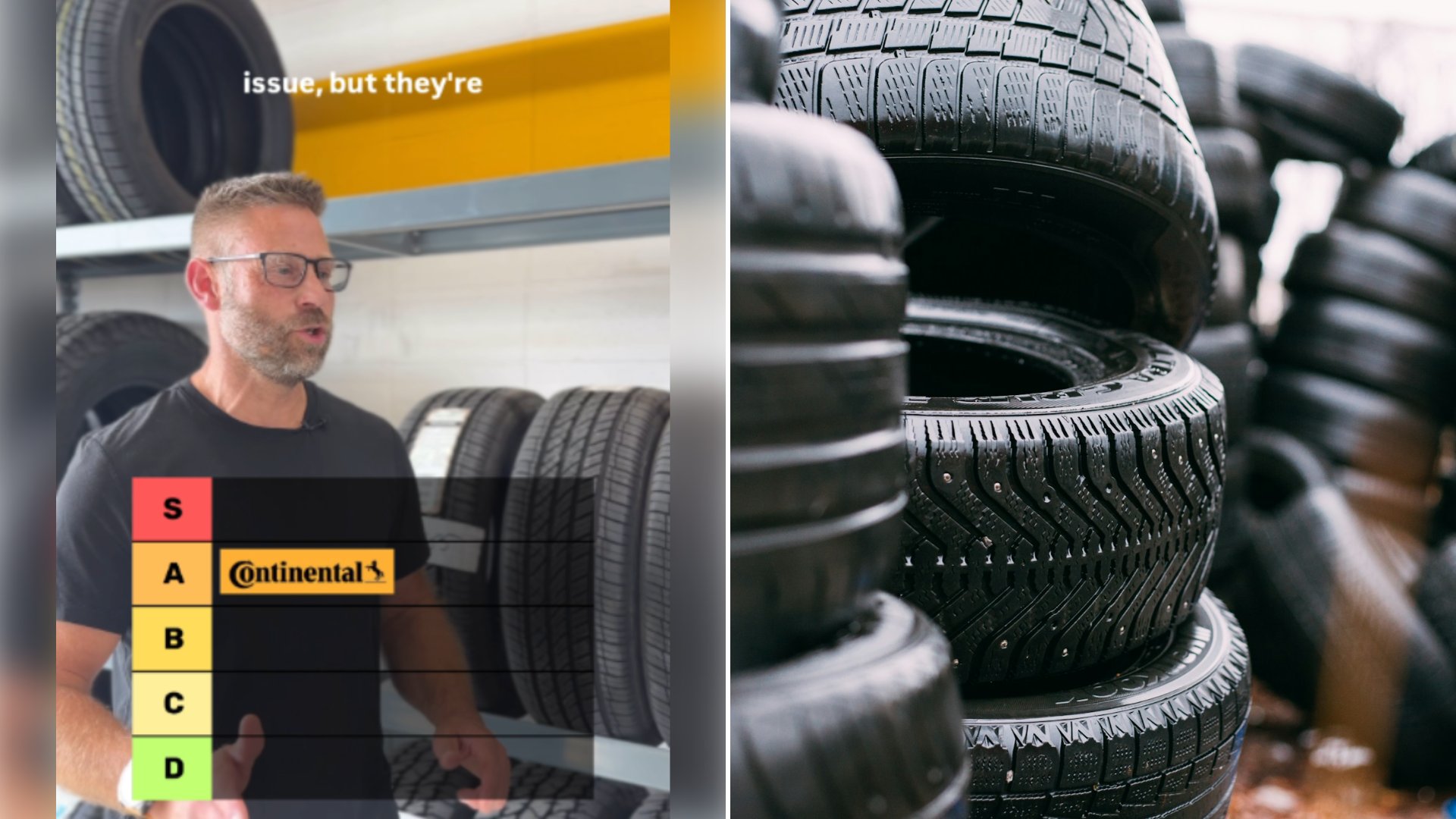
Standing in front of a wall of tires stacked on yellow racks, a technician from @econolube, the account of Econolube in Spruce Grove, Alberta, gets handed tire brands one at a time and drops each logo onto a tier board running from S at the top down to D. He gives every brand a one line verdict from the shop floor, and the board fills up as he goes: Toyo and Yokohama at the top, Continental and Michelin just under them, Goodyear and Nexen in the middle, Bridgestone alone in C, and three budget names at the bottom.
The shop’s caption invites a fight: “Think we got it wrong? Comment your pick.” The technician is not named in the video or the caption, so everything below is his opinion from his own experience at an independent shop, not a test result.
The clip opens on Continental, which he puts in A and calls a “really quality tire.” His only knock is price, and even that he says is improving, describing the brand as “really dialing that in” while it tries to win more of the North American market.
Bridgestone is where he expects pushback. He puts it in C tier and says so before anyone can object: “I know it’s gonna create some feedback.” His reason is specific, and it is about balancing. He says you cannot get those tires to balance out and that they “always have issue even from brand new.”
Goodyear lands in B. He calls it a quality tire, but says it is “not really readily available to an independent shop.” That is a supply complaint, not a quality one, and it matters if you rely on a local garage rather than a dealer or chain.
Toyo gets the first S. “It’s a fantastic tire,” he says, adding that “longevity is great” and that “their winter tires are phenomenal.” Nexen, whose logo is the one shown on screen, goes into B with praise for both price and quality.
Michelin is the one brand he rates highly and still holds back. It goes in A, and the only reason it is not higher is cost: “the price point is just way too high.” Yokohama then joins Toyo in S. He calls it “another Japanese tire,” says it “balances out really well,” and sums it up as “good bang for your buck.”
The last three logos to drop are Laufenn, Joyroad and Westlake, and all three go straight to D. “If you need something black and round, those things will do,” he says, but he warns you will be frustrated with how long they last. His sharpest point is about damage: in his experience, when one of these gets a sidewall injury, the tire usually just separates. He finishes by saying tires are complicated and the shop can help drivers pick one for the conditions they drive in.
His sidewall warning lines up with the industry’s repair rules on one point. The U.S. Tire Manufacturers Association’s puncture repair procedures limit repairs to the tread area, say a puncture cannot be larger than 1/4 inch (6 mm) across, and say not to repair any injury that extends into the shoulder or belt edge. Whatever brand you buy, a cut or bulge in the sidewall means a replacement, not a plug.
There is also a printed grade on most passenger tires that lets you check part of his longevity argument yourself. According to the National Highway Traffic Safety Administration’s consumer guide to Uniform Tire Quality Grading, the treadwear number is a comparative rating, so a tire graded 200 should wear about twice as well as one graded 100 on the government test course. Traction is graded AA, A, B or C for stopping on wet pavement, and temperature A, B or C, with C the legal minimum. The guide notes that deep tread winter tires are not covered by the grading.
For winter tires, the marking to look for is different. Continental’s own guide to winter tire markings says the three peak mountain snowflake symbol is a stricter certification that identifies winter tires under tire regulations, while the M+S marking on its own is “neither defined nor measured.”
Checking His Tiers Against Your Own Tire Quote
Start with your own shop. His Goodyear comment is a reminder that the best tire on paper is no help if your garage cannot get it. Ask which brands they can order in your size, how fast, and which ones they have had to rebalance or replace under warranty.
Ask about balancing on the day. Since his whole case against Bridgestone rests on balance, ask the installer to tell you if any tire needs an unusual amount of weight, and come back if you feel a vibration at highway speed after the job.
Read the sidewall before you pay. Compare the treadwear grade between the options you are quoted, check the traction letter, and for winter tires look for the mountain snowflake symbol rather than M+S alone.
Weigh the budget tier honestly. If you choose a D tier tire to save money, check the tread and sidewalls more often, keep the inflation where your door placard says, and treat any sidewall cut, bubble or bulge as the end of that tire.
Keep your invoice. It shows the brand, size, date and balancing work, which is what you will need if a tire fails to balance or wears out early and you want the shop or the maker to look at it.
More from Steel Horse Rides
- Driver Walks Out of a Passport Appointment to a Flat on a Tire With Under 1,000 Miles and Roadside Assistance Finds an Entire Wrench Buried Halfway Into the Tread
- Roadside Assistance Worker Says He Saw a Stranger’s Tire Smoking and Followed Her to the Shoulder, Fits Her Flat Spare, Calls It Free Out of Kindness and Gives In Only When She Insists
- Mobile Mechanic Walks Up to a Blue Dodge Pickup That Dies the Second It Starts, Cleans One Valve, Watches the Idle Shoot to 2000 RPM and Comes Back With a New Part to Fix It