

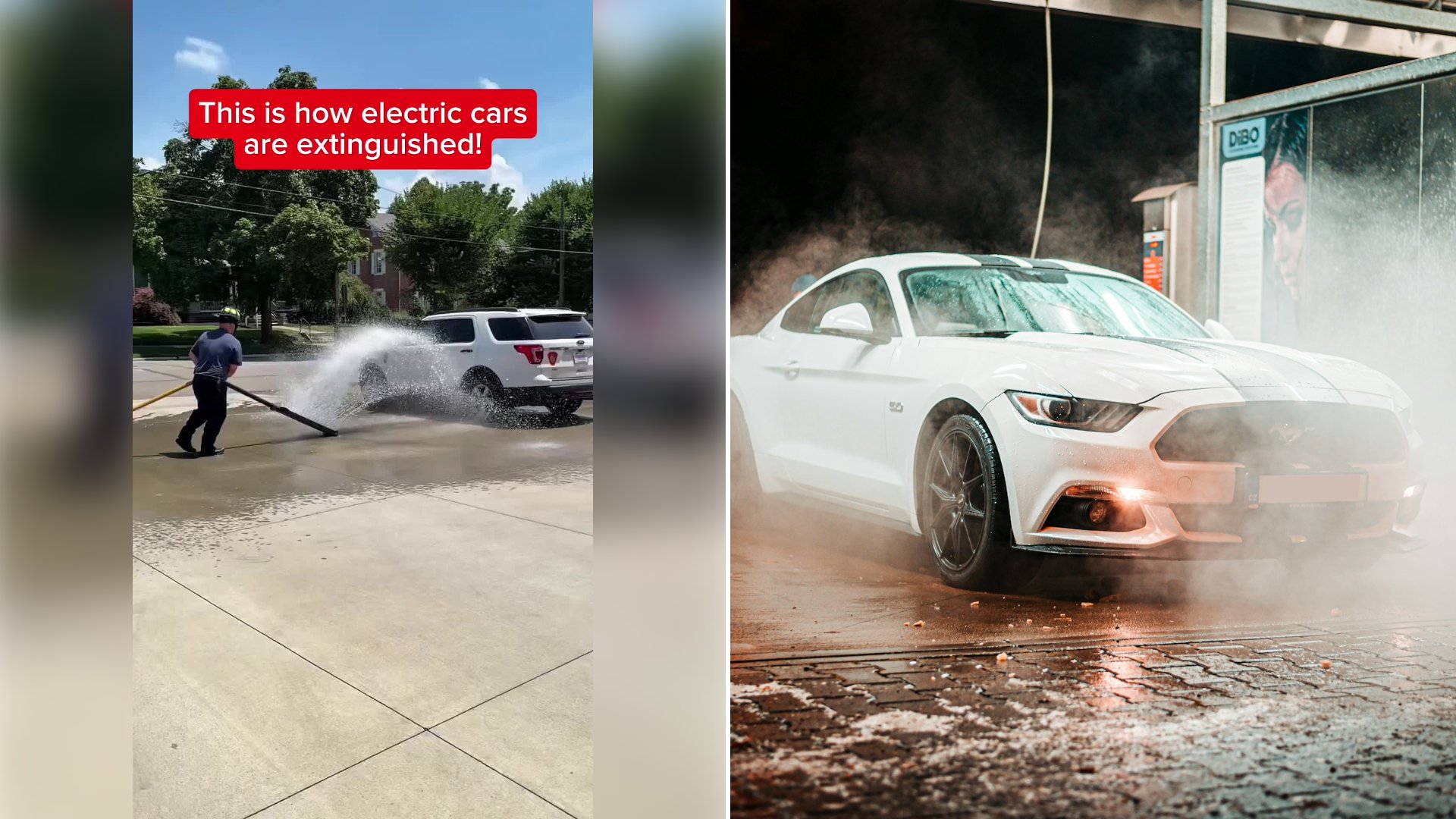
A very short TikTok from an account that posts engineering and science clips carries a red banner reading “This is how electric cars are extinguished!” and a caption saying the fire department has found a new way to control electric vehicle fires by spraying water directly on the battery to stop thermal runaway. The footage under that headline does not appear to show an electric car, and it does not show a fire.
What it shows is a person in a dark uniform on a wide concrete lot, dragging a hose across the ground toward a white SUV. The nozzle throws a broad fan of water that sweeps over the lower part of the vehicle, and the person then walks around the SUV while water pools on the pavement. There is no flame, smoke, steam or damage anywhere in the frame, and the vehicle sits still the entire time.
Word captions run along the bottom as the clip plays. They say the battery is directly cooled down to prevent thermal runaway, and that EV companies and fire departments are actively working on better methods. The clip has no spoken audio that the platform could transcribe, so the claim comes entirely from the text on screen and the caption.
The visuals do not back it up. In the closing shots the camera moves in close on the rear of the SUV, where a small emblem on the quarter panel looks like a fire department badge and a round exhaust tip is clearly visible under the bumper. A tailpipe points to an engine that burns fuel, not to an electric car, and the video never says what kind of vehicle it is, whose it is, or where the demonstration took place. It may be a training exercise with a stand in vehicle, but the clip does not say.
The clip also does not show where the water is going. The caption says the spray is aimed at the battery, yet the viewer cannot see under the vehicle or inside it, and nothing in the footage shows a battery pack, a temperature reading or a thermal camera.
Thermal runaway is a real concern for responders, and the federal government has studied it. The National Transportation Safety Board describes it as uncontrolled increases in temperature and pressure that can lead to battery reignition. In a safety report it released in January 2021, the board said all three crash-damaged batteries it examined reignited after firefighters extinguished the vehicle fires, and it linked the risks of electric shock and reignition to stranded energy that remains in a damaged battery.
The same release recommended that manufacturers create emergency response guides modeled on ISO standard 17840 and SAE International recommended practice J2990. That is guidance for responders, and it is a separate matter from the spray method the caption describes.
The takeaway is a modest one. The clip is a few seconds of someone spraying water around a white SUV, wrapped in a bold headline about a new method for putting out electric car fires. Whether any fire department has adopted a technique like the one the caption describes is not something this video can show, and the vehicle in it appears to be a conventional one.
More from Steel Horse Rides
- Car Expert Lays Out the Most Reliable Used Cars To Buy at Every Budget From One Thousand Dollars Up To Twenty Five Thousand Dollars and Explains Why
- Mobile Mechanic Says a Dealership Blamed a Timing Chain for Up to Five Thousand Dollars, Then He Pulls a Clogged VVT Solenoid and Watches Every Camshaft Code Disappear
- Mechanic Points to Sooty Black Residue Inside a Kia K5 Exhaust Tip and Tells Viewers To Stop Buying Hyundai and Kia Over Known Engine Reliability Problems