

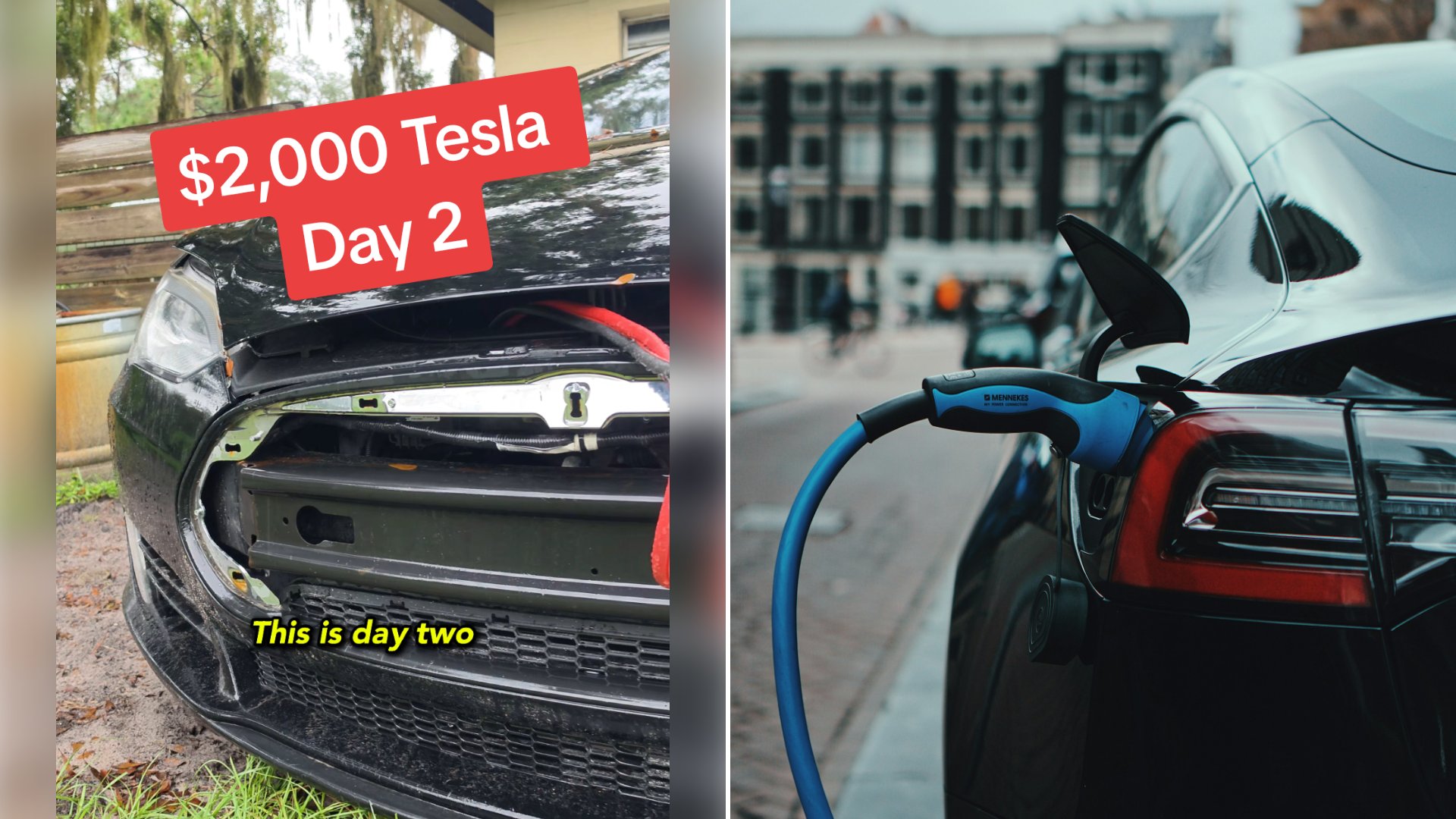
A video from @samcracc lays out the premise in the caption: “Can I Fix this Dead Tesla with 300,000 miles that I bought at the junk auction?” Text on screen labels the clip “Day 2: Fixing my $2,000 Dead Tesla,” showing the car’s front clip stripped open in a driveway as the creator works through the troubleshooting. The series, tagged #restoration, #tesla and #diy, has already drawn 30.9K likes, 309 comments, 3,339 saves and 258 shares as people wait to see whether a six-figure car’s running gear can really come back from the junkyard for the price of a used motorcycle.
@samcracc Can I Fix this Dead Tesla with 300,000 miles that I bought at the junk auction?
A $2,000 price tag only makes sense once you understand what a project like this is actually betting on. Research from Insurify puts out-of-warranty Tesla battery pack replacement costs anywhere from $5,000 to $25,000 depending on the model, with a Model S pack running $13,000 to $20,000 and a Cybertruck pack reaching $15,000 to $25,000. If the high-voltage pack on this particular car turns out to be the problem, the math on a $2,000 purchase stops working fast; the entire bet of a build like this is that the car is “dead” for a cheap, low-voltage reason, like a flat 12-volt battery or a corroded connector, rather than a catastrophic failure in the main pack itself.
That bet has gotten more common as Tesla salvage volume has exploded. A data analysis from the salvage marketplace A Better Bid, reported by Manufacturing.net, found that Teslas made up just 0.31% of listings on the platform in 2019 but had climbed to 2.34% by the first half of 2026, describing roughly a sevenfold surge in listings since 2019. The same analysis found the median winning bid for a salvage Tesla sits at $10,700, nearly three times the platform-wide median of $3,850, because rebuilders specifically chase Teslas for their intact battery modules, drive units, and electronics rather than scrapping them for sheet metal.
A 300,000-mile Tesla pulled from a junk auction sits at the extreme end of that spectrum, where age, mileage, and unknown history all stack the odds against a simple fix. But the troubleshooting logic the video is built around, isolating the high-voltage system, checking the 12-volt battery, and watching for the car’s modules to wake up on the CAN bus, is the same diagnostic path any salvage EV rebuilder follows before deciding whether a car is worth saving. Whether this one turns into a $2,000 miracle or a parts donor for someone else’s project, it is exactly the kind of gamble that has turned Tesla salvage lots into one of the more closely watched corners of the used-EV market.
More from Steel Horse Rides
- Owner Says the Seats in a 1986 Toyota 4Runner Smell Exactly How You Would Imagine, Then Pulls Out the Carpet and Asks Followers to Pick the Color for the New Kit
- Mechanic Pulls a Snapped Crankshaft Apart in Two Pieces on the Shop Bench, Says the Car Drove In Like That and Jokes the Customer Only Wanted an Oil Change
- Narrator of a Repair Clip Says a Car That Shook Every Time the Owner Hit the Gas Had an Engine Mount Cracked Clean in Half, Then Explains Why the Impact Wrench Is Not the Last Step