

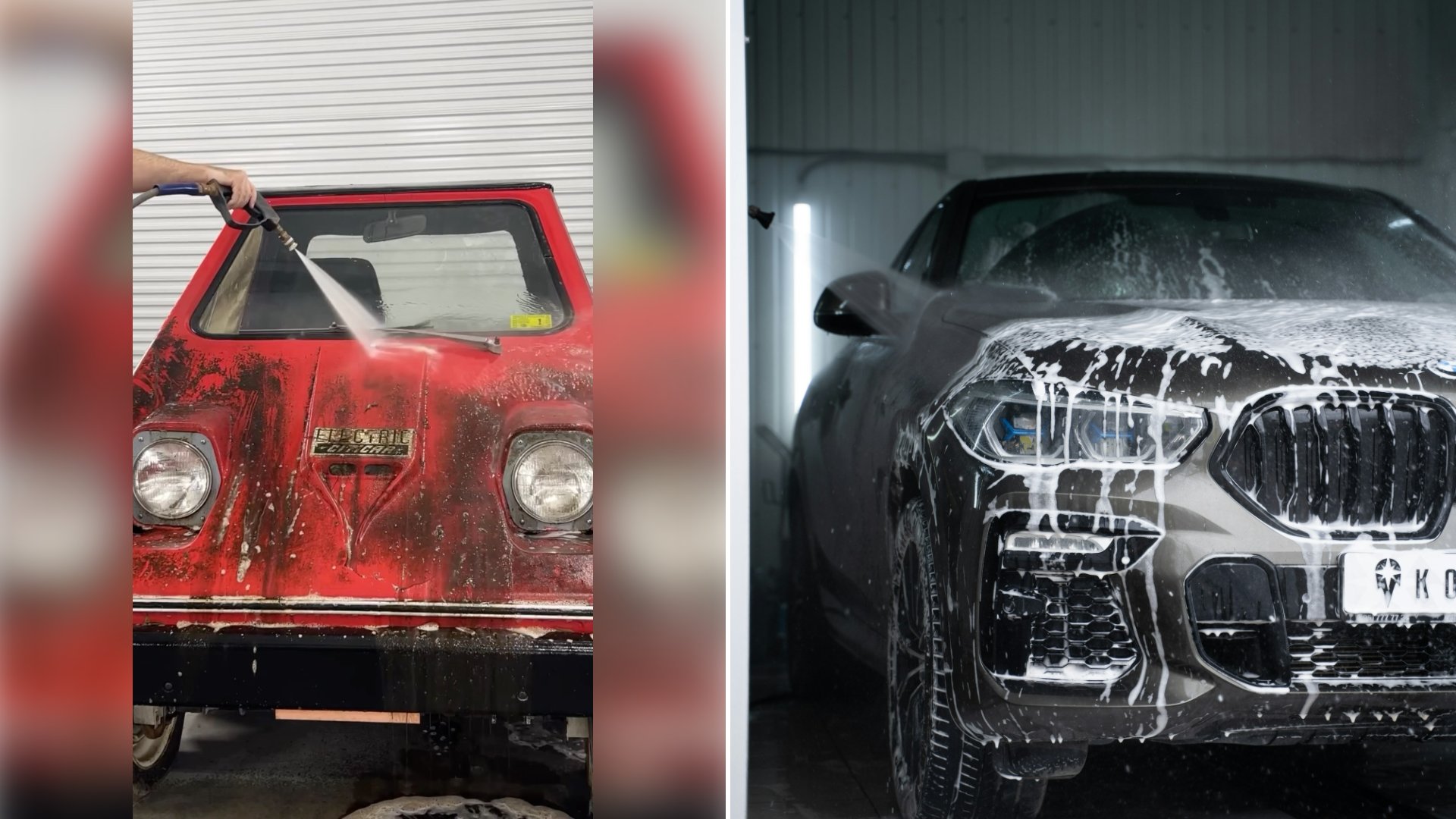
A video from @mad_detailingusa keeps its caption simple: “Satisfying Citi Car Pressure Washing! #satisfying #cleaning #detailing #cardetailing #pressurewashing” The footage shows years of caked-on grime sheeting off a boxy little car under a pressure washer, with the real paint color only becoming visible as each pass clears another section of the body. The clip reached 72,200 likes, 253 comments, and 908 shares.
“Citi Car” is not a generic nickname here, it is almost certainly the Sebring-Vanguard CitiCar, one of the most unusual footnotes in American automotive history. According to the detailed history on Wikipedia’s entry on the Citicar, Sebring-Vanguard built the wedge-shaped electric commuter car from 1974 through 1977 in direct response to the 1973 oil crisis, and for a brief stretch it was reportedly the sixth-largest automaker in the United States by unit volume, an extraordinary claim for a company nobody remembers today. The car used lead-acid batteries, a top speed in the thirties to forties depending on configuration, and a fiberglass body designed to be as light and cheap to produce as possible.
Coverage revisiting the CitiCar decades later, including InsideEVs’ retrospective on the 1970s EV that came before Tesla, frames it less as a failed product and more as a car that was decades ahead of the market it was trying to serve. Gas prices eventually fell back down, buyer interest in short-range electric commuters evaporated with them, and Sebring-Vanguard’s successor, Commuter Vehicles Inc., folded by the early 1980s. What survived is a small, devoted collector following that treats surviving CitiCars the way other enthusiasts treat barn-find muscle cars: as rare, technically significant machines worth the restoration effort precisely because so few exist in driveable condition today.
That context is what makes a simple pressure-washing clip land differently than the thousand other satisfying detailing videos online. This isn’t a generic sedan getting de-grimed for views, it’s one of the first mass-produced electric cars in American history, built nearly fifty years before EVs became mainstream, finally getting its real paint color back after who knows how long sitting forgotten. The satisfaction of watching the dirt disappear is the hook; the realization of exactly what car is underneath it is what keeps people watching twice.
More from Steel Horse Rides
- Owner Says the Seats in a 1986 Toyota 4Runner Smell Exactly How You Would Imagine, Then Pulls Out the Carpet and Asks Followers to Pick the Color for the New Kit
- Mechanic Pulls a Snapped Crankshaft Apart in Two Pieces on the Shop Bench, Says the Car Drove In Like That and Jokes the Customer Only Wanted an Oil Change
- Narrator of a Repair Clip Says a Car That Shook Every Time the Owner Hit the Gas Had an Engine Mount Cracked Clean in Half, Then Explains Why the Impact Wrench Is Not the Last Step