

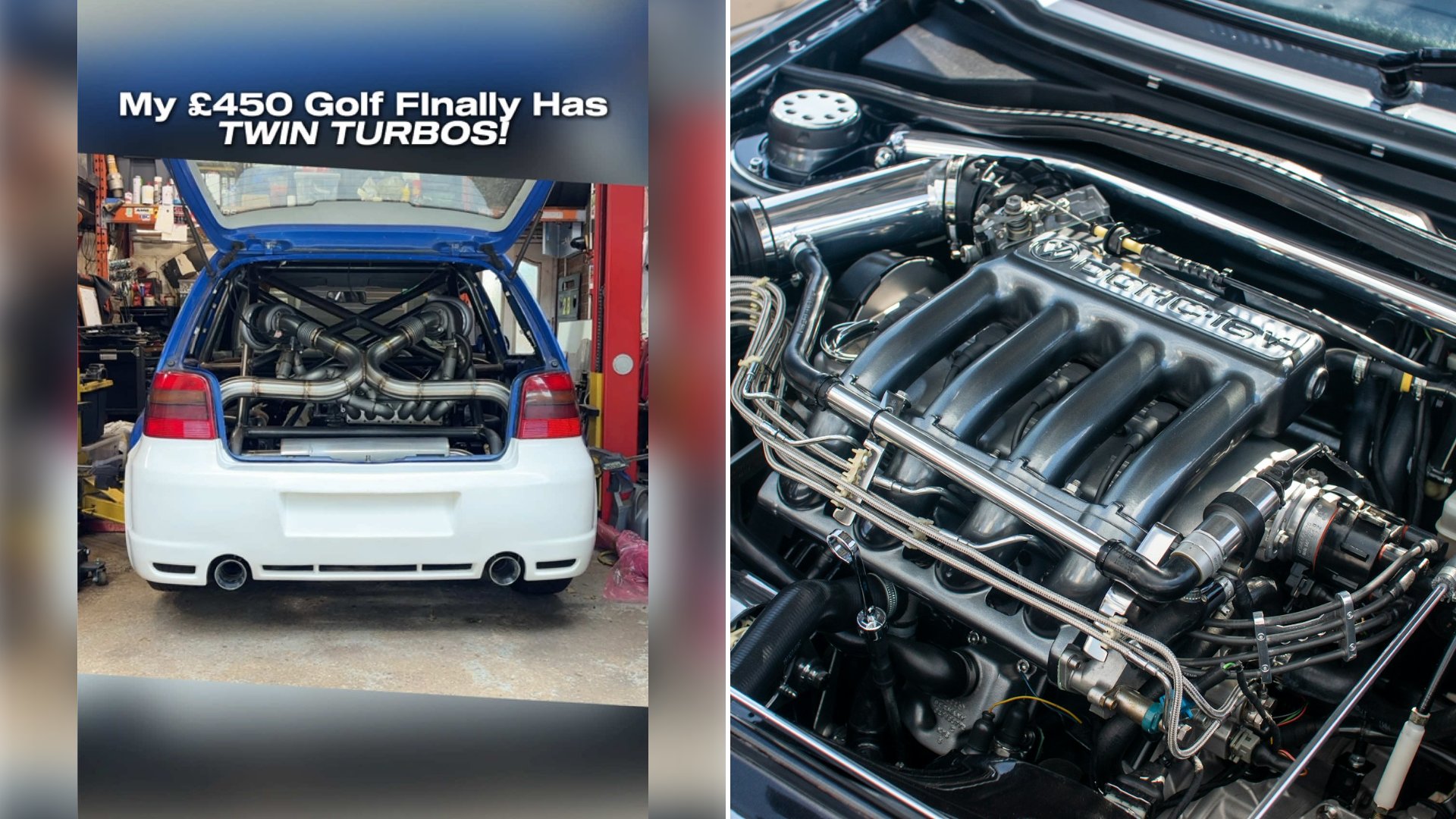
A video from Twin Engine Corsa opens on a question mark worth answering: “My £450 Golf Finally Has TWIN TURBOS!” The caption puts it plainly: “We put TWO turbos in the back of a £450 Golf 👀.” Tagged #twinturbo, #vwgolf, #vr6, #engineswap, and #modifiedcars, the video shows a pair of massive turbo housings and intertwined piping crammed into the hatchback’s rear compartment, and pulled in 177,000 likes, 2,754 comments, 14,300 saves, and 45,500 shares.
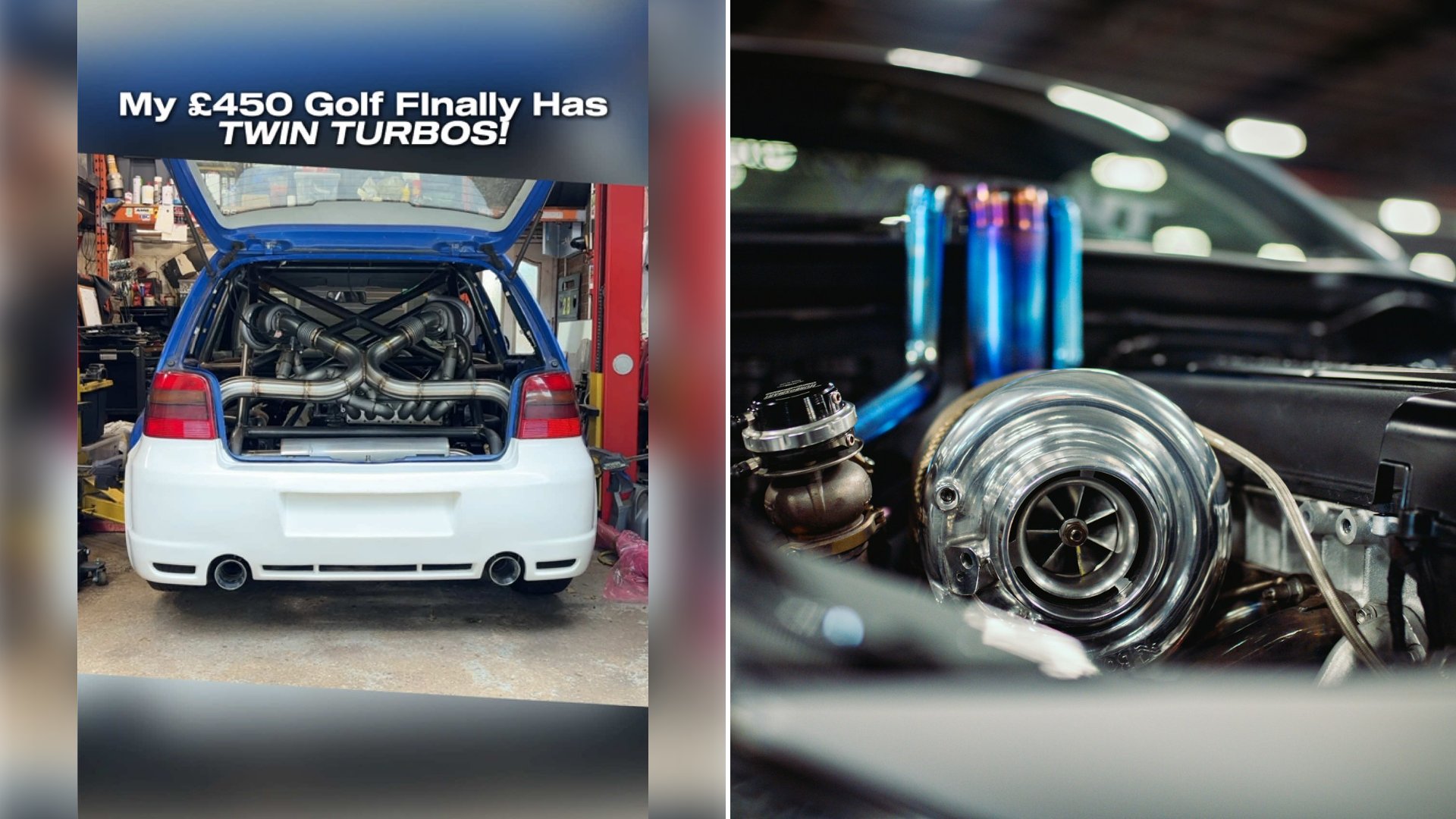
@twinenginecorsa We put TWO turbos in the back of a £450 Golf👀
The #vr6 hashtag points to exactly why this build is interesting mechanically rather than just loud. Wikipedia’s rundown of Volkswagen’s VR6 explains that the engine uses an unusually narrow 10.5 to 15 degree angle between its two cylinder banks, compared with 45 to 90 degrees on a conventional V6, letting it share a single cylinder head and need only two camshafts. That narrow-angle design was built specifically for transverse, front-wheel-drive layouts, which is exactly why a six-cylinder engine can squeeze into an engine bay originally sized for a four-cylinder Golf. Volkswagen introduced the VR6 in the 1991 Passat B3 and Corrado, brought it to the Golf Mk3 by 1992, and kept building variants of it until production finally ended in late 2024.
Bolting two turbochargers onto an engine that compact isn’t a new idea among VW tuners chasing serious power from a small car, and the results can be dramatic. The Drive’s coverage of a different twin-turbo VR6 project, a Mk1 Golf built in South Africa with two complete 2.8-liter VR6 engines, one at each end of the car, reported a dyno result of roughly 536 horsepower and 590 lb-ft of torque once both engines were turbocharged, a build the article describes as chasing the “more engine, more power” idea to its logical extreme. That project is a far more radical take than squeezing a single twin-turbo VR6 into a Golf’s rear hatch area the way this video shows, but it illustrates the same underlying appeal: the VR6’s compact dimensions leave tuners room to work with forced induction setups that a wider, more conventional V6 simply couldn’t fit.
A turbo setup mounted in the rear hatch rather than up front, the way this build appears to be laid out, also points to a mid-engine or rear-mounted conversion rather than a simple bolt-on kit under the hood, the kind of project that typically means custom fabrication for piping, cooling, and mounting rather than parts ordered straight from a catalog. For a car that reportedly cost just £450 to begin with, turning it into a platform for a serious forced-induction VR6 build is the kind of transformation that explains why the reveal pulled the attention it did.
More from Steel Horse Rides
- Owner Says the Seats in a 1986 Toyota 4Runner Smell Exactly How You Would Imagine, Then Pulls Out the Carpet and Asks Followers to Pick the Color for the New Kit
- Mechanic Pulls a Snapped Crankshaft Apart in Two Pieces on the Shop Bench, Says the Car Drove In Like That and Jokes the Customer Only Wanted an Oil Change
- Narrator of a Repair Clip Says a Car That Shook Every Time the Owner Hit the Gas Had an Engine Mount Cracked Clean in Half, Then Explains Why the Impact Wrench Is Not the Last Step